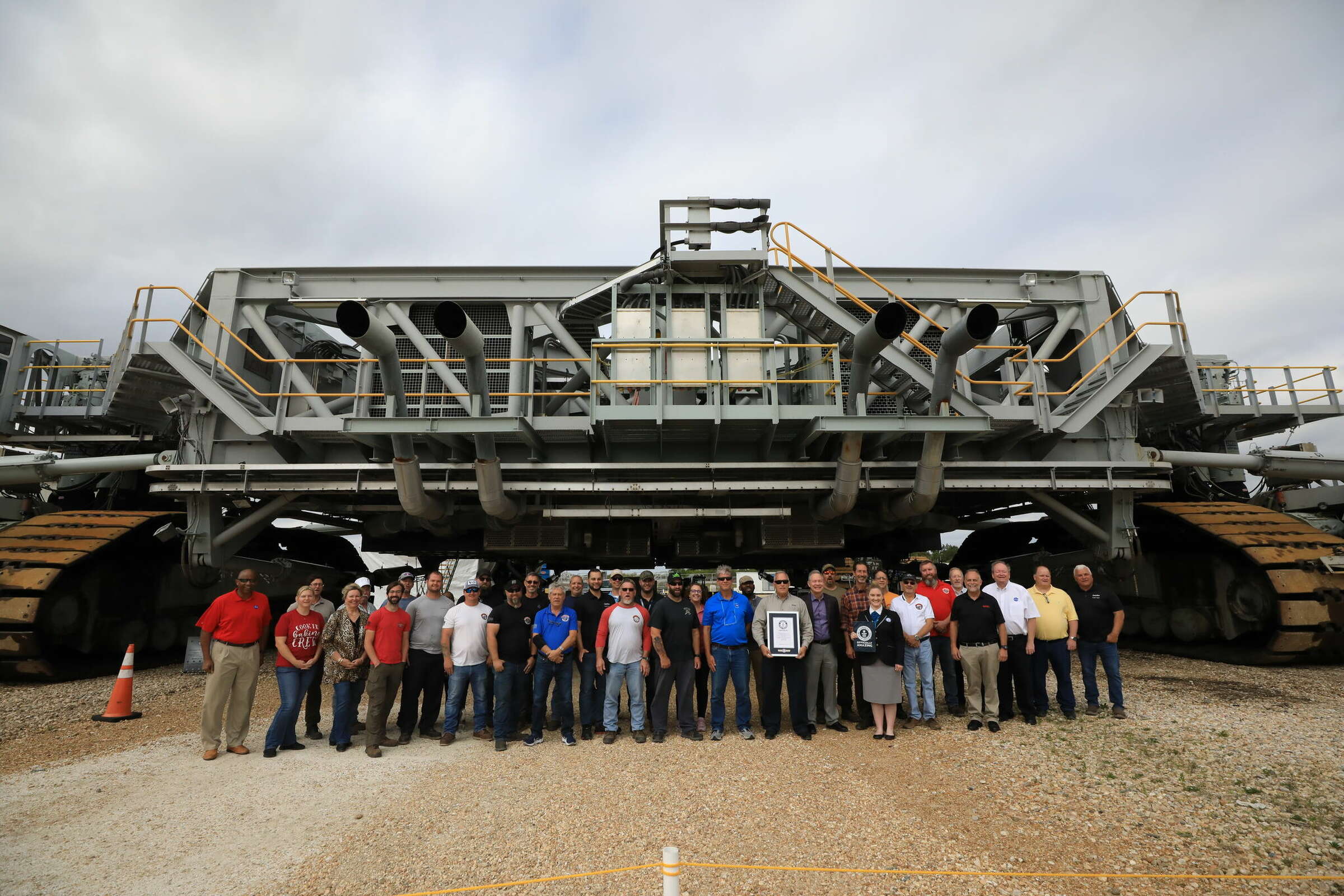
Yesterday NASA introduced the four astronauts who will man the Artemis next (hopefully) year. Will be good to see Americans out in space again. And I saw this last week in the paper. While Texas can boast of the largest highway (Katy Freeway) in the world, Florida (both Red states, just saying) has the "heaviest self powered vehicle" on Earth.
NASA's Crawler Transporter 2 is now recognized as "the heaviest self-powered vehicle" by Guinness World Records. Act Now
The Guinness World Records is spotlighting an underappreciated piece of NASA hardware.
Crawler Transporter 2 is now recognized as "the heaviest self-powered vehicle." The transporter sits beneath NASA's Artemis moon rocket and spacecraft and slowly rolls them to the launch pad prior to liftoff.
To shoulder these vehicles, Crawler Transporter 2 weighs about 6.65 million pounds — that's roughly 15 Statues of Liberty or 1,000 pickup trucks.
“Anyone with an interest in machinery can appreciate the engineering marvel that is the crawler transporter,” Shawn Quinn, manager of the Exploration Ground Systems Program that operates the systems and facilities needed to prep and launch rockets, said in a news release.
NASA has used crawler transporters since their construction in 1965. This particular vehicle, Crawler Transporter 2, has been modified for the Artemis missions and is now heavier than its sibling transporter originally built to carry Saturn V rockets during the Apollo Program. Crawler Transporter 2 is larger than a baseball infield and powered by locomotive and large electrical power generator engines.
With the Artemis Program, Crawler Transporter 2 must carry the Space Launch System rocket and Orion spacecraft from NASA's Vehicle Assembly Building to Launch Pad 39B. It moves roughly 1 mile per hour, meaning the 4.2-mile trek at NASA's Kennedy Space Center in Florida can take eight to 12 hours...
...John Giles, NASA’s Crawler Element Operations manager, said in the news release. “To have a Guinness Worlds Records title is icing on the cake for an extraordinary piece of equipment.”
Well done ladies and gentlemen, and good luck next year.
Thirty-five years ago, one of my Army ROTC instructors told me, "Thiac, you won't believe this, the shuttle just blew up." We didn't have a TV in our office, but I knew the Air Force did have one in their cadet lounge. I walked down there and watch the repeats with some of the AFROTC cadets. Like 911, it's a day you always remember where you were.
Later that evening, Ronald Reagan gave the country what it needed. In a few minutes and just over 600 words, he soothed a shocked nation, and world, wondering why, and how, this could happen. He included in it a reminder to the young people of risk of going forward, in any endeavor. I recall the words of one of Star Trek-TNG's greatest antagonist, Q, to Captain Picard:
If you can't take a little bloody nose, maybe you ought to go back home and crawl under your bed. It's not safe out here. It's wondrous, with treasures to satiate desires both subtle and gross. But it's not for the timid.
The text and video of one of his greatest addresses to the people of this nation. And the world.
RIP Rawhide. God, we can use you today.
Ladies and gentlemen, I'd planned to speak to you tonight to report on the state of the Union, but the events of earlier today have led me to change those plans. Today is a day for mourning and remembering.
Nancy and I are pained to the core by the tragedy of the shuttle Challenger. We know we share this pain with all of the people of our country. This is truly a national loss.
Nineteen years ago, almost to the day, we lost three astronauts in a terrible accident on the ground. But we've never lost an astronaut in flight; we've never had a tragedy like this. And perhaps we've forgotten the courage it took for the crew of the shuttle; but they, the Challenger Seven, were aware of the dangers, but overcame them and did their jobs brilliantly. We mourn seven heroes: Michael Smith, Dick Scobee, Judith Resnik, Ronald McNair, Ellison Onizuka, Gregory Jarvis, and Christa McAuliffe. We mourn their loss as a nation together.
For the families of the seven, we cannot bear, as you do, the full impact of this tragedy. But we feel the loss, and we're thinking about you so very much. Your loved ones were daring and brave, and they had that special grace, that special spirit that says, "Give me a challenge and I'll meet it with joy." They had a hunger to explore the universe and discover its truths. They wished to serve, and they did. They served all of us.
We've grown used to wonders in this century. It's hard to dazzle us. But for 25 years the United States space program has been doing just that. We've grown used to the idea of space, and perhaps we forget that we've only just begun. We're still pioneers. They, the members of the Challenger crew, were pioneers.
And I want to say something to the schoolchildren of America who were watching the live coverage of the shuttle's takeoff. I know it is hard to understand, but sometimes painful things like this happen. It's all part of the process of exploration and discovery. It's all part of taking a chance and expanding man's horizons. The future doesn't belong to the fainthearted; it belongs to the brave. The Challenger crew was pulling us into the future, and we'll continue to follow them.
I've always had great faith in and respect for our space program, and what happened today does nothing to diminish it. We don't hide our space program. We don't keep secrets and cover things up. We do it all up front and in public. That's the way freedom is, and we wouldn't change it for a minute.
We'll continue our quest in space. There will be more shuttle flights and more shuttle crews and, yes, more volunteers, more civilians, more teachers in space. Nothing ends here; our hopes and our journeys continue.
I want to add that I wish I could talk to every man and woman who works for NASA or who worked on this mission and tell them: "Your dedication and professionalism have moved and impressed us for decades. And we know of your anguish. We share it."
There's a coincidence today. On this day 390 years ago, the great explorer Sir Francis Drake died aboard ship off the coast of Panama. In his lifetime the great frontiers were the oceans, and an historian later said, "He lived by the sea, died on it, and was buried in it." Well, today we can say of the Challenger crew: Their dedication was, like Drake's, complete.
The crew of the space shuttle Challenger honored us by the manner in which they lived their lives. We will never forget them, nor the last time we saw them, this morning, as they prepared for their journey and waved goodbye and "slipped the surly bonds of earth" to "touch the face of God."
One of the few useful things from the Carter years, the launch of Voyager 1 on September 5, 1977. Ironically, Voyager 2 was launched on August 20, 1977. They were initially planned to go into the Jupiter area, but they have made it to the outer edge of the our solar system. 60 Minutes did a great story on the Voyagers a couple of months ago, and it's worth a few minutes of your time.
NASA is getting really good at squeezing every last bit of life out of its hardware. It recently extended the Dawn spacecraft’s mission over Ceres for a second time, while New Horizons is on its way to check out a small icy body called 2014 MU69 in January 2019. Yesterday, NASA announced that it has successfully fired up four of Voyager 1’s backup thrusters, which haven’t been used since 1980, which should extend its life by a couple of years.
Voyager 1 is the only human-made object flying outside of our solar system, and it’s still communicating with Earth by way of the Deep Space Network, which allows engineers to send it instructions. The probe currently uses its attitude control thrusters to make tiny corrections — firing for only milliseconds at a time — to rotate it to point its antenna towards Earth. However, since 2014, engineers have found that those thrusters have been wearing down, and aren’t as effective.
The JPL’s engineers began to look into alternatives, and found a new way to steer the spacecraft: the probe’s trajectory correction maneuver (TCM) thrusters. These are located on the back of the spacecraft and are identical to the thrusters that they’ve used so far. The last time these thrusters were active was in November 1980, when the probe zipped by Saturn. They haven’t been used since then, and on Tuesday, the Jet Propulsion Laboratory fired them up for the first time, and discovered that they worked. According to Voyager project manager Suzanne Dodd, the reactivated thrusters should help extend the life of the probe for another “two to three years.”
The team will switch over to the TCM thrusters in January, but there is a drawback: they require heaters to operate, which will draw on the probe’s limited power. The team will use the thrusters until they can no longer use the heaters, and will then switch back to the attitude control thrusters that they’ve been relying on. The JPL will also test out the TCM thrusters on Voyager 1’s twin, Voyager 2, although NASA says that that spacecraft’s attitude control thrusters are in better shape.
Well, we're not up to Voyager 6 yet, so we should not be worried about the VGER coming to attack us in the 23rd Century.