Police Work, Politics and World Affairs, Football and the ongoing search for great Scotch Whiskey!

Showing posts with label Technology. Show all posts

Wednesday, March 1, 2023

A newer version of an age old issue.

Mac, leave me with a baby.

Mrs. Beverly McConnell (Paula Prentiss) to her husband, Lieutenant Commander William "Mac' McConnell (Tom Tryon) before he ships out.


This is a story as old as mankind. Men going off to war, and their wives and them are concerned of making a family if he returns. A very serious concern. I'm reading George C. Marshall: Education of a General by Forrest C. Pogue, and currently it's covering his service in World War I. One of the items that stuck me was the loss of life. I've been told before both Britain and France lost a generation of you men in the trenches of World War I, and that was one of the (many) reasons France was taken so fast. The men who would have been there to defend France were never born because their fathers were killed a generation before. I've read that one of the reasons Field Martial Montgomery was not as aggressive to engage with his army after D-Day was he had the last army Britain could field. They were scraping to find manpower, reclassifying former draft rejects to fill their needs. 

From the book (pages 157-158), "The British Expeditionary Force at the end of 1917 was nearly one hundred thousand men smaller than the year before, and there were not enough men left at home to make up the deficit. The French, in the same cruel state of exhaustion, had had to distance one hundred separate battalions for lack of replacements." Good God. 

Well, a modern solution to the age old possibility of loosing the family after the father goes to war. Many Ukrainian couples are freezing sperm so they can have children if, God forbid, the father dies.

Before going to fight, many Ukrainians are freezing their sperm


It is one of the concerns for mothers and expectant mothers at the clinic, who spoke to AFP of their hopes and fears for the future as around five children are born at the hospital every day to both local women and internally displaced people (IDPs) forced to flee from Russian-held areas of the country. After the war began, the hospital set up a shelter in the basement including a room with beds for mothers and cots for newborns. 

Natalia kyrkach-antonenko found out within two hours of it happening. An artillery strike. Shrapnel to the head. Death in seconds. Volunteers identified her husband Vitaly by his devilish looks and long hair; his nom de guerre “Beautiful” was no accident. One telephone call later, and Ms Kyrkach-Antonenko’s dreams of a family together were gone. But she had prepared for the eventuality. Now she intends to raise a family alone using sperm the couple froze on one of Vitaly’s two rotations back home. In an emotional appeal on social media, written a month after her husband’s death, she urged other couples to take out the same insurance policy. “It could be your only chance. Think and don’t put it off, I beg you.”

Russian tanks brought Ukraine’s booming fertility industry to a shuddering stop in February. The clinics reopened in April to a changed world. Previously the customers were typically foreigners, taking advantage of Ukraine’s liberal rules on surrogacy. Now they are often Ukrainian couples, anxious because the husband has to go and fight. Mother and Child, the country’s largest fertility clinic, launched a programme to meet the new demand, encouraging servicemen and women to freeze their sperm or eggs free of charge, lest they be injured or killed on the front. Their partners were offered large discounts on assisted-conception programmes that usually cost between $1,300 and $4,000. The most needy were given the treatment free. Doctors called the initiative “Hero Nation”, a nod to the growing number of babies conceived to dead or seriously injured parents. They credit the programme with helping the clinic return to roughly 80% of its pre-war capacity...

I've known people who have had issues with conception and gone to in vitro fertilization to have a family. One of the greatest technologies developed in the last century,  People will go to their whatever means they have to to have a family, and now technology is helping men become fathers beyond the grave. Truly amazing. 

Tuesday, January 10, 2023

Drones and force projection...

 A three-year-old meme on Facebook shows how force projection has changed in the last few  decades:


Sucks to be him.


But it points out how drones are changing warfare, especially force projection. The United States (and to a lesser degree Great Britain and other allies) have used aircraft carriers to project power far over our shores to secure the sea lanes since the mid-20th century. This method cost a fortune (the new Ford Class carrier is 13 billion for the ship alone), complicated, requires other ships to form carrier fleets, and is becoming more problematic as other weapons are coming on to challenge these capital vessels. An open discussion these days, is the carrier today at the stage of the battleship a century ago? For my post, another discussion for another day.


Now I found this article very interesting, looking at the issue on how drones, and particularly drone sales, are shaping alliances and diplomacy.  


The Dawn of Drone Diplomacy


Unmanned Vehicles Are Upending the Arms Trade—and the Balance of Power

By Erik Lin-Greenberg December 20, 2022


Iranian-built drones now routinely puncture the skies over Kyiv. Elsewhere in Ukraine, Turkish- and American-manufactured drones help Ukrainian forces target Russian troops. These operations demonstrate the growing role of remote-controlled weapons in battle. The conflict also showcases how drone exports have increasingly become an instrument of diplomacy.


With drone use on the rise, states have capitalized on drone exports to increase their global clout. To be sure, this is part of an established trend: governments have long leveraged arms exports as a diplomatic tool. Beyond filling state coffers and defraying research and development costs, arms sales help states advance their foreign policy agendas. Selling or donating weapons to like-minded partners can be used to extract concessions, exert influence, counter rivals, and strengthen military ties. A new era of arms trade is emerging, in which new exporters such as Iran and Turkey are displacing traditional weapons suppliers and are using drone exports to extend influence beyond their borders. These exports threaten Washington’s influence and the security of its partners. To keep ahead, U.S. policymakers should help allies build drone programs while developing approaches to counter the threat of rival drones…


Drone diplomacy is on the rise because it meets a growing demand. International leaders are increasingly convinced that their defense and foreign policy ambitions hinge on possessing remote-controlled weapons. Drones have changed the character of modern conflict by allowing states to project power while minimizing risk to friendly personnel


Recent combat operations in the Ukraine are the best advertising for this relatively new industry, showing smaller nations how to engage at distance with little cost…


While the US initially dominated the market, it became a signer of the Missile Technology Control Regime (MTCR, limiting sales of US drones, even to allies. China and Israel, not signers of the MTCR, quickly filled the void…


Drone sales help the supplier’s diplomacy by deepening ties with the client government, by enabling the buyer nation to challenge adversaries for low cost, and allowing seller counties to use drone sales to leverage buyer nations for other items…  


…By deepening ties with client states, countering rivals, and extracting quid pro quo concessions, drone diplomacy threatens regional stability and challenges the influence of established arms exporters such as the United States. Indeed, drone suppliers such as Iran routinely arm states such as Sudan, Syria, and Venezuela that were otherwise unable to acquire drones because of sanctions and other political roadblocks. Newly acquired drones allow these states to reignite frozen conflicts, violate human rights, and undercut internationally led conflict-resolution efforts. In recent years, activists and lawmakers criticized Turkey’s sale of TB2 drones to Ethiopia for enabling strikes that reportedly killed dozens of civilians...


And the Biden administration wants to loosen sanctions on Iran. Wait, did I say that? Yes, allowing them to continue to expand their sales to disabling regimes all over the world.


I won’t go as far as saying the carrier is at the end of its life, but it’s sailing into the sunset. As of right now, we use massive carrier task forces to project power. But a 2nd rate nation can field a few dozen drones and strike or recon a few dozen miles over the battlefield. When will they be able to develop/buy/deploy a few submarines that can launch single use drones and attack one-hundred miles deep into a country. When will that increase to five-hundred? One-thousand? And for the cost of a ten-thousand-dollar drone, eventually with artificial intelligence, not a 35-million-dollar airplane with a pilot. 


Better war through technology. We better be engaged now; our adversaries are already moving to fill the market. And a piece of paper like the Missile Technology Control Regime will be as effective at stopping future war as the 1922 Washington Naval Conference did in stopping World War II. 


Tuesday, September 21, 2021

Another example of the inmates running the asylum…or at least the prisons.

Or maybe I'm blowing it out of proportion. OK, I can see letting prisoners have email, as long as it can be monitored. These people will organize unlawful acts with any communications. Music, books, fine, but you must be very careful with communications with the outside.
110,000 Texas prison inmates to get computer tablets with apps, radio and email

Tablets will create efficiencies for the state, TDCJ said, and a consistent connection to the outside world might also reduce recidivism, as well.

DALLAS — The Texas Department of Criminal Justice will soon distribute computer tablets to almost all of its prison inmates across the state.

“We have 118,000 inmates. There will be a few categories, some of the disruptive inmates, that we may not be able to issue to… but at this point, we would have well over 110,000 tablets issued within the system,” said Bryan Collier, executive director of the Texas Department of Criminal Justice.

Collier made the comments in Tuesday’s "Virtual Re-entry Symposium" hosted annually by Unlocking Doors, a non-profit organization that prepares inmates to re-enter into society.

“Inmates will be given a tablet that will be preloaded with education materials, some e-books, some religious materials,” Collier added. “They have radio. They can also have music on it. It’ll come pre-loaded with some music. They will have an opportunity to buy some additional things to add to it.”

In addition, inmates can send and receive email – not real-time – but within 24-hours, Collier explained. They can even file a grievance on their tablets.</> Perhaps more importantly, he said, this creates a smart, safe way for prison administrators to put specific content in front of every inmate’s eyes...


I hope it does make the prison more manageable. Good luck Texas Department of Corrections.

Sunday, November 22, 2020

I wonder if a real James Bond will use this...

One of the great scenes of Thunderball was James Bond using a jet pack to escape from the bad guys. Looking it over, Bond really didn't have much to worry about from them. The way these dudes fired their pistols, they couldn't hit the side of a barn from inside, to use that old cliche.


Now we have a real flight pack, used in Her Majesty's Service. The navy that is:

The Royal Navy is testing jet pack assault teams
For decades, science fiction has been telling us that jet packs are right around the corner. But, while it seems there’ll still be some time before any of us are using them to get to work, the UK and US have been experimenting with jet suits for a number of applications, including defense.

Of course, this isn’t the first time Gravity Industries’ jet packs have been spotted flying around Royal Navy ships. That’s fitting, seeing as Gravity Industries’ founder Richard Browning served in the British Royal Marines prior to beginning his new life as a jet pack mogul. Last year, he had the opportunity to fly his 5-engine jet pack suit around the pride of the Royal Navy, the HMS Queen Elizabeth.

While the Royal Navy hasn’t announced any plans to adopt these jet packs for military purposes, both the Royal and U.S. Navies have acknowledged that they’ve been in contact with Gravity Industries. According to Browning himself, he’s already met with members of the U.S. Special Operations command — specifically, the Navy SEALs — to discuss what capabilities his jet packs could offer...

Last month, the Great North Air Ambulance Service (GNAAS), a UK-based charity that provides helicopter emergency services, began testing jet suits from Gravity Industries to see if they might allow paramedics to fly directly up to hard-to-reach locations where hikers and mountain climbers find themselves injured.

As GNAAS pointed out, “The undulating peaks and valleys can often mean the helicopter is unable to safely land close to the casualty, forcing travel by vehicle or foot.” That’s not optimal for emergency situations and could potentially even put rescue workers in danger. That’s where these jet packs could come in...
I had to give up my private pilot license a few years back because of a medical issue. But who knows, with this I may be able to get up again, and experience the ...lifting mind I've trod the high untrespassed sanctity of space, put out my hand and touched the face of God. 

Or just have some fun and hopefully not get myself killed!

Friday, May 8, 2020

A large scale version of improvise, adapt, overcome...

Having lived in the Deep South most of my life, I can relate to not having power in August. It's miserable without air conditioning. Not to mention your frig and freezer last only so much. One of the major issues recoving from Hurricane Katrina was refrigerators and freezers containing a HAZMAT site of spoiled meats and other items.

Now I'm fortunate, my subdivision was built in the last 30 years, so our main power cables are buried. During Hurricane Harvey, my family was out of power for only 18 hours. But an issue, what happens when the power plant is out. Well, here is a solution for than issue.


Mobile power plants take to the high seas, sidestepping red tape involved with traditional plants

Karpowership is marketing floating power plants across the developing world, where governments seek extra voltage to keep the lights on during the pandemic. Shown, Karmol LNGT undocking in Singapore on Aug. 1, 2019.
As economic lockdowns complicate efforts to bring electricity to every corner of the planet, one company is putting generation units on ships that can sit offshore and plug into local grids on short notice.
Karpowership is marketing floating power plants across the developing world, where governments are seeking extra voltage to power hospitals and other facilities to keep the lights on during the coronavirus pandemic.

Vessels can hook into an onshore grid quickly, sidestepping the red-tape and construction issues involved with building a traditional power plant. And these ships come with their own fuel -- liquefied natural gas and fuel oil -- tapping into markets that are currently oversupplied.

"We can deploy them in less than 30 days," Zeynep Harezi, chief commercial officer of Kapowership, said by phone from her office in Istanbul where the ships are designed.

The generators on the ships can produce between 36 megawatts to 470 megawatts of electricity and are already fully financed. While the ships use fossil fuels and present a challenge to the global drive for cleaner energy, they remain among the few solutions for feeding power to remote areas.

Such ships can work well in places with high barriers for onshore power stations or that lack access to gas pipelines, the International Gas Union said in its annual LNG report. There's also risks: high cost and upfront capital requirements. Also, floating power plants concepts compete with more traditional units that run on liquid fuels, renewables and nuclear power, which may receive governmental support over LNG, the report said.
"The concept of a fully integrated floating re-gasification and power plant may be a more realistic solution to grant easy access to clean electricity production," the IGU said. "Such fast track projects, built and commissioned at reputed shipyards, may materialize in the near future..."

...The company converts existing dry bulk vessels, buys engines in bulk and builds them "one after another, almost like a production line," Harezi said.
The technology for the power plant is internal combustion engine, rather than more typical turbines. While more expensive to build, they are cheaper to maintain and better suited for countries in hot climates with unstable grids, which are often in desperate need for power to avoid blackouts...

To the people who created this, thank you. God knows as the 3rd World develops (China, India anyone) power is needed. And this will help Fill the gap as new/replacement power stations are brought online.

Tuesday, June 4, 2019

Atlanta, you are dead on here.

I've had some actions with federal law enforcement, and...let's just say they were enlightening. Not being disrespectful at all, but after these interactions my, for lack of a better term, "idol worship" of the feds ended. Federal law enforcement agencies (e.g. FBI, ATF) are like any other law enforcement agency, with a larger budget and a different focus. And, like local/state cops, they have their strengths and weaknesses. Of their personnel, I'd say 2-5% of them walk on water, they swim on land, they are that good. And 2-5% should not be outside of the house without adult supervision. And the remaining 90% +/- are varying degrees of strengths and weaknesses, trying to do the job as best they can.

I found this interesting, because it was "da feds," and Barrack Hussein Obama mmm mmm mmm, and his hand picked AGs, Eric Holder and Loretta Lynch, who demanded local cops have Body Worn Cameras (BWCs). And for the most part, they have been a positive for cops on the street. But for some reason, some federal agencies do not want their actions on video for all to see.

Atlanta Pulls All Officers From Federal Task Force After Shooting

Atlanta, GA – The mayor of Atlanta and that city’s police chief pulled all their police officers off of the federal task forces on which they were serving after a request to have the officers wear bodycams was declined.

The impetus for the decision was a shooting that occurred during a Federal Bureau of Investigation (FBI) task force service of a warrant in January, WXIA reported.

Jimmy Atchison, 21, was fatally shot by Atlanta Police Officer Sung Kim during that raid.

Atchison was wanted on an armed robbery charge and was hiding in a closet at his apartment complex when he was killed, WGCL reported.

Afterward, Atlanta Mayor Keisha Bottoms and Police Chief Erika Shields insisted that, in the future, all Atlanta police officers wear bodycams during all operations, WXIA reported.

But federal agencies informed Atlanta officials that officers on task forces would not be allowed to wear bodycams.

“The Mayor and the Chief have insisted that Atlanta Police officers on that task force – as well as the Drug Enforcement Administration’s High Intensity Drug Trafficking Area and the U.S. Marshal’s Southeast Regional Task Force – wear body-worn cameras when on duty,” the Atlanta Police Department said in a statement to WGCL. “When it was made clear that APD officers would not be allowed to wear body-worn cameras while serving on these task forces, the decision was made to pull them from those duties...”

...The federal agencies who have lost Atlanta officers from their task forces have expressed regret and said they will still support the police department.

“The United States Marshals Southeast Regional Fugitive Task Force has had a long and successful partnership with the Atlanta Police Department. Our collaborative effort has resulted in several hundred fugitives wanted by the APD for violent felonies being located and arrested every year,” the U.S. Marshals told WGCL in a statement.

“We are sad to see this partnership come to an end, but are always willing to assist the APD if asked in the future. Our task force’s mission is to locate and arrest those charged with committing violent felony crimes. This is an important mission that we will continue to perform for the citizens of Atlanta, the Metropolitan area, and the rest of the state of Georgia,” the statement said.

Atchison’s family has looked to the Fulton County District Attorney’s Office for answers on what happened the night the 21 year old was killed, but haven’t gotten much information from that avenue because the FBI was handling the death investigation, not the Georgia Bureau of Investigation.

That means the district attorney’s office does not have access to the weapons and physical evidence involved in the incident, WGCL reported.

“It’s also important to point out, even though the local police departments require their officers to wear and use body cameras, for some reason, federal law enforcement are not required to do the same,” the Fulton County District Attorney’s Office said in a statement. “We understand that the local law enforcement officers involved in the incident erroneously believed they were not required to wear the cameras. The lack of body camera footage creates a substantial gap in the normal investigative process...”

Last year the Houston Police Department had an issue with the FBI that, to say the least, left a bad taste in the mouth of many local cops. The FBI was called in by the Conroe TX Police Department for assistance with a kidnapping. They found the house where the kidnapping victim was, went to breech, and during the forced entering, the breaching tool dropped inside the house. The agent used his AR-15 to continue to force the door open. The agent did not know the kidnapping victim was up, his hands tied up with duct tape. This man grabbed at the rifle, and the agent, believing their was someone trying to take his weapon, fired. The man later died at a hospital.

Speaking with some officers from HPD that I know, the FBI at first said they would handle the investigation. Then a few hours later wanted HPD to handle it. After they had removed the body, the weapon, etc from the scene. Kinda makes the investigation a bit difficult.

Again, technology is a good thing, and we should use it. But I don't care for hypocrisy at any level. Federal law enforcement, get off your ass and get with the times, embrace BWCs and other methods to make your actions more open to the public. Or do you just not like having your actions Monday morning quarterbacked by SJW and other race bating poverty pimps. BTY, you got a lot more money for them to sue for than the locals.


Friday, March 22, 2019

A look back at 20th Century teaching...

My friend Darren at Right on the Left Coast has mentioned occasionally that his smart board is not necessarily more efficient as a chalkboard for teaching math. Personally I think if the instructor, briefer, presenter, cannot keep the target of your efforts engaged, it won't matter if the words and images are on a smart board or not. With that in mind I found this article and it's fascinating. Lessons from a 1917 classroom, found on old chalkboards, during renovations.
School Stumbles Upon Chalkboards From 1917 During Renovation, Perfectly Preserved Lessons Provide Rare Look Into Past.

Classrooms at Emerson High School in Oklahoma City were getting a routine facelift when renovators accidentally uncovered an incredible glimpse into the history of American education.

Construction workers were removing chalkboards– taking them down to replace them with new Smart Boards– when they stumbled upon some older chalkboards underneath. Luckily, they stopped to examine the chalkboards before destroying them, and they quickly realized that the boards were from 1917… Nearly 100 years ago! Stuck underneath layers of other boards, these antique chalkboards had been preserved with the chalk still on them, providing an amazing view of life in a mid-20th-century classroom.

Dates on the board are from late November and early December 1917, with illustrations celebrating Thanksgiving in untouched chalk.


“It was so eerie because the colors were so vibrant, it looked like it was drawn the same day,” said English teacher Cinthea Comer. “To know that it was drawn 100 years ago… it’s like you’re going into a looking glass into the past.”

Principal Sherry Kishore says she loves the discovery, and she’s been amazed to see how the school taught basically the same lessons back then as it does today, but the teaching techniques are totally different.

The wheel above, for example, is an outdated method for teaching multiplication. “I have never seen that technique in my life,” Kishore said.
Another common lesson that looks different is the Pledge of Allegiance.

“I give my head, my heart, and my life to my God and One nation indivisible with justice for all.”

It’s unclear why this pledge differs from the early version of the Pledge of Allegiance that was established in 1892, but it clearly borrows some phraseology from that Pledge.

One lesson that is no longer taught in schools today is a lesson on hygiene. One section of the board– pictured below– lists “My Rules To Keep Clean” with tips like “Take my bath often” and “Wash my teeth.”

Principal Kishore showed her 85-year-old mother the board, and the familiar curriculum left her speechless. “She just stood there and cried,” said Kishore. “She said it was exactly like her classroom was when she was going to school.”

Kishore’s mother would have started school in the mid to late 1930’s, over a decade after the boards were drawn, but the rediscovered chalkboards are no doubt more familiar to her than the high-tech chalkboards used today!
Principal Kishore has called this discovery the highlight of her career. She is working with the school district and the city to preserve the boards.

Lessons in needed subjects (reading, writing, and arithmetic), not gender studies and global warming. And it was part of what was needed to produced functional citizens for the republic, and that is not an exaggeration. When education was done right! :<)

Saturday, May 5, 2018

Another case of technology that doesn’t give me a warm and fuzzy...

Towards the end of the epic Patton, the general is asked about future arms:
Correspondent: General, we're told of wonder weapons the Germans were working on: Long-range rockets, push-button bombing weapons that don't need soldiers. What's your take on that?

Patton: "Wonder weapons?" My God, I don't see the wonder in them. Killing without heroics. Nothing is glorified? Nothing is reaffirmed? No heroes, no cowards, no troops, no generals. Only those who are left alive and those who are left... dead. I won't live to see it.
I thought of this after reading this article last week in the Houston Chronicle. But my concern is they actually find this rational.
Pentagon may win race over self-driving vehicles

The Pentagon may soon be competing with Tesla and its Model S P90D on self-driving vehicles.

Forget Uber, Waymo and Tesla: The next big name in self-driving vehicles could be the Pentagon.

“We’re going to have self-driving vehicles in theater for the Army before we’ll have self-driving cars on the streets,” Michael Griffin, the undersecretary of defense for research and engineering, told lawmakers this month at a hearing on Capitol Hill. “But the core technologies will be the same.”

The stakes for the military are high. Fifty-two percent of casualties in combat zones can been attributed to military personnel delivering food, fuel and other logistics, Griffin said. Removing people from that equation with systems run on artificial intelligence could reduce injuries and deaths significantly.

“You’re in a very vulnerable position when you’re doing that kind of activity,” Griffin said. “If that can be done by an automated unmanned vehicle with a relatively simple AI driving algorithm where I don’t have to worry about pedestrians and road signs and all of that, why wouldn’t I do that?”

The Pentagon has a long history of support that helped to develop or refine key technologies that become widespread later, including space flight and the internet.

With an annual budget of almost $700 billion, the Pentagon can afford to aggressively pursue autonomous vehicle technology well beyond fuel and food delivery trucks. The Army, for instance, is pushing forward with efforts to develop unmanned tanks and smarter vehicles for bomb disarmament, though many of those technologies will be remote-controlled, not autonomous.

Maj. Alan L. Stephens, an officer at the Mounted Requirements Division of the U.S. Army Maneuver Center of Excellence in Georgia, said in December that the Army wants to start testing light, fast remote-controlled tanks with the same firepower as the current 70-plus-ton manned M1 Abrams tank within the next five years.

Among critics’ concerns is the potential development of autonomous weapons that make their own life-and-death targeting decisions. Ash Carter, who was defense secretary under President Barack Obama, told a Silicon Valley audience in 2016 that “in the matter of the use of lethal force, there will always be — at least speaking for the United States — a human being involved in decision-making...”

The rest of the article has some comments on the legality of using this technology in combat. I question the wisdom of using it on a widespread basis, period. While using a form of this for logistics is very plausible, I have serious issue with the thought of AI replacing man in something as fast moving and complicated as battle. No form of artificial intelligence will replace the intellect, knowledge base, initiative, and intuition of a man on the battlefield. Can I see something like a “suicide submersible” being used to attach itself on a ship and detonate, yes. But a computer guided ship having to make a decision on planting an explosive on a hull, when it may be compromised, absolutely not. Also, the potential for compromised computers or communications would be a literal “war stopper.”

I am not a fantasy believer in automated cars. The technology is still decades away, man driven autos are going nowhere. And I will never see the end manned aircraft, armored vehicles, etc.

Friday, August 4, 2017

The USMC HyperSub

I gotta say, this looks interesting:


The Marines Are Eyeing A Badass Speedboat That Transforms Into A Spy Sub

...As part of the Ship-To-Shore Maneuver Exploration and Experimentation (S2ME2) Advanced Naval Technology Exercise 2017, the joint rapid-prototyping demonstration intended to augment existing amphibious assault tactics with 21st-century emerging technologies, Navy and Marine officials are observing more than 100 high-tech prototypes in action. But the crown jewel of the exercises is likely a militarized version of the Hyper-Submersible Powerboat, or HyperSub, a sleek speedboat that converts to a submarine...

...Designed by HSP Technologies, the commercial HyperSub is nearly a decade old, but the company announced Wednesday that a militarized prototype, dubbed “Project X,” would hit the seas at this year’s S2ME2
(Ship-to-Shore Maneuver Exploration and Experimentation...yea, had to look it up! :<) )demonstration. Just 45 feet long and weighing in at 30,000 pounds, the HyperSub’s diesel engines power a 30mph surface cruise speed while hauling up to 6,000 pounds of cargo.

But below the surface is where things get interesting. As The War Zone points out, the HyperSub is a bit more cumbersome than the existing rigid-hull inflatable craft utilized by the Pentagon, and the HyberSub’s two Innerspace Corporation electric thrusters only enable a top speed of 6mph underwater for up to 12 hours. But compared to other ship-to-shore vehicles, the HyperSub is a true submersible, making it an ideal amphibious assault craft...

...This versatility makes the HyperSub ideal for reconnaissance and intelligence-gathering missions, a major emphasis focus of the S2ME2 exercise. From The War Zone:

One of the most obvious missions for a HyperSub with these systems would be special operations tasks, from infiltrating teams of elite troops to scouting hostile coastlines for secretive missions. The results of the tests at Camp Pendleton might spark interest within U.S. Special Operations Command, where seabasing and other maritime requirements are still emerging.

Marine Corps reconnaissance elements could be interested in the craft’s covert capabilities for reconnoitering landing sites before an amphibious assault and for forward deploying frogmen and special operations teams. On top of that, the HyperSub in its current form or the same basic layout in a larger incarnation could perform more conventional duties, like carrying Marines ashore during an amphibious assault or ferrying supplies to an established beachhead or forward base...

Glad to see the Ford class of nuclear carries online, something to build a fleet around, but good to know we can also field smaller end vessels for more directed missions.

Monday, March 6, 2017

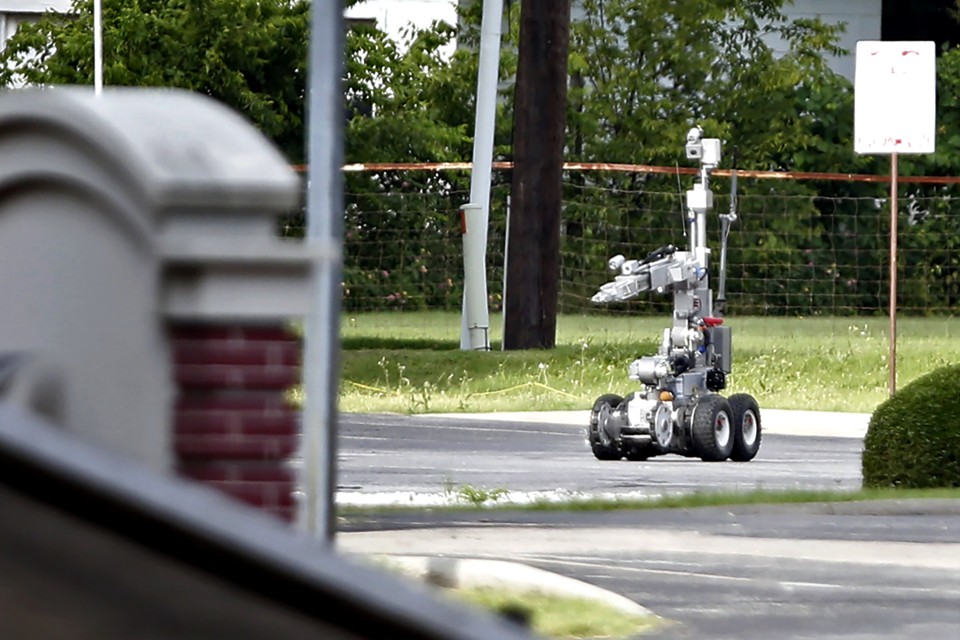
We have another R2-FU on the market....

In the days after the Dallas police shooting last summer, where five officers were murdered by a radical anti-cop extremist, the Dallas police used a robot to eliminate this waste of sperm from the human gene pool, I had heated discussions with many people of the use of this technique. Some called it out right murder and I said it wasn't, it was a different version of a sniper. As Dallas PD could not approach the shooter without exposing their officers to fire, the Chief of Police made the call to use this robot. I have no doubt if the sniper had a shot at him, the same call would have made.


Now with some good old American ingenuity, we now have an upgraded version of the R2-FU.
SHOT Show 2017: Med-Eng Introduces New ‘Avenger’ Robot to Help Bomb Technicians Defeat Terrorist Threats

Med-Eng announced the launch of the Avenger Remotely Operated Vehicle (ROV) at the 2017 SHOT (Shooting, Hunting, Outdoor Trade) Show, Booth #12762. This bomb disposal and tactical robot has been engineered to provide police and military response teams with enhanced capabilities to manage ongoing and emerging threats posed by terrorists, particularly in urban environments where Vehicle-Borne Improvised Explosive Devices (VBIEDS, or ‘car bombs’) are of concern.

The Avenger, designed and manufactured by ICP NewTech, is a mid-sized ROV with most of the operational capabilities typically found only in much larger and more expensive robots. Its performance-to-size ratio is outstanding and reflects the advanced electro-mechanical engineering that guided its development. The Avenger’s highly dextrous arm and claw can easily reach inside, above and below cars, pick-up trucks and delivery vans, to remotely investigate suspicious devices, such as Improvised Explosive Devices (IED).

The system includes an on-board computer that fuses data from multiple Chemical, Biological, Radiological, Nuclear and Explosive (CBRNE) sensors and cameras, and relays it to a command post. This integrated sensor suite provides a mission-critical tool for managing CBRNE and Hazmat threats, such as a terrorist’s ‘dirty bomb’, and mitigating risks to the surrounding public. The numerous sensor ports are compatible with many specialized sensors that bomb squads already have, so they can make use of their existing equipment and attach new tools in the future.

In announcing this new urban response tool, The Safariland Group President Scott O’Brien remarked, “We are very excited to present the men and women on the front lines with a sophisticated robot that will allow them to remotely engage hazardous threats with great effect.” He continued, “The safety of first responders, elite military EOD teams and local citizens is of utmost importance to Safariland and this new system will prove to be an integral part of securing densely populated areas across the United States and the international community.”

Rob Reynolds, general manager of Med-Eng, described the Avenger as, “a robot platform that has real potential to change the landscape of the mid-sized ROV market for the betterment of end users.” He elaborated, “The Avenger combines the mobility and ease of deployment advantages of a mid-sized robot with the reach, lift and sensor-fusion capabilities of bigger platforms. We have been extremely impressed by its performance, technology integration and reliability, and firmly believe it will be readily embraced by bomb squads and EOD teams worldwide looking for a highly effective and affordable robot in a smaller size.”

Eamon Jackson, CEO of ICP NewTech, commented, “We listened very carefully to the needs of end users and recognized the operational challenges they’re facing now and in the foreseeable future. It became clear that response teams needed a robotic platform that could be easily transported through congested urban centers, which meant keeping the robot at a smaller scale. We then applied our engineering expertise to develop a system that could attack a range of VBIED-type threats, overcome obstacles, and give users the freedom to deploy and leverage many of their existing sensors and EOD tools.” He concluded, “The Avenger sets a new high mark that will benefit police and military agencies for years to come....”

Better and better....

Wednesday, February 8, 2017

China and intelligent weapons...

Last year I read a sobering novel called Ghost Fleet, the story of a near future (next 20 years) war between the United States and China. It reminded me of the techno-thrillers of Tom Clancy, not quite as fast but very detailed. And disturbing.

We have become dependent on technology to a great degree. I bemoan the fact a lot of my rookie officers cannot use a map well, but they do know how to use the map app on their smart phone. When I was a trainer I would occasionally take control of the car computer and direct my trainee to use his radio and a notebook only. Welcome to the analog world man, and rely on one fact. Technology will fail.

Now we have one of our two great adversaries making significant leaps on technology, but both civilian and military applications. It may mean serious changes to how we view power projection, especially with our carrier operations.
China’s Intelligent Weaponry Gets Smarter

Robert O. Work, the veteran defense official retained as deputy secretary by President Trump, calls them his “A.I. dudes.” The breezy moniker belies their serious task: The dudes have been a kitchen cabinet of sorts, and have advised Mr. Work as he has sought to reshape warfare by bringing artificial intelligence to the battlefield.

Last spring, he asked, “O.K., you guys are the smartest guys in A.I., right?”

No, the dudes told him, “the smartest guys are at Facebook and Google,” Mr. Work recalled in an interview.

Now, increasingly, they’re also in China. The United States no longer has a strategic monopoly on the technology, which is widely seen as the key factor in the next generation of warfare.

The Pentagon’s plan to bring A.I. to the military is taking shape as Chinese researchers assert themselves in the nascent technology field. And that shift is reflected in surprising commercial advances in artificial intelligence among Chinese companies.

Last year, for example, Microsoft researchers proclaimed that the company had created software capable of matching human skills in understanding speech.

Although they boasted that they had outperformed their United States competitors, a well-known A.I. researcher who leads a Silicon Valley laboratory for the Chinese web services company Baidu gently taunted Microsoft, noting that Baidu had achieved similar accuracy with the Chinese language two years earlier.

That, in a nutshell, is the challenge the United States faces as it embarks on a new military strategy founded on the assumption of its continued superiority in technologies such as robotics and artificial intelligence...

..But the global technology balance of power is shifting. From the 1950s through the 1980s, the United States carefully guarded its advantage. It led the world in computer and material science technology, and it jealously hoarded its leadership with military secrecy and export controls.

In the late 1980s, the emergence of the inexpensive and universally available microchip upended the Pentagon’s ability to control technological progress. Now, rather than trickling down from military and advanced corporate laboratories, today’s new technologies increasingly come from consumer electronics firms. Put simply, the companies that make the fastest computers are the same ones that put things under our Christmas trees.

As consumer electronics manufacturing has moved to Asia, both Chinese companies and the nation’s government laboratories are making major investments in artificial intelligence.

The advance of the Chinese was underscored last month when Qi Lu, a veteran Microsoft artificial intelligence specialist, left the company to become chief operating officer at Baidu, where he will oversee the company’s ambitious plan to become a global leader in A.I.

And last year, Tencent, developer of the mobile app WeChat, a Facebook competitor, created an artificial intelligence research laboratory and began investing in United States-based A.I. companies.

Rapid Chinese progress has touched off a debate in the United States between military strategists and technologists over whether the Chinese are merely imitating advances or are engaged in independent innovation that will soon overtake the United States in the field.

“The Chinese leadership is increasingly thinking about how to ensure they are competitive in the next wave of technologies,” said Adam Segal, a specialist in emerging technologies and national security at the Council on Foreign Relations.

In August, the state-run China Daily reported that the country had embarked on the development of a cruise missile system with a “high level” of artificial intelligence. The new system appears to be a response to a missile the United States Navy is expected to deploy in 2018 to counter growing Chinese military influence in the Pacific.

Known as the Long Range Anti-Ship Missile, or L.R.A.S.M., it is described as a “semiautonomous” weapon. According to the Pentagon, this means that though targets are chosen by human soldiers, the missile uses artificial intelligence technology to avoid defenses and make final targeting decisions.

The new Chinese weapon typifies a strategy known as “remote warfare,” said John Arquilla, a military strategist at the Naval Post Graduate School in Monterey, Calif. The idea is to build large fleets of small ships that deploy missiles, to attack an enemy with larger ships, like aircraft carriers.

“They are making their machines more creative,” he said. “A little bit of automation gives the machines a tremendous boost.”

Whether or not the Chinese will quickly catch the United States in artificial intelligence and robotics technologies is a matter of intense discussion and disagreement in the United States.

Andrew Ng, chief scientist at Baidu, said the United States may be too myopic and self-confident to understand the speed of the Chinese competition.

“There are many occasions of something being simultaneously invented in China and elsewhere, or being invented first in China and then later making it overseas,” he said. “But then U.S. media reports only on the U.S. version. This leads to a misperception of those ideas having been first invented in the U.S.”

A key example of Chinese progress that goes largely unreported in the United States is Iflytek, an artificial intelligence company that has focused on speech recognition and understanding natural language. The company has won international competitions both in speech synthesis and in translation between Chinese- and English-language texts...

Sunday, August 14, 2016

Old stuff still works....

When I joined the intelligence racket back in 1988, computer networks were just coming on line and we still worked on maps, reference books and a lot of other hard copy. Beginning the in the 1990s, computers and this new thing called the Internet (I think the ALGORE invented it), and we started the online revolution if you will.

Now there is some pushback. I've complained that many rookie officers can't handle a map, even the veterans. Most of use old dudes (Damned I can't believe I'm calling myself that!) learned on a 1/50k map (if you don't know, Google it) and I will not allow them to use an iPhone or other system because the need to know how to handle themselves when the technology goes down. The Navy recently began to teach navigation by the stars to their officer candidates to insure they can navigate when technology fails. In a recent book I've read, Ghost Fleet, one of the themes is the overuse of computers.

Well, it's not like they had overdue of computers before, but the People's Liberation Army (PLA) is bring back some old technology.
Intelligence: Oldies From The 20th Century

August 14, 2016: On July 15 North Korea activated, for the first time since 2000, a “numbers station.” This is a special radio station that uses a specific shortwave radio frequency that periodically (on pre-arranged dates and times) broadcasts sequences of numbers. These broadcasts often last a few minutes then that channel goes silent.

Numbers stations were a popular 20th century technique for sending secret messages to agents in foreign nations or combat zones. It began during World War I, with Morse code used instead of a spoken voice. Given the frequency used and the strength of the signal the audience for these new North Korean messages was in South Korea, China or Japan. Analysis of the audio indicated that the North Koreans were using Cold War era Russian (Soviet) broadcast equipment. Apparently this gear was put in storage in 2000 and revived for the new broadcasts.

Since the Cold War ended few nations still use numbers stations, most notably Cuba, China, Taiwan, Israel and, until 2000, North Korea. For nations with international Internet access (and this does not include North Korea) there are more effective Internet based methods for sending secret messages. North Korea is known to have used these Internet based method so it is a mystery as to why they have revived their numbers station broadcasts. Then again it could just be another ploy to frighten their enemies (which is just about everyone, especially South Korea, the United States and Japan.) These three nations do not appear alarmed by the broadcasts, but that could be said for most North Korean threats.

When I was a second lieutenant in Korea, back in 1988, one of the best lessons I learned was the answer to the question, "Where are we?" I was in the armored vehicle and couldn't see anything. A captain responded, "You got a map, tell me!" And I went out, looked at the map, looked at the terrain features and in fifteen minutes was able locate our new position. A good reason learned for a very green officer.

Good to know the basics.

Thanks to Darren at RotLC for the link.

Tuesday, June 7, 2016

The Rise of Manufacturing Marks the Fall of Globalization

An interest read on the future of manufacturing. I've enclosed the introduction. You may need to enter an email to see the rest of the article, but it's well worth it.
The Rise of Manufacturing Marks the Fall of Globalization

Whether you're reading this article on a smartphone, tablet or laptop, chances are the device in front of you contains components from at least six countries spanning three or more continents. Its sleek exterior belies the complicated and intricate set of internal parts that only a global supply chain can provide. Over the past century, finished products made in a single country have become increasingly hard to find as globalization — weighted a term as it is — has stretched supply chains to the ends of the Earth. Now, anything from planes, trains and automobiles to computers, cellphones and appliances can trace its hundreds of pieces to nearly as many companies around the world. And its assembly might take place in a different country still.

Opportunities for producing and assembling products and their components have spread worldwide, making it is easier for countries to climb the production value ladder. States at the bottom, extracting raw materials, can gradually move up, first making low-value components and then progressing to higher-value ones or basic assembly. But just as technology spurred globalization and the shifts in international trade that followed, so, too, will it revolutionize how countries again do business with one another. Compounded by the economic and demographic changes taking place today, automation, advanced robotics and software-driven technologies are ushering in a new era — one of shorter supply chains that will provide fewer opportunities for the developing world. Regions once labeled "emerging economies" may instead stagnate, and the divide between the haves and have-nots within and among nations could widen further....

Sunday, May 8, 2016

The Rise and (Eventual) Fall of a Battery Technology

A little off the beaten path from what I normally post on, but I found this interesting as I was catching up on my emails. I've often said solar is close to a pipe-dream until battery technology catches up. Looks like we got a few steps forward here.

The Rise and (Eventual) Fall of a Battery Technology

Summary

Fire, the wheel, the compass, the internal combustion engine, the Internet: All are technologies that changed the world. Batteries could be next. Geographic constraints define geopolitics, but new technologies have the potential to overcome such constraints and, in doing so, to drastically change global dynamics. For this reason, we monitor technological advancements and developments, including in energy storage — batteries. Improvements to battery technology could shape our lives in remarkable ways, enhancing renewable energy integration into the power grid, making mobile robotics practical and reducing the price of electric vehicles in the not-so-distant future. If technologies advance to the point where current fuel sources (hydrocarbons) become less influential, the results will be quite literally earth-changing.

Analysis

The modern battery can trace its roots back to Alessandro Volta in the late 18th and early 19th centuries. Soon after, the first commercially produced battery — using zinc, copper and a brine solution — was made available. In 1859, the first rechargeable battery was invented, and since then, numerous material combinations — including lead acid, nickel cadmium, nickel iron and most recently lithium — have been used to power the growing assortment of electric devices used daily.

Lithium-ion batteries are the current industry standard of battery technology, in terms of storage capacity and lifetime. Increased use is reflected in the quickly climbing price of lithium. With no alternative available for widespread use and commercialization, demand is only expected to grow. As the supply side makes advancements, the cost to manufacture batteries will decline, enabling even greater increases in the use of lithium-ion battery technology. These advancements will be evident in the transportation sector and in the storage of renewable energy. In fact, South Korea recently announced the deployment of the world's largest lithium nickel manganese cobalt, a specific type of lithium-ion battery that typically has a longer life than other material combinations, to support the country's power grid. Additional projects are expected to emerge — especially in East Asia, Europe and the United States — as renewable capacity increases.

As battery technology becomes even more widespread, the production of lithium will change political and economic relationships across the globe. It is often assumed that the Andean region of South America will gain the most from increased lithium demand, as its stores are more cheaply and easily recoverable than those in other regions. Chile, already one of the world's largest lithium producers, is in a particularly favorable position. Its lithium market is projected to see double-digit growth for the next several years, and will continue to climb alongside prices. (Global prices increased by 20 percent between September 2014 and October 2015 and are expected to increase by another 20 percent before 2018.) Neighboring Bolivia, which has similarly large lithium resources, will not fare quite as well, at least initially. It is underdeveloped and lacks the coastal access and political environment necessary to successfully compete with Chile and other global producers. Depending on future development and social advancements, it could eventually be a significant lithium producer. China and parts of the United States will also likely benefit as the industry expands. Australia, Brazil and Canada, where reserves are more expensive to exploit, could also benefit from an expanded market, especially if prices remain high enough.

Beyond Lithium

But to assume that lithium will be the primary battery type in the long term, or even the sole energy storage technology in the near term, is shortsighted. Lithium is a geographically concentrated and comparatively expensive material. This, along with the inherent physical limitations of existing technologies, means that research into building a better, cheaper battery can be expected to continue with fervor. Academic and industrial journals are littered with papers and announcements on new milestones that various battery technologies have reached.

The most interesting developments are those that move away from lithium and toward the cheaper, more abundant sodium. However, sodium ions are larger than lithium ions. This means that for sodium to be a viable alternative, the graphite currently used in battery anodes must be replaced with another material. Recent articles have proposed replacing graphite with discarded organic material, including leaves and apples. The carbonized forms of these natural materials appear to be much more suitable for sodium ions. A lot of work needs to be done — and other potential solutions exist — but the march toward a sodium-ion battery continues, as do frequent and unexpected breakthroughs.

What exactly could replace lithium is unknown at this point, but there are options in the research pipeline that could prove useful. Even as the industry standard, lithium-ion batteries face competition in every sector. Flow batteries — which are easily scalable because they allow electrons to flow between vats of fluid — are one option for grid storage, as are fuel cells, flywheels and supercapacitors. Though it may take a decade or more for a lithium-ion competitor to emerge, the drive toward cheaper, more abundant materials will continue.


In the meantime, lithium-ion batteries will advance and become more prevalent. And though, eventually, lithium-ion batteries may very well fill many of the roles that hydrocarbons now play, lithium will never have the same geopolitical importance as oil. Using gasoline as a fuel requires constant replenishment. Batteries must be recharged, but the materials inside do not need to be replaced. Batteries can also be recycled and lithium reused. While this is good news, perhaps, for the environment, it also limits the amount a country can gain by promoting lithium exports.

Over the course of history, society relied first on wood and wind for its energy before moving to coal, oil and natural gas. The next transition — conceivably, to batteries — is just getting started. With it will come the rise of a whole new set of commodities, best reflected by lithium's recent success and predicted growth. However, in all likelihood, lithium will eventually be replaced by something cheaper, more abundant and more universally accessible. Lithium's prospects in the near future are exciting, but the duration of its success will be limited.

The Rise and (Eventual) Fall of a Battery Technology "The Rise and (Eventual) Fall of a Battery Technology is republished with permission of Stratfor."

Thursday, March 31, 2016

Geopolitical Weekly: The Tech Revolution Comes of Age, March 29, 2016

By Matthew Bey

Technological revolutions frame historical eras. Each cycle thrusts new sectors into prominence, turning companies into strategic assets for their governments to exploit. Whether it is European trading companies in the colonial era or international oil companies in the 20th century, technological revolutions give corporations such power and importance that they become inherently geopolitical.

The information technology revolution is no different. Computer software and hardware technologies have become indispensable to the modern economy, underpinning the economies of the developed world. The companies that operate in this space, such as Samsung, Apple, Google, Facebook and Baidu, are among the most powerful in the world today. At the same time, they often find themselves at the center of geopolitical disputes.

Though 30 years in the making, the IT revolution remains in its infancy. The balance of power between tech companies and governments has not yet been fully defined. Likewise, the extent to which countries such as China — countries where, by Western standards, state institutions work too closely with the business elite — will benefit from this revolution, and whether they will be able to wrest control of it away from entrenched Western powers, remains to be seen.

From Trading to Transportation

Over the past 500 years, two revolutions have defined the way the world's powers interact. The first was the development of deep-water navigation in the 15th and 16th centuries, which marked the start of five centuries of European global domination. European trading companies such as the Dutch East India Co. and British East India Co. soon became de facto arms of their governments, implementing foreign policy goals throughout their colonies and even administering them politically at times.

The second, the Industrial Revolution, was equally transformative, redefining the roles of global empires. Though many raw materials were needed to fuel this economic revolution, energy — for both electricity and transportation — became the most politicized and technologically difficult to access. The electric and transportation industries quickly gained political power, and by the early 1900s, oil became the fuel source of choice for transportation.

Oil companies, in turn, quickly became instruments for accomplishing their governments' geopolitical objectives. For example, for more than 60 years, the United Kingdom's Anglo-Persian Oil Co., which developed the Iranian petroleum industry, influenced British policy toward Tehran. Not only did the company profit London financially, but it also sold oil to the Royal Navy below market value and helped to reinforce Iran's alliance with the West in the first half of the Cold War. When Iran nationalized its petroleum industry in 1951, London even helped orchestrate a coup d'etat to regain control.

Today, the relationship between governments and oil companies is far more nuanced. In the wake of the Cold War, the West is more reluctant or less able politically to back revolutions and coups d'etat to protect its energy interests. Modern Western international oil companies, even those whose governments hold sizable stakes in them, are largely independent actors that lack the kind of monopoly on government sales that, for example, the Anglo-Persian Oil Co. had. International oil companies retain their political sway in negotiating with countries, however, thanks to their formidable financial and technological resources. Even now, Iran — despite its backlash against Western oil companies and Supreme Leader Ayatollah Ali Khamenei's anti-Western rhetoric — is salivating at the prospect of U.S. and European oil companies returning to invest.

The digital revolution, beginning in the second half of the 20th century, is now having similar effects on the global system. The Internet has redefined the modern economy, enabling the growth of software, global supply chains and modernized manufacturing processes. And the revolution is far from finished. Emerging technologies such as smart grids, additive manufacturing, artificial intelligence and intelligent industrial robots are all poised to make a significant impact in the coming decades.

A New Transformation, a Different World

But this transformation is occurring in a world fundamentally different from that of previous revolutions. Worldwide, the United States sits at the heart of financial institutions, controls the oceans and undisputedly leads in technology development. At the same time, Europe's economy has been surpassed by China's and India's for the first time since the Industrial Revolution began. Not since before it perfected deep-water navigation has Europe lacked the wealth and the political control of Asia.

With the possible exception of Germany, Europe's former industrial powers have all been noticeably absent from the latest revolution. Meanwhile, South Korea, Taiwan, Japan and the United States have been the main contributors to software and hardware development. For that reason, these countries' companies dominate the technology landscape: Microsoft, Apple, Google and Facebook are all U.S. companies, Samsung is South Korean, and Foxconn and TSMC are Taiwanese. China has seen tremendous growth in these areas as companies such as Baidu, Xiaomi, Lenovo and Huawei follow in the footsteps of their Korean, Japanese and Taiwanese counterparts.

As the tech revolution continues, the relationship between tech companies and their governments is still being defined. Although governments retain considerable control over regulation, companies' mastery of technology gives them a great deal of negotiating power. Figuring out how to regulate, control and monitor the Internet and eventually leverage the sector to fulfill its geopolitical imperatives now tops the list of nearly every country's objectives.

In the West, individual privacy has become a key issue that will remain indefinitely. People often balk at the thought that Google, Facebook and other companies maintain databases of information culled from their search histories, communications, purchases and GPS locations. But these companies rely on such information to develop and perfect their services, whether by customizing online advertisements and searches or updating real-time traffic information.

Of course, regulations on Internet privacy are ambiguous, as Google has now found out with French officials. In March, France slapped a fine on the U.S. company for failing to enforce the European Union's "right to be forgotten" policy on all Google searches, not just those in France. For the United States and Europe, striking a balance between security and privacy — digitally and otherwise — has been an ongoing struggle. Privacy Shield, the new trans-Atlantic data transfer agreement between the United States and the Europe Union, will ensure that U.S. companies do not need to store private information locally in Europe, at least for now. Should the agreement fail, however — for example, through renewed disputes between the United States and the European Union or further fragmentation within the Continental bloc — the issue of control over private information would resurface.

Beyond just the United States and Europe, other countries are moving to gain control over the tech sector, the Internet and the information flowing through both. Because most of China's tech sector depends on foreign technology, its efforts to regulate the tech sector and the Internet are limited. When it drafted its terrorism and cyber-security laws, Beijing pushed for a backdoor to circumvent encryption. Foreign companies, most notably Apple, opposed a backdoor solution, and China ultimately had to drop the issue.

It was for this reason that the world was so concerned about how Apple's fight with the FBI would turn out. Had the U.S. government forced Apple to unlock Syed Farook's cellphone, it would have set a precedent other countries could cite as they sought to implement their own backdoor measures. But now the FBI claims to have unlocked the phone without Apple's help. If that is true, countries such as China will probably have to revisit their backdoor policies until they lower their dependence on foreign tech companies.

Future Competition

Although today the tech world revolves around the United States, China has the most Internet users — more than the next two countries combined — and its overall economy will soon overtake that of the United States. Should China successfully close the gap between its companies and their foreign competitors, it will be the one country that could dethrone the United States as the pre-eminent global tech power.

Beijing will not attain this goal easily, if at all. Despite China's rising importance in the tech sector, even Chinese powerhouses such as Xiaomi primarily use foreign-engineered components. But in the tech world, as in almost every facet of the current global economic system, Beijing is trying to bring the dominance of Western institutions to an end. Thus, the continued prominence of the United States and its allies in the tech sector poses just as much of a hindrance to China's ambitions as the strength of the International Monetary Fund, the World Bank and the U.S. dollar does in the global financial system.

Though China might one day overcome its technological dependence on other countries, the developing world is unlikely to supplant U.S. or other Asian tech companies for decades, if ever. Mass media and connectivity will continue to spread the cultures that dominate the tech sphere throughout the world, much in the way trading companies did. And as Chinese companies expand their presence in regional markets over time, China will seize the opportunity for virtual colonization as well.

Becoming Supranational

Giant tech conglomerates are now finding that tech innovation and computer science applications can revolutionize industries beyond their own. As a result, many of today's tech companies are integrating themselves in almost every emerging technology. For example, Google, which already has business operations spanning web services, advertising, entertainment, media, operating systems and imagery, is moving into the automotive sector via autonomous vehicles, the leading edge of artificial intelligence, robotics, defense and advanced computing techniques. The breadth of sectors in which Google, Baidu and Samsung are getting involved is perhaps more varied than those that trading companies used, especially since these sectors provide the foundation for future revolutions in manufacturing.

Moreover, the sheer amount of data that these companies possess — not to mention their ability to process the data — is unmatched by Moscow, Beijing or Washington. This enables them to use their data in innovative and unique ways, perhaps the most powerful of which are still unimaginable today. Even now Baidu claims to be developing software to help predict crowd problems. If effective, this would prove an invaluable tool to Beijing, which could use it to predict and prevent mass protests on the scale of those in Tiananmen Square in 1989.

But the IT revolution is now just 30 years in the making. Its impact on the world's economy may not yet be fully realized, and its most profound developments may be yet to come. To put the revolution into perspective, 30 years after Vasco da Gama first visited India, the world's most dominant trading companies, such as the British East India Co., were 70 years from even forming. Standard Oil was not formed until nearly a century after the Industrial Revolution began.

The world is just beginning to adjust to the newfound realities that the tech revolution has introduced. Consequently, countries are just beginning to adapt them to their overall geopolitical imperatives. For now, most states remain in reactive mode, trying to adjust their policies on the fly to accommodate changing realities. They will likely struggle to exert the same amount of control over the tech industry that they had over oil and trading companies. If advances in technology continue to outpace regulatory measures, the United States, China and Europe may find themselves on equal footing with regard to their control over the tech world. And as the balance of power between governments and corporations shifts, companies such as Google or Facebook could evolve into independent supranational actors with little state control and huge geopolitical power nonetheless.

COPYRIGHT: STRATFPR.COM

Monday, March 21, 2016

A remote control drone that can carry 1100 pounds...

The potential for this is great. They are mentioning how you can airlift men from the battlefield. There is also the potential for airlifting injured civilians in distant rural areas to trauma centers at a fraction of the cost of standard helicopters.


Military drone ambulance can carry loads of up to 500kg

The Israeli company Urban Aeronautics created AirMule, a drone capable of carrying loads of up to half a ton. The equipment was developed primarily for military use, to be used in missions in hard to reach places where conventional helicopters can’t access.

“[It could fly to] anyone out in the field who needs water, food, batteries, supplies, medical equipment and so forth,” Rafi Yoeli told the BBC. “Later, it could be used to fetch soldiers that you don’t want to leave behind or are wounded. There are plenty of situations where you cannot send a helicopter – for example, in the middle of fighting where you want to evacuate people from a street or from a narrow roof. Eventually, there could be civilian applications, such as rescue missions in the mountains or flying into disaster areas – for example, nuclear facilities where no person in a helicopter could get in.”

Still in testing phase, AirMule flies completely autonomously: take-off, maneuvers, landing, everything is done by the device’s navigation system and the Israeli aircraft can reach speeds of up to 180 km/h.

Despite the interesting proposal of carrying people in a drone that can be remote-controlled, one must keep in mind some obstacles that involve drones in general. Like the flight distance which is limited to 49 km, while helicopters have no distance limits as long as the fuel lasts. According to the creators, the drone has incredible flight capacity even in turbulent weather, resisting winds of up to 50 knots, a significant improvement over existing helicopters.

Thank you Mike K for the link.

Good news from Detroit

Detroit is a war zone right now and there is not much positive from a law enforcement perspective. However, this is good news, using technology to catch the bad guy, or bad girl, in this case.


At first I was a bit uneasy with the stations identifying the locations, but it makes sense. Generally criminals don't shoot where they know there are being video taped. And the results were excellent, captured in less than two hours and the officers get real time intelligence.

Great word Detroit.

Thursday, January 14, 2016

Your Threat Score

In my profession there are still dead heads complaining why we need to use computers to write offense or accident reports. "Paper is find...just press hard for your third copy...", etc. Now here is some really good stuff. Fresno Police are using a new technology to assess the threats their officers face as they respond to calls for service. To use the phrase, Fascinating.

The new way police are surveilling you: Calculating your threat ‘score’

FRESNO, Calif. — While officers raced to a recent 911 call about a man threatening his ex-girlfriend, a police operator in headquarters consulted software that scored the suspect’s potential for violence the way a bank might run a credit report.

The program scoured billions of data points, including arrest reports, property records, commercial databases, deep Web searches and the man’s social- media postings. It calculated his threat level as the highest of three color-coded scores: a bright red warning.

The man had a firearm conviction and gang associations, so out of caution police called a negotiator. The suspect surrendered, and police said the intelligence helped them make the right call — it turned out he had a gun.

As a national debate has played out over mass surveillance by the National Security Agency, a new generation of technology such as the Beware software being used in Fresno has given local law enforcement officers unprecedented power to peer into the lives of citizens.

Police officials say such tools can provide critical information that can help uncover terrorists or thwart mass shootings, ensure the safety of officers and the public, find suspects, and crack open cases. They say that last year’s attacks in Paris and San Bernardino, Calif., have only underscored the need for such measures.

But the powerful systems also have become flash points for civil libertarians and activists, who say they represent a troubling intrusion on privacy, have been deployed with little public oversight and have potential for abuse or error. Some say laws are needed to protect the public...

False analogy. The question of the NSA is them monitoring private conversations without court authority and for little purpose. They are collecting so much data it cannot be analyzed. Arrest reports, property records, commercial databases and especially social media postings are open to the public. You don't want people to know your write gang bang crap, don't write it on Facebook. Not to mention these inquiries are targeted to a specific person.

In many instances, people have been unaware that the police around them are sweeping up information, and that has spawned controversy. Planes outfitted with cameras filmed protests and unrest in Baltimore and Ferguson, Mo. For years, dozens of departments used devices that can hoover up all cellphone data in an area without search warrants. Authorities in Oregon are facing an internal investigation after using social media-monitoring software to keep tabs on Black Lives Matter hashtags.

“This is something that’s been building since September 11,” said Jennifer Lynch, a senior staff attorney at the Electronic Frontier Foundation. “First funding went to the military to develop this technology, and now it has come back to domestic law enforcement. It’s the perfect storm of cheaper and easier-to-use technologies and money from state and federal governments to purchase it...”

Padon me, worthless argument. "Planes outfitted with cameras filmed protests and unrest in Baltimore and Ferguson, Mo." Hate to tell you but if you are in the public, you have no expectation of privacy and can be photographed. I've often said as a cop I have no expectation of privacy while on patrol and you can use your iPhone to take pictures of me.

...An arsenal of high-tech tools


Fresno’s Real Time Crime Center is the type of facility that has become the model for high-tech policing nationwide. Similar centers have opened in New York, Houston and Seattle over the past decade.

Fresno’s futuristic control room, which operates around the clock, sits deep in its headquarters and brings together a handful of technologies that allow the department to see, analyze and respond to incidents as they unfold across this city of more than 500,000 in the San Joaquin Valley.

On a recent Monday afternoon, the center was a hive of activity. The police radio crackled over loudspeakers — “subject armed with steel rod” — as five operators sat behind banks of screens dialing up a wealth of information to help units respond to the more than 1,200 911 calls the department receives every day.

On 57 monitors that cover the walls of the center, operators zoomed and panned an array of roughly 200 police cameras perched across the city. They could dial up 800 more feeds from the city’s schools and traffic cameras, and they soon hope to add 400 more streams from cameras worn on officers’ bodies and from thousands from local businesses that have surveillance systems.

The cameras were only one tool at the ready. Officers could trawl a private database that has recorded more than 2 billion scans of vehicle licenses plates and locations nationwide. If gunshots were fired, a system called ShotSpotter could triangulate the location using microphones strung around the city. Another program, called Media Sonar, crawled social media looking for illicit activity. Police used it to monitor individuals, threats to schools and hashtags related to gangs.

Fresno police said having the ability to access all that information in real time is crucial to solving crimes.

They recently used the cameras to track a robbery suspect as he fled a business and then jumped into a canal to hide. He was quickly apprehended.

The license plate database was instrumental in solving a September murder case, in which police had a description of a suspect’s vehicle and three numbers from the license plate.

But perhaps the most controversial and revealing technology is the threat-scoring software Beware. Fresno is one of the first departments in the nation to test the program.

As officers respond to calls, Beware automatically runs the address. The searches return the names of residents and scans them against a range of publicly available data to generate a color-coded threat level for each person or address: green, yellow or red.

Exactly how Beware calculates threat scores is something that its maker, Intrado, considers a trade secret, so it is unclear how much weight is given to a misdemeanor, felony or threatening comment on Facebook. However, the program flags issues and provides a report to the user.

In promotional materials, Intrado writes that Beware could reveal that the resident of a particular address was a war veteran suffering from post-traumatic stress disorder, had criminal convictions for assault and had posted worrisome messages about his battle experiences on social media. The “big data” that has transformed marketing and other industries has now come to law enforcement.

Fresno Police Chief Jerry Dyer said officers are often working on scant or even inaccurate information when they respond to calls, so Beware and the Real Time Crime Center give them a sense of what may be behind the next door.

“Our officers are expected to know the unknown and see the unseen,” Dyer said. “They are making split-second decisions based on limited facts. The more you can provide in terms of intelligence and video, the more safely you can respond to calls.”

Intelligence is for the Commander, a saying from my army days on why we need information before going into an operation. This is a updated version of this process and I think it's great. Naturally you have the straw man threats...

But some in Fresno say the power and the sheer concentration of surveillance in the Real Time Crime Center is troubling. The concerns have been raised elsewhere as well — last year, Oakland city officials scaled back plans for such a center after residents protested, citing privacy concerns.

Rob Nabarro, a Fresno civil rights lawyer, said he is particularly concerned about Beware. He said outsourcing decisions about the threat posed by an individual to software is a problem waiting to happen.

Nabarro said the fact that only Intrado — not the police or the public — knows how Beware tallies its scores is disconcerting. He also worries that the system might mistakenly increase someone’s threat level by misinterpreting innocuous activity on social media, like criticizing the police, and trigger a heavier response by officers.

“It’s a very unrefined, gross technique,” Nabarro said of Beware’s color-coded levels. “A police call is something that can be very dangerous for a citizen.”

You know who else it can be dangerous for idiot, the cop going into a hostile place. This may shock you counselor, but I go where other people need someone to restore order. And idiots expect me to restore order to a situation that took years to deteriorate. So yes, I need information to safety and efficiently accomplish that task.

...Dyer said such concerns are overblown, saying the scores don’t trigger a particular police response. He said operators use them as guides to delve more deeply into someone’s background, looking for information that might be relevant to an officer on scene. He said officers on the street never see the scores.

The Fresno City Council called a hearing on Beware in November after constituents raised concerns. Once council member referred to a local media report saying that a woman’s threat level was elevated because she was tweeting about a card game titled “Rage,” which could be a keyword in Beware’s assessment of social media.

Councilman Clinton J. Olivier, a libertarian-leaning Republican, said Beware was like something out of a dystopian science fiction novel and asked Dyer a simple question: “Could you run my threat level now?”

Dyer agreed. The scan returned Olivier as a green, but his home came back as a yellow, possibly because of someone who previously lived at his address, a police official said.

“Even though it’s not me that’s the yellow guy, your officers are going to treat whoever comes out of that house in his boxer shorts as the yellow guy,” Olivier said. “That may not be fair to me.”

He added later: “[Beware] has failed right here with a council member as the example.”

Really, it's failed. It described you as "Green", low threat, while the house is "Yellow", medium threat. BTY, we don't know if you have a record from this article. You may have been busted for a few fights back in your young and stupid days. Just saying. And please Mr Oliver, don't use that four letter F word with me. The world ain't fair.

The rest of the article is the expected "balance" of ACLU comments in every "objective" media report. Again, this may disturb some but understand, as long as the data is from open sources, it's available for analysis. The ACLU types who seem to have no issue with certain high officials of our government using FBI data files which do contain restricted sensitive information will object to law enforcement using open sources like this. I will say as long as the information is available to the civilian (and yes, the criminal) it's available to the cops.

Thank you Darren at RotLC for the link.