Police Work, Politics and World Affairs, Football and the ongoing search for great Scotch Whiskey!

Sunday, February 17, 2019

The Eleventh Hour of the Eleventh Day....

I knew an officer who was in Vietnam when the war ended. Eight in the morning (local time) on January 28, 1973. He told me it was the longest night of his life, but he had one thought: I live though tonight, I live forever!

Fortunately he did live through that night, although he has since passed on.

But I found this page on the end of World War I. By the way, if you haven't see it, watch They Shall Not Grow Old. The best documentary on the war I've ever seen. But this is an audio of the actual end of the war, the end of the firing of the artillery and small arms. A sinister sound.


Eerie recording reveals moment the guns fell silent at the end of WWI

On the eleventh hour, of the eleventh day, of the eleventh month, the guns fell silent.

It brought an end to four years of war which crippled Europe, leaving 17 million dead including 888,246 British or Colonial servicemen...

...The artillery activity it illustrates was recorded on the American front near the River Moselle, one minute before and one minute after the war ended.

Strangely, audio couldn’t be recorded at the time so the Allies created them using ‘sound ranging, which recorded the intensity of noise to photographic film (a seismograph for earthquakes is a good comparison).

This visual record allowed the Imperial War Museum to turn the moment back into audio to give an impression of what the moment was like...

The last World War I veteran died in 2012, and we are loosing over 300 World War II veterans a day. I'm 54, I have no doubt I will see the end of the World War II generation, and the Korea War, before my time has passed.

May they Rest In Peace.

Friday, February 15, 2019

Officer Down


Police Officer Toshio Hirai
Gardena Police Department, California
End of Watch Thursday, November 15, 2018
Age 34
Tour 12 years
Badge 381
Cause Motorcycle crash
Incident Date Wednesday, November 14, 2018

Police Officer Toshio Hirai succumbed to injuries sustained in a motorcycle crash the previous day.

His police motorcycle was struck by a car at the intersection of Western Avenue and 238th Street, in Harbor City, while he was en route to the police station.

Officer Hirai had served with the Gardena Police Department for 12 years. He is survived by his wife and 2-year-old son.
Rest in Peace Bro…We Got The Watch

Nemo me impune lacessit

Day is done, Gone the sun, From the lake, From the hills, From the sky. All is well, Safely rest, God is nigh. 

Wednesday, February 13, 2019

Officer Down


Police Officer Jared William Franks
Greensboro Police Department, North Carolina
End of Watch Saturday, November 10, 2018
Age 24
Tour 2 years, 5 months
Badge 315

Police Officer Jared Franks was killed in a vehicle crash at the intersection of South Elm-Eugene Street and Webster Road while responding to a robbery in progress call.

His patrol car collided with another patrol car at the intersection and then struck a house. He was transported to a local hospital where he was pronounced dead.

Officer Franks had served with the Greensboro Police Department for 2-1/2 years and was assigned to the District Two Patrol Division.
Rest in Peace Bro…We Got The Watch

Nemo me impune lacessit

Day is done, Gone the sun, From the lake, From the hills, From the sky. All is well, Safely rest, God is nigh. 

Monday, February 11, 2019

Officer Down


Sergeant Ronald Lee Helus
Ventura County Sheriff's Office, California
End of Watch Thursday, November 8, 2018
Age 54
Tour 29 years, 4 months
Incident Date Wednesday, November 7, 2018

Sergeant Ron Helus was shot and killed after responding to an active shooter at a bar at 99 Rolling Oaks Drive in Thousand Oaks.

When he arrived, Sergeant Helus heard gunfire coming from inside the bar, which was occupied by nearly 200 college students. He and a California Highway Patrol officer immediately made entry into the bar and confronted the shooter, but Sergeant Helus was shot five times by the subject and severely wounded. He was also struck one time by a friendly-fire round during the shooting. The other officer was able to pull Sergeant Helus from the building and provided medical aid.

Sergeant Helus was taken to a local hospital where he died from his wounds. Eleven citizens were also shot and killed in the incident, and numerous others were wounded.

The suspect was later found dead inside the bar from a self-inflicted gunshot wound.

Sergeant Helus served with the Ventura County Sheriff's Office for 29 years. He is survived by his wife and son.
Rest in Peace Bro…We Got The Watch

Nemo me impune lacessit

Day is done, Gone the sun, From the lake, From the hills, From the sky. All is well, Safely rest, God is nigh. 

What's going on in the World Today 190211

Maj. T.J. "King" Kong: Survival kit contents check. In them you'll find: one forty-five caliber automatic; two boxes of ammunition; four days' concentrated emergency rations; one drug issue containing antibiotics, morphine, vitamin pills, pep pills, sleeping pills, tranquilizer pills; one miniature combination Russian phrase book and Bible; one hundred dollars in rubles; one hundred dollars in gold; nine packs of chewing gum; one issue of prophylactics; three lipsticks; three pair of nylon stockings. Shoot, a fella' could have a pretty good weekend in Vegas with all that stuff.

HYPERLINKS MAY REQUIRE AN EMAIL:

USA


The U.S. Is Fighting a 21st Century Trade Battle Armed With a 1930s Mindset

Highlights

- The United States may score some successes in persuading its trade partners to reduce their tariffs, but its current strategy fails to address the fact that tariffs are not the biggest limiters of U.S. exports.

- Ultimately, nontariff barriers such as health and safety regulations and intellectual property rights present greater obstacles to trade in the contemporary world than tariffs do.

- With the United States focused on tariffs, its exporters could soon face greater difficulties as competitors in Canada, the European Union, Asia and elsewhere gain access to more markets thanks to comprehensive free trade deals that eliminate more important nontariff barriers.

Can turning back the clock to the 1930s achieve a 21st-century trade win? That might be the question on everyone's lips as the White House aims to significantly increase presidential authority over U.S. tariffs by asking Congress during next week's State of the Union address to pass the Reciprocal Trade Act. The name of the bill itself echoes perhaps the single most consequential trade act in U.S. history, the Reciprocal Trade Agreements Act, which President Franklin D. Roosevelt signed in 1934 to help the United States recover from the Great Depression...

Why Did the State Department Just Spend $84,375 on a Sculpture by Bob Dylan?
The purchase represents the cultural aspects of U.S. diplomacy for some and lavish and wasteful spending for others.

In the middle of what would become the longest government shutdown in U.S. history, the State Department processed an unusual expense: a piece of iron artwork that stands about 4 feet high.

The cost? $84,375. The artist? The American singer-songwriter Bob Dylan.

The sculpture, paid for with federal funding not subject to the shutdown, raises questions about how and where the State Department spends money at a time when the Trump administration is pushing to slash funds for American diplomacy and trying to curb overall federal government spending.

Dylan’s ironwork was purchased under the department’s Art in Embassies program, which places American art in U.S. diplomatic outposts worldwide to showcase U.S. culture and soft power. It will be displayed at the U.S. Embassy in Mozambique, according to a State Department spokeswoman.

Proponents of the program view art and culture as important tools of diplomacy. Placing artwork at embassies offers a way to engage with local artists and communities across the world at a relatively small price—compared with the overall cost of running an embassy.

But for critics, the Dylan sculpture illustrates the way the State Department mismanages money, particularly on new embassies, even as it struggles to fund its core functions. The Trump administration has repeatedly proposed massive budget cuts for Foggy Bottom (though many of those cuts have been batted away by Congress in federal spending bills).

President Donald Trump himself has criticized ballooning costs for embassy construction abroad—though thus far he has spared the artwork. In early 2018, he railed against the $1 billion price tag of the new U.S. Embassy in London, blaming former President Barack Obama for getting a “bad deal” on the move. (The decision to move the embassy was made during the George W. Bush administration.) In New York, the State Department drew public scrutiny last year for spending $52,701 on “customized and mechanized curtains” at the residence of the U.S. ambassador to the United Nations, a decision that was made under the Obama administration.

“The State Department needs more money, but it also has to be a better steward of taxpayer money for these type of expenditures,” said Brett Bruen, a former U.S. diplomat who heads the public affairs firm Global Situation Room, when asked about the Dylan sculpture. “The [department] has spent lavishly on these new embassies even as the core functions of American diplomacy have faced significant reductions...”

BY 2020, THE USA WILL BECOME THE 3RD LARGEST EXPORTER OF LNG.

Canadian border more of a terror concern than Mexican for U.S.: report

... in arguing for a border wall, [he] has said repeatedly that terrorists are slipping across from Mexico, known cases of extremists entering the U.S. through its land borders to the north or the south are exceedingly rare. Even then, State Department reports on terrorism have expressed more concern about the Canadian border than the Mexican one because Canada, unlike Mexico, has been home to “violent extremists inspired by terrorist groups such as ISIS and al-Qaida and their affiliates and adherents,” according to a 2017 paper.

AFRICA

NOTHING SIGNIFICANT TO REPORT

ASIA

Australia parliament hit by cyber-hack attempt

The attempted breach is the latest in a number of known attacks on the Australian government

Authorities in Australia say they are investigating an attempt to hack into its parliament's computer network.

Lawmakers said there was "no evidence" that information had been accessed or stolen, but politicians' passwords have been reset as a precaution.

Local cyber-security experts have suggested the hack likely came from a foreign state.

Australian PM Scott Morrison said he didn't intend to comment in depth on "the source or nature of this".

He said there was "no suggestion" that government agencies or departments had been targeted. MPs and their staff use the parliament network to store emails, among other data...

CENTRAL/ZOUTH AMERICA

Tracking Mexico's Cartels in 2019
By Scott Stewart
VP of Tactical Analysis, Stratfor

Editor's Note

Since 2006, Stratfor has produced an annual cartel report chronicling the dynamics of the organizations that make up the complex mosaic of organized crime in Mexico. When we began, the landscape was much simpler, with only a handful of major cartel groups. But as we noted in 2013, the long process of balkanization — or splintering — of the groups has made it difficult to analyze them the way we used to. Indeed, many of the organizations we had been tracking, such as the Gulf cartel, imploded and fragmented into several smaller, often competing factions. Because of this fracturing, we changed our analysis in 2013 to focus on the clusters of smaller groups that emanate from three main geographic areas: Sinaloa state, Tamaulipas state and the Tierra Caliente region.

Surprisingly little has changed over the past year in terms of cartel dynamics. Various leaders and lieutenants have been arrested or killed, and additional splintering has continued for some already fractured groups, but by and large, 2018 was characterized by a stasis in the conflict zones of the assorted factions. In the past, periods of stasis often entailed that cartel groups were staying within their areas of control and that violence would be lower. However, in the current period, large and bloody struggles are continuing unresolved, and cartel groups remain locked in nasty turf wars. This environment means that most of these clashes will rage on well into 2019.

This violence has been reflected in the murder statistics, as the homicide figure for 2018 hit 33,341 — far surpassing the 2017 tally of 29,168. While Mexico's homicide rate of about 27 per 100,000 people is higher than that of the United States (which is expected to come in at about 5 per 100,000 people for 2018), it is still considerably lower than the rates for other countries in the region, including El Salvador (about 82 per 100,000), Honduras (about 56 per 100,000) and Jamaica (about 47 per 100,000)...

A chart plots the number of murders in Mexico by year.

EUROPE

NATO leaders to meet in London in December

Brussels (AFP) - The leaders of NATO's 29 countries will gather in London in December for a special meeting to mark the alliance's 70th anniversary, Secretary General Jens Stoltenberg announced Wednesday.

Stoltenberg tweeted that the British capital was "the ideal setting to mark 70 years of transatlantic military cooperation, as the home of NATO's first HQ back in 1949".

Britain is due to leave the European Union on March 29 and the December meeting will be seen as a signal of solidarity between NATO and the UK -- which is the continent's leading military power, along with France.

"Brexit will change the United Kingdom's relationship to the European Union but it will not change the United Kingdom's relationship to NATO," Stoltenberg said...

AFGHANISTAN

NOTHING SIGNIFICANT TO REPORT

CHINA

U.S., China: Trade Talks End on an Up Note

Stratfor's geopolitical guidance provides insight on what we're watching out for in the week ahead.

The Big Picture

With just a month left before the trade truce between China and the United States ends March 1, the world is eagerly waiting to see whether the high-level negotiations between the two powers will take the path to de-escalation and an agreement.

What Happened

With U.S. President Donald Trump hinting that there is a "good chance" of a trade deal with China, two days of negotiations involving senior officials ended on a high note this week. China's chief negotiator Liu He made a surprise offer to purchase 5 million tons of U.S soybeans when he met with Trump in the White House on Jan. 31. Meanwhile, officials from the U.S. Chamber of Commerce said progress had been made on greater market access and on enforcement of intellectual property rights — two core U.S. concerns. But it wasn't revealed how much overall progress was made or what divisions remain. The details on some core issues — such as China's forced technology transfer and subsidies to strategic industries — were far from clear. Ahead of the talks, China reportedly offered to increase U.S. imports from $155 billion in 2018 to $200 billion in 2019 and to even eliminate its trade surplus with the United States by 2024. And China has taken steps to fast-track domestic legislation that would prohibit forced transfers of technology and open the country's markets more, though implementation will take years and thus fall short of U.S. demands in the short term...

IRAN

Iran Holds in Syria

Threat Lens Key Takeaways

- Iran's limited military capabilities in Syria have tempered its reaction to Israeli airstrikes there.

- While unlikely to occur, a stronger Iranian reaction could escalate into a major conflict with Israel, which might spill over into Lebanon and Iraq.

- Only a major development could alter the thinking behind Iran's restraint.

On Feb. 1, the deputy head of Iran's Islamic Revolutionary Guard Corps (IRGC) again threatened Israel, saying Iran could destroy it in three days. Despite these threats, Iran has exercised restraint when it comes to confronting Israel militarily, even after dozens of strikes on Iranian forces and equipment in Syria since 2013. These attacks have been focused on degrading Iran's military capabilities in Syria and interdicting its supply lines to Hezbollah in Lebanon.

Iranians after a suspected Iranian surface-to-surface missile was launched from Syria into the Golan Heights. Iran has struck Israel just one other time since 2013, when Iranian forces fired upward of 50 rockets and mortars in May 2018 into the Golan Heights in response to Israeli attacks. The barrage did not inflict a single casualty and caused negligible damage. When Israel responded with its largest killing at least 12 series of airstrikes in Syria, hitting more than 70 targets, Iran did not answer...


Armed men blow up gas tanker truck in Iran, policeman killed: Mehr

A policeman was killed and another seriously wounded after armed men blew up a tanker truck carrying liquified gas in northwestern Iran early on Wednesday, Mehr news agency reported. Police approached two men at a petrol station in the town of Dareh Garm and the men began shooting at the tanker, the agency said.

IRAQ

Will Iraq’s Old Divisions Undermine Its New Prime Minister?

In his first hundred days on the job, Adel Abdul Mahdi has hit entrenched political roadblocks to choosing cabinet ministers and changing a system of political patronage.

BAGHDAD—When he was sworn in as Iraq’s new prime minister in late October 2018, Adel Abdul Mahdi vowed to fight corruption, address electricity and water shortages, create private sector jobs, and curb an entrenched system of political patronage that has long hamstrung Iraq’s ability to serve its people.

Abdul Mahdi’s agenda was as ambitious as it was necessary. It sought to calm public anger following the worst anti-government protests the country has seen in years, fueled by a severe water and sanitation crisis in Iraq’s south that had resulted from years of neglect and mismanagement of public resources. The prime minister’s pledge to choose his own ministers, rather than let political parties pick candidates, aimed to restore trust in a political process that many Iraqis had come to dismiss as corrupt and undemocratic.

But with the 100-day mark of his administration gone, Abdul Mahdi and his reform agenda appear to be faltering. He has been able to freely choose only a handful of ministers, while four ministerial positions remain vacant amid haggling among political parties insisting on their candidates. His budget has drawn widespread criticism for failing to shift resources away from salaries and the security sector toward services, agriculture, industrial development, and the reconstruction of war-torn areas in the country’s north...

ISRAEL

Israel releases report on links between BDS and militants

The Israeli government released a report Sunday claiming to reveal close links between the Palestinian-led boycott movement against Israel and militant groups. Israel's Strategic Affairs Ministry, which leads the country's efforts against the boycott movement, said it uncovered extensive connections between pro-boycott groups and activists affiliated with Hamas and the Popular Front for the Liberation of Palestine. The Boycott, Divest and Sanctions movement dismissed the report as "wildly fabricated."

KOREAN PENINSULA

Preparing for a “Decent Chance” of Success and Failure with North Korea

Patrick M. Cronin

In a presidential tweet on Wednesday, President Donald Trump sounded cautiously hopeful regarding negotiations with North Korea. “Decent chance of Denuclearization,” he announced in uncharacteristically low-key fashion through social media. He added that negotiations had already achieved more than symbolic gains in the form of a freeze on nuclear weapons and missile testing, the return of soldiers’ remains from the Korean War, and the release of three Americans held prisoner.

The next summit is unlikely to prove a decisive success or failure, although pre-negotiating a couple of specific steps in the direction of denuclearization would help ensure progress. The president has 2019 and perhaps 2020 to demonstrate that diplomacy is productive and not simply buying Pyongyang relief from pressure and time to keep acquiring lethal weapons.

In this next phase of diplomacy, the United States and its allies must simultaneously prepare for two broad contingencies: first, a breakthrough denoted by Pyongyang undertaking significant steps toward dismantling its nuclear capabilities; and conversely, failure in the form of a protracted impasse or an abrupt, crisis-induced short-circuiting of negotiations.

As long as the United States is embarked on this diplomatic rollercoaster ride, there are concrete steps that it can take to prepare for different contingencies and safeguard its core interests when it encounters turbulence along the way...

How Vietnam’s Transition Experience May be Helpful for North Korea Today

Bradley O. Babson February 7, 2019

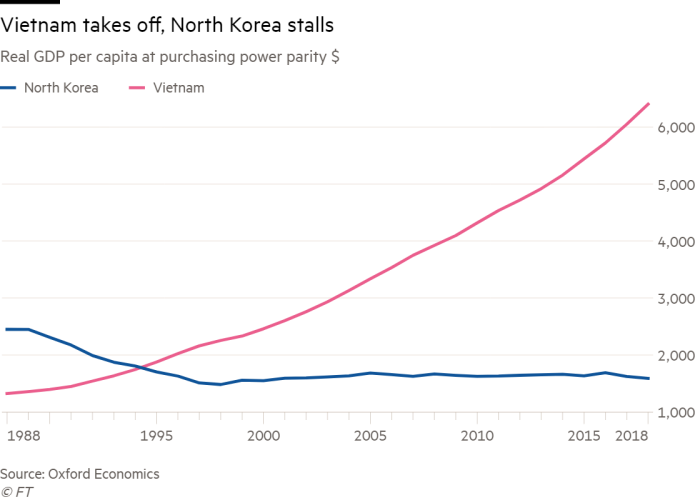
The recent visit of the DPRK’s Foreign Minister Ri Yong Ho to Hanoi and the announcement that Vietnam will host a second summit between US President Trump and DPRK leader Kim Jong Un on February 27-28 have rekindled interest in how Vietnam’s success story might have relevance for North Korea today. In the late 1980s, both countries faced poor-performing state-led economies, over-dependence on China, and the economic shock of sharp reductions in Soviet aid and trade. While economic crises gripped both countries, their strategic choices in response could not have been more different. Vietnam chose to embark on economic reforms, end its occupation of Cambodia, downsize its military, improve relations with the US, and open itself to the international community for aid, investment and trade. North Korea responded by adopting isolationist, self-reliant economic policies, seeking improved inter-Korean relations, increasing military tensions by pursuing a nuclear weapons program and a confrontational policy toward the US, and appealing for humanitarian assistance from the international community in the face of economic collapse and a growing famine.
The trajectories of the two countries since the early 1990s illustrate the dramatic consequences of these strategies. For decades, the North Korean regime has grappled with the challenges of economic development, poverty reduction, social stability and maintenance of a communist political system, which should make the Vietnamese experience of significant interest as Kim Jong Un embarks on implementing the so-called new strategic line, prioritizing economic development...

RUSSIA

Russian Navy has new weapon that makes targets hallucinate, vomit: report

... Russian state news agency RIA Novosti reported that a Russian military contractor has installed the weapon on two Russian warships. The weapon fires a beam similar to a strobe light that affects the target's eyesight, making it more difficult for them to aim at night. During testing, volunteers reportedly used rifles and guns to shoot targets that were protected by the weapon. The volunteers reported having trouble aiming because they couldn't see. Additionally, about half of the volunteers said they felt dizzy, nauseous and disoriented. About 20 percent of the volunteers reported experiencing hallucinations.


SYRIA

NOTHING SIGNIFICANT TO REPORT

MIDDLE EAST GENERAL

How U.S. Mission Creep in Syria and Iraq Could Trigger War With Iran

One previously unreported incident from 2017 illustrates the risks of Trump’s latest plan.

Lara SeligmanFebruary 4, 2019, 12:55 PM

An incident in Syria two years ago involving the transport of an Iranian port-a-potty nearly led to a confrontation between American and Iranian forces, underscoring just how quickly even minor events could escalate there.

The episode, told here for the first time, is particularly instructive as the Trump administration signals it might leave behind a small force in both Syria and Iraq to monitor Iranian activities...

CYBER ISSUES

An Arrest at Apple Shows How Corporate Spies Worm Their Way Into the System

By Scott Stewart
VP of Tactical Analysis, Stratfor
Highlights

- Two cases in which engineers working on Apple's autonomous vehicle program allegedly stole trade secrets show that corporate espionage will continue to be a major threat to companies.

- Nevertheless, the prosecution of an insider may not necessarily discourage future employees from following the same path.

- The differences in the tactics in the two cases demonstrate that corporate spies will learn from the mistakes of predecessors, and adapt to changes in security policy.

Chen Jizhong was all ready to head for China on Jan. 22 when FBI special agents swooped in on the Apple engineer. Chen's alleged crime, according to a complaint filed in the U.S. District Court for the Northern District of California, was to have stolen trade secrets relating to the company's autonomous vehicle program. In doing so, Chen appeared to be following in the footsteps of Zhang Xiaolang, a Chinese compatriot and Apple colleague whom authorities also nabbed as he prepared to flee to China in July 2018. In both cases, the men were planning to start employment with Apple's Chinese competitors in the driverless car market...

INTEL GENERAL

US intelligence warns China is using student spies to steal secrets

...at the direction of a high-level Chinese intelligence official, Ji allegedly attached background reports on eight US-based individuals who Beijing could target for potential recruitment as spies, according to a federal criminal complaint. The eight -- naturalized US citizens originally from Taiwan or China -- had worked in science and technology. Seven had worked for or recently retired from US defense contractors. The complaint says all of them were perceived as rich targets for a new form of espionage that China has been aggressively pursuing to win a silent war against the US for information and global influence.... The sheer size of the Chinese student population at US universities presents a major challenge for law enforcement and intelligence agencies tasked with striking the necessary balance between protecting America's open academic environment and mitigating the risk to national security....While US officials stress that they believe the vast majority of Chinese students are here for legitimate purposes, they have also made it clear that the Trump administration continues to grapple with counterintelligence concerns posed by foreign agents seeking to exploit vulnerabilities within academic institutions. Rather than having trained spies attempt to infiltrate US universities and businesses, Chinese intelligence services have strategically utilized members of its student population to act as "access agents" or "covert influencers," according to Joe Augustyn, a former CIA officer with firsthand knowledge of the issue from his time at the agency.... "We know without a doubt that anytime a graduate student from China comes to the US, they are briefed when they go, and briefed when they come back," according to Augustyn.... According to the complaint, FBI agents discovered about 36 text messages on one iCloud account that Ji and the intelligence officer allegedly exchanged between December 2013 and July 2015. In 2016, after he graduated, Ji enlisted in the US Army Reserve under a program in which foreign nationals can be recruited if their skills are considered "vital to the national interest."... "They're exploiting the very open research and development environment that we have," Wray told a Senate Intelligence Committee hearing last year, expressing concern that academic officials aren't taking the threat from China seriously enough.

Hackers Turn the Tables on Russia

A new website features documents pilfered from Kremlin officials and agencies.

Russian government officials are getting a taste of their own medicine. A new site that collects hacked and leaked material from around the web late last week published a major collection of documents and emails belonging to Russian government officials and oligarchs.

On Friday, a site calling itself Distributed Denial of Secrets published a 108-gigabyte archive dubbed the “Dark Side of the Kremlin,” which includes emails and documents from the Russian Interior Ministry, the Russian weapons exporter Rosoboronexport, and Kremlin officials, oligarchs, and separatist forces in eastern Ukraine. The trove is the result of numerous hacks conducted by various groups in Russia and Ukraine in recent years.

The Russian documents and emails “show how the Russian power system is interconnected, and documents influence operations in real time—from those separatists/terrorists backed by Russia to those in the Orthodox and business worlds,” said Emma Best, the co-founder of Distributed Denial of Secrets and a journalist and transparency activist, in message to Foreign Policy.

Russian attempts to influence the 2016 presidential election by hacking into the email and computer systems of Democratic Party operatives captured the world’s attention. But such hacking operations are rampant within Russia itself, and government ministries, Kremlin officials, and even the prime minister have all had the contents of their inboxes strewn across the internet.

The material from these hacks is scattered around the web, but Distributed Denial of Secrets has for the first time gathered up these Russian leaks, along with dozens of others from around the world, and collated them on a single, easy-to-access site.

Writing on Twitter, Aric Toler, the lead Eurasia researcher with the open-source investigative group Bellingcat, said that finding the leaks had previously been like collecting rare baseball cards. Now, they exist in a well-organized repository.

The transparency advocates behind Distributed Denial of Secrets aim to build on the early promise of WikiLeaks—before its credibility was damaged was by the political and personal machinations of its founder, Julian Assange—to expose corruption and promote government transparency.

Their repository includes material provided by groups with conflicting agendas, including Shaltai Boltai, a shadowy collective thought to have been behind the hack of Prime Minister Dmitry Medvedev’s email and his Twitter account in 2014. Though the collective has targeted some of Russia’s top politicians, it is also believed to have worked with the FSB, the successor organization to the KGB.

When the hack on Medvedev’s email eventually revealed some of the vast wealth he’d accumulated, including a palace in St. Petersburg and a vineyard in Tuscany, Russians responded with mass protests. Some of the protestors took to the street with sneakers tied around their necks, a reference to the expensive sneakers he was shown have purchased—Nike Air Max 95s.

“The Russian ones [hacks] that have had the most consequences are more internal palace politics—the FSB hacking someone to embarrass them,” Toler told FP.

Best’s site includes some documents WikiLeaks refused to publish, such as leaks from the Russian interior ministry. Its archive features some hacking greatest hits from recent years and some overlooked gems...

Can commercial satellites be used for espionage?

Companies like Planet Labs are producing millions of detailed images of Earth. What happens if those photos fall into the wrong hands?

For decades, the U.S. has relied on spy satellites to look deep into the territory of American adversaries, and for years, these were the cameras dominating Earth's orbit.

Not anymore.

As David Martin reports on 60 Minutes this week, there are now commercial companies putting small satellites in space and allowing customers to purchase panoramic images of Earth. As a result, the U.S. government no longer holds a monopoly on the photos taken from orbit—and has no power to classify commercial images as top secret.

One of those companies, Planet Labs, has put about 300 satellites into orbit, enough to image the entire landmass of Earth every day. The company has done it, in part, by reducing the dimension of its satellites. Government satellites are the size of a pickup truck; Planet Labs' are the size of a loaf of bread.

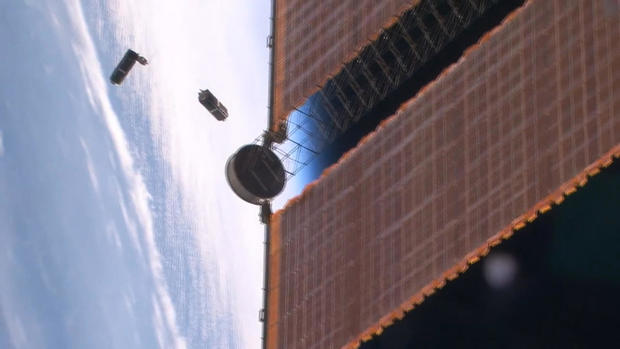

The U.S. government sets limits on commercial satellite use and mandates that American companies obtain a license. It also restricts the optical resolution of satellites; commercial cameras are not allowed to zoom down to the same detail as a spy satellite.

Still, the resolution comes relatively close. Martin told 60 Minutes Overtime that U.S. military officers could use commercial satellites for 90 percent of the intelligence they need.

These new satellites make close monitoring—if not outright espionage—an option, particularly for governments that do not have their own advanced satellite technology. The first spy photos that American satellites took of the former Soviet Union were not as high quality as the photos that Planet Labs is now taking.

The National Geospatial Intelligence Agency even uses Planet Labs images to get a more complete look at the world, particularly in places where U.S. spy satellites are not focused.

The humanitarian uses for commercial satellite images are numerous. Planet Labs' photographs monitor change, creating before-and-after pictures of environmental transformations, such as deforestation, receding glaciers, and melting ice caps.

But there is also plenty of potential for people to use commercial images in nefarious ways.

For example, people with access to satellite images could keep a daily record of the number of U.S. Navy ships in port. "If the United States were trying to move an army, as they did in the first Persian Gulf War," Martin said, "move an army without the enemy seeing it, the satellite would see it."

Anyone who obtained the images would also see an army on the move. Dictators wanting to cleanse an ethnicity would similarly be able to track movements of refugees, Martin said.

How, then, do commercial companies prevent their images from falling into the wrong hands? Will Marshall, a Planet Labs co-founder, told Martin his company hired an ethics officer to monitor this specific question.

"We have a process to review every single new client on a case-by-case basis," Marshall said. "Is it in line with our values?"

U.S. sanctions prohibit companies like Planet Labs from selling to countries like North Korea or Russia. But, Martin said, that's what front companies are for.

"You can, I think, rely on Planet to operate in good faith," Martin said. "Whether or not they can be fooled is another question."

To watch David Martin's 60 Minutes report on small satellites, click here.

TERRORISM

‘Improvised explosion’ hits New Mexico strip mall, kills 1

An “improvised explosion” detonated in an alley behind a strip mall in Albuquerque, New Mexico, on Monday and killed a man authorities believe was responsible for the device... the blast didn’t appear to be linked to any terrorist act but the FBI is investigating. The name of the man killed has not been released and police don’t know if he was connected to the shopping center and have yet to determine a motive.

Fractured Far Right Escalates Harassment Against Left in Portland

...The Proud Boys, a street gang that saw its peak riding the coattails of the “alt-right,” has been at the center of a two-year campaign of attacks in liberal cities around the country. Building a narrative about “protecting the community” from anti-fascists, members have patrolled urban centers and are accused of initiating gang-style assaults that have left dozens hospitalized. In Portland, this has been especially persistent since the Proud Boys linked up with Patriot Prayer, known for its Trumpian rabble-rousing and public instigations of violence.

10 Security Resolutions for 2019
By Scott Stewart
VP of Tactical Analysis, Stratfor

Come the end of December, people the world over sit down to make resolutions for the year ahead. And with the On Security column for Jan. 1, what better way to ring in the new year than with 10 security resolutions to help people keep themselves, their families and their homes safe from a wide array of threats.

1. I resolve to practice the appropriate level of situational awareness for my environment.

Situational awareness is more a state of mind than a hard skill. Because of this, anyone can practice it. But to do so effectively, one must understand the different levels of situational awareness and which level is appropriate for which circumstance. For more about situational awareness, read Building Blocks of Personal Security: Situational Awareness...

MISC

Visualizing the World's Busiest Ports

A graphic by Visual Capitalist showing the world's busiest ports and top 50 container ports.

By Nick Routley for Visual Capitalist

An estimated 90 percent of world trade is facilitated by maritime shipping, and as trade volumes continue to increase, the world's busiest ports continue to grow larger and more efficient to meet demand.

In fact, in just the last four years, the median annual volume of the top 50 ports jumped from 5.49 to 5.86 million twenty-foot equivalent units (TEUs).
Here are the world's 20 largest ports, using the most recent data from the World Shipping Council:..

Flightworthy SpaceX Raptor Roars To Life

Feb 4, 2019 Irene Klotz | Aerospace Daily & Defense Report

LOS ANGELES—SpaceX fired up an operational, methane-burning Raptor rocket engine for the first time on Feb. 3, marking a key step toward the start of flight tests of a multipurpose, interplanetary-class space transportation system.

Though called Starship and designed for human missions to Mars and beyond, the superheavy-lift, reusable transport will first cut its operational teeth delivering payloads into Earth orbit, a service currently provided by SpaceX’s Falcon family of rockets, and sending billionaire Japanese entrepreneur Yusaku Maezawa and 6-8 artists (not yet named) on a six-day flight around the Moon, among other missions.

SpaceX intends to start low-altitude flight tests of a prototype Starship upper stage this year at its newest field center in Boca Chica, Texas, near Brownsville. In preparation, engineers on Sunday night fired up the first operational Raptor engine for a three-second test.

“First firing of Starship Raptor flight engine. So proud of great work by SpaceX team,” CEO and CTO Elon Musk, who was on site for the test, posted on Twitter.

Raptors, which burn gaseous methane and liquid oxygen, first will be used in low-altitude hopper tests of Starship’s upper stage. The prototype ship is being repaired after 50 mph winter storm winds broke its mooring blocks on Jan. 22, toppling the nosecone.

Three Raptors will be used to propel the Starship prototype up to three miles in altitude.
SpaceX intends to group 31 Raptor engines, each providing 200 metric tons of force, to power the first stage of Starship, an interplanetary space transportation system previously known as Big Falcon Rocket, or BFR. Vacuum-optimized Raptors will be used for the upper stage. Both stages are designed for operational reusability.



Friday, February 8, 2019

Officer Down


Corporal Travis Wells
Dallas Police Department, North Carolina
End of Watch Thursday, November 1, 2018
Age 46
Tour 22 years

Corporal Travis Wells was killed in a vehicle crash in the 300 block of the Dallas-Bessemer City Highway at 10:00 am.

His patrol car left the roadway and struck a tree, causing him to suffer fatal injuries.

Corporal Wells had served with the Dallas Police Department for 22 years. He is survived by his wife.
Rest in Peace Bro…We Got The Watch

Nemo me impune lacessit

Day is done, Gone the sun, From the lake, From the hills, From the sky. All is well, Safely rest, God is nigh. 

Wednesday, February 6, 2019

Officer Down


Deputy Sheriff Loren Y. Vasquez
Waller County Sheriff's Office, Texas
End of Watch Wednesday, October 31, 2018
Age 23
Tour 5 months

Deputy Sheriff Loren Vasquez drowned after her patrol car was caught into floodwaters near the intersection of FM 362 and Hoover Lane.

She was responding to investigate reports of high water when her patrol car was swept into a water-filled ditch and overturned. After considerable effort, other deputies were able to remove her from the vehicle. She was transported Memorial Hermann Hospital Cypress where she was pronounced dead.

Deputy Vasquez had served with the Waller County Sheriff's Office for only five months and was on her third shift after completing field training.
Rest in Peace Sis…We Got The Watch

Nemo me impune lacessit

Day is done, Gone the sun, From the lake, From the hills, From the sky. All is well, Safely rest, God is nigh.

Monday, February 4, 2019

Officer Down


Special Agent Dennis P. McCarthy
United States Department of Homeland Security - Immigration and Customs Enforcement - Homeland Security Investigations, U.S. Government
End of Watch Saturday, October 27, 2018
Age 65
Tour 31 years
Cause 9/11 related illness
Incident Date Tuesday, September 11, 2001

Special Agent Dennis McCarthy died as the result of cancer contracted due to his exposure to toxic substances following the 9/11 Terrorist Attacks at the World Trade Center in New York City, New York.

Agent McCarthy responded to help secure the site of the destroyed U.S. Custom House at the World Trade Center site in the immediate aftermath of the attacks. He remained at the scene to assist with search and recovery efforts.

Special Agent McCarthy had served with Homeland Security Investigations and the former United States Customs Service for over 31 years. Special Agent McCarthy's brother was also a DEA agent who was killed in combat during the Gulf War while activated with the U.S. Marine Corps Reserve.

On the morning of September 11th, 2001, seventy-two officers from a total of eight local, state, and federal agencies were killed when terrorist hijackers working for the al Qaeda terrorist network, headed by Osama bin Laden, crashed four hijacked planes into the World Trade Center towers in New York City, the Pentagon in Arlington, Virginia, and a field near Shanksville, Pennsylvania.

After the impact of the first plane into the World Trade Center's North Tower, putting the safety of others before their own, law enforcement officers along with fire and EMS personnel, rushed to the burning Twin Towers of the World Trade Center to aid the victims and lead them to safety. Due to their quick actions, it is estimated that over 25,000 people were saved.

As the evacuation continued, the South Tower unexpectedly collapsed as a result of the intense fire caused by the impact. The North Tower collapsed a short time later. Seventy-one law enforcement officers, 343 members of the New York City Fire Department and over 2,800 civilians were killed at the World Trade Center site.

A third hijacked plane crashed into a field in rural Pennsylvania when the passengers attempted to re-take control of the plane. One law enforcement officer, who was a passenger on the plane, was killed in that crash.

The fourth hijacked plane was crashed into the Pentagon in Arlington, Virginia, killing almost 200 military and civilian personnel. No law enforcement officers were killed at the Pentagon on 9/11.

The terrorist attacks resulted in the declaration of war against the Taliban regime, the illegal rulers of Afghanistan, and the al Qaeda terrorist network which also was based in Afghanistan.

On September 9th, 2005, all of the public safety officers killed on September 11th, 2001, were posthumously awarded the 9/11 Heroes Medal of Valor by President George W. Bush.

The contamination in the air at the World Trade Center site caused many rescue personnel to become extremely ill and eventually led to the death of several rescue workers.

On May 1st, 2011 members of the United States military conducted a raid on a compound in Abbottabad, Pakistan, and killed Osama bin Laden.
Rest in Peace Bro…We Got The Watch

Nemo me impune lacessit

Day is done, Gone the sun, From the lake, From the hills, From the sky. All is well, Safely rest, God is nigh.

What's going on in the World Today 190204

HYPERLINKS MAY REQUIRE AN EMAIL:

USA


The INF Treaty Is Dead. Is New START Next?

Experts worry about a new arms race after U.S. withdrawal from nuclear pact.

The U.S. decision to withdraw from a nuclear arms treaty with Russia that was a cornerstone of European security in the post-Cold War era could erode other arms control agreements even as it enhances Washington’s ability to respond to growing threats from both Russia and China, according to analysts.

U.S. Secretary of State Mike Pompeo on Friday announced the withdrawal from the Intermediate-Range Nuclear Forces Treaty, in what was a long-expected decision by President Donald Trump’s administration.

“For years, Russia has violated the terms of the Intermediate-Range Nuclear Forces Treaty without remorse,” Pompeo told reporters at the State Department. “It does no good to sign an agreement if a party’s not going to comply with it.”

While experts and Western officials broadly agree Russia is violating the treaty, they are split on whether the Trump administration’s decision to scrap it is a good idea. NATO supported the U.S. decision, saying in a statement released shortly after Pompeo’s remarks that Russia “continues to deny its INF Treaty violation, refuses to provide any credible response, and has taken no demonstrable steps toward returning to full and verifiable compliance...”

...Bell and other proponents of arms control fear that the Trump administration will feel emboldened to scrap other treaties, particularly the New START agreement. Signed in 2011, the strategic arms treaty limits the number of U.S. and Russian nuclear warheads and delivery systems, and it is due to expire in early 2021 unless Washington and Moscow agree to extend it. Most analysts are in agreement that Russia is adhering to the New START treaty...

...Some experts also say the withdrawal could help the United States stave off China’s growing conventional military power in Asia. Since China has never been a signatory of the INF Treaty, it has been able to build up a vast arsenal of nonnuclear weapons, such as the DF-21 “carrier killer,” that now threaten freedom of navigation in the Pacific.

With the United States released from the treaty’s constraints, it could begin to match China’s growing intermediate-range conventional force arsenal. Experts said a U.S. buildup would likely include mobile, ground-launched ballistic missiles operated by the U.S. Army and stationed on islands in the Pacific Ocean.

“China [and] Iran, for that matter, are not bound by the treaty,” said the senior administration official on the phone call with reporters. “We cannot be the only country bound by a treaty.”

Indeed, last year the then-commander of U.S. Pacific Command warned that the United States’ adherence to the INF Treaty has already eroded its lead in the region...

Trump’s Muscular New Plan to Fend Off Russian and Chinese Missiles

The U.S. president rolled out the most ambitious missile defense strategy since the end of the Cold War.

The United States is seeking potentially the most serious expansion of its missile defense capabilities since the Cold War, with President Donald Trump putting his weight behind an ambitious new plan that explicitly states America’s intent to defeat missiles fired from Russia or China.

In his fifth visit to the Pentagon since he took office two years ago, Trump rolled out the results of the administration’s long-delayed Missile Defense Review, which was initially anticipated by the end of 2017. Putting his presidential clout behind the new strategy, Trump tied a stronger missile defense posture to his long-promised wall along the southern border, saying that, as president, his first duty is “the defense of the country.”

“All over, foreign adversaries—competitors and rogue regimes—are steadily enhancing their missile arsenals,” Trump said in an address at the Pentagon auditorium. “I will accept nothing less for our nation than the best, most cutting-edge missile defense systems.”

The review reflects a more aggressive U.S. position on missile threats. Where previous missile defense reviews focused primarily on rogue states such as North Korea or Iran, the 2019 strategy explicitly addresses threats from Russia and China. The report notes that if deterrence and diplomacy fail and a conflict begins, the United States will target an adversary’s missiles even before they are launched.

“Missile defense necessarily includes missile offense,” said Acting Secretary of Defense Patrick Shanahan during the rollout event.

As part of the new strategy, the Department of Defense will focus on tighter integration of offensive attack capabilities—both U.S. and allied forces—with existing missile defenses, with the goal of detecting and shooting down an incoming missile much earlier in its flight, according to the report. The document also stresses that regional missile defense systems, such as the THAAD battery in South Korea or the Aegis Weapon System mounted on cruisers and destroyers all over the world, are mobile and can be rushed to conflict zones.

Another key piece is adapting existing systems to strike enemy threats prior to or during a missile launch. The U.S. military is currently testing the possibility that the F-35 fighter jet, which has a state-of-the-art sensor system that can track boosting missiles, could be equipped with an interceptor capable of shooting down an adversary’s ballistic missile in its boost phase—as it is launching.

The review also for the first time addresses the threat of cruise missiles—which are maneuverable and thus much harder to detect, track, and defeat than missiles with a ballistic trajectory—and hypersonic glide vehicles, which are lofted into the atmosphere and glide down more than five times faster than the speed of sound. The decision to include cruise and hypersonic missiles in addition to traditional ballistic threats is directly in response to Russia’s and China’s recent development of these types of weapons. Russian President Vladimir Putin has in recent months touted a nuclear-powered cruise missile, an underwater nuclear drone, and an “invulnerable” hypersonic weapon...

US Air Force’s plan to launch light-attack aircraft competition is now deferred indefinitely

WASHINGTON — The start of a competition to provide light-attack aircraft for the U.S. Air Force has been postponed for the foreseeable future, as the service decides the way forward for additional experiments, the Air Force’s No. 2 civilian said Friday.

The Air Force started evaluating light-attack plane offerings in 2017 and was set to release a request for proposals in December 2018 to potentially lead to a program of record. But the service is not ready to commit to a program just yet, and wants to continue the experimentation phase, Under Secretary of the Air Force Matt Donovan told reporters after an Air Force Association event.

"We're going to broaden the scope a little bit,” he said, potentially alluding for the possibility of new aircraft types to enter the competition.

Asked if this meant the two aircraft positioned by the Air Force as potential contenders for a contract — the Sierra Nevada Corp.-Embraer A-29 Super Tucano, and the Textron AT-6 Wolverine — were no longer in the running, Donovan responded: “We’re not excluding anything.”

The Air Force’s decision is a somewhat surprising one. The light-attack experiment began with four aircraft involved in flight tests at Holloman Air Force Base in New Mexico: the A-29 and AT-6, but also Textron’s Scorpion jet and L3’s AT-802L Longsword.

The AT-6 and A-29 moved onto the second phase of experiments in 2018, which were mostly centered around the planes’ maintainability and network capability...


After years fighting terrorism, the SEALs turn their eyes toward fighting big wars

ARLINGTON, Va. — After spending the better part of the past two decades supporting wars in a desert region, the U.S. Navy is starting to bring the SEALs back into the fold as it faces threats from major powers such as China and Russia.

The Navy is incorporating its elite special warfare teams into strategic calculations for every potential major power combat scenario, from China and Russia to Iran and North Korea, said Vice Chief of Naval Operations Adm. Bill Moran in a round-table with reporters at the Surface Navy Association’s annual symposium.

The movement toward reconnecting with the blue water force (the Navy’s regular ships, aircraft and submarine forces) started under former Naval Special Warfare Command head Rear Adm. Brian Losey, who retired in 2016. The effort has continued to grow under subsequent commanders, said Moran.

“It’s to the point now where we include them in all of our exercises, our war games, our tabletops — because as much as it is their chance to ‘re-blue,’ it’s our chance to reconnect from the blue side," he added. “We’ve grown used to not having them in a lot of those situations. Now as we’ve done the tabletops, the exercises and the war games, we see: ‘Wow, there is some great capability here that can set the conditions for the kind of operations in every single one of those campaigns.’ And that will continue to grow, I think.”...


AFRICA

NOTHING SIGNIFICANT TO REPORT

ASIA

In Trump’s World, Nukes Are Self-Defense

As the Japan-U.S. alliance weakens, could Tokyo drop its nuclear weapons ban?

Facing the reality of a nuclear North Korea, worsening relations with ostensible ally South Korea, and an unpredictable partner in Washington, Japan’s government is ramping up its military defenses, shedding many of its postwar taboos. Could the ban on nuclear weapons also be sent to the scrap heap at the same time as the country gets a real army? The idea seems far-fetched, but Japan is increasingly alone in a fast-changing Asian security environment.

Since the advent of the atomic age, Japan has sat comfortably under the U.S. nuclear umbrella, a key element in a defense alliance that is often touted by both U.S. and Japanese officials as the strongest in the world. The treaty, first signed in 1951, provides U.S. security guarantees for a country that had renounced the use of force in its post-World War II constitution, which was largely drafted by Japan’s U.S. occupiers. In exchange, Japan is home to extensive U.S. military bases that have helped to project power into the center of East Asia. The alliance seemed unbreakable. But that was before Donald Trump became U.S. president—a leader ostensibly willing to put everything on the table, with a view of Japan seemingly stuck in the 1980s.

From the cost of military bases to the chronic trade deficit, Trump’s statements have Japanese officials privately worried that the United States might take rash action that would have been unthinkable in previous administrations—such as a deal with North Korea that leaves Japan exposed.

Cementing the warming personal relations between North Korean leader Kim Jong Un and Trump were recent comments from Kim ahead of their planned February summit.

“Kim Jong Un said that we will believe in President Trump’s positive way of thinking, wait with patience and in good faith and, together with the U.S., advance step by step toward the goal to be reached by the two countries,” North Korea’s official KCNA news agency said last Thursday.

The problem for Japan is what that might mean for its security. U.S. Secretary of State Mike Pompeo told Fox News last week that “Chairman Kim continues to assure the president of the United States he is intent on denuclearization”—but promises of denuclearization on one side of the Sea of Japan are prompting backroom talk of going the opposite way on the other.

That would be a huge step. The only country to have seen firsthand the devastation of atomic weapons, Japan has long held a no-nukes policy based on three principles: nonpossession, nonproduction, and nonintroduction of nuclear weapons. It has been a leading force at the United Nations for nonproliferation and the eventual elimination of nuclear weapons...

...Yet from a technical standpoint, experts agree that acquiring nuclear weapons would be fairly easy for Japan, taking anywhere from six months to a few years. It has stockpiles from its nuclear power plants of 47 tons of plutonium, enough for around 6,000 nuclear warheads, and the rockets developed for its civilian space program could be rebadged for military purposes. Experts say, however, that developing a full-fledged operational deterrent would be much more complex and much more expensive.

Japan defense scholars also stress that a decision to go nuclear would face a number of political and geopolitical issues, chief among them domestic public opinion. “While there has been a modest increase in support for an enhanced conventional defense force, there is no sign of public support for acquiring nuclear weapons and is in fact at its lowest level ever,” said Corey Wallace, an Asia-Pacific security expert and fellow in the Graduate School of East Asian Studies at the Freie Universität Berlin. He also notes that China would be firmly opposed, with fairly serious repercussions on relations that have been improving in recent years...

CENTRAL/ZOUTH AMERICA

NOTHING SIGNIFICANT TO REPORT

EUROPE

EU Offers Up a Meager Workaround to U.S. Iran Sanctions

The new vehicle will do little to ease Iran’s economic pain, though it should help humanitarian trade.

After months of trying, the European Union on Thursday finally announced a scheme to partially sidestep the Trump administration’s renewed sanctions on Iran, a bid by Europe to quiet the death rattles of the Iran nuclear deal. But the initiative, of modest economic value if big political symbolism, is unlikely to do much to placate Tehran’s pleas for economic dividends from staying in the deal.

Led by Germany, France, and the U.K.—the three European countries most involved in drafting the 2015 nuclear deal—Europe formally launched INSTEX, a special financial vehicle designed to enable Iran to keep trading with European firms despite Washington’s ban on doing business with the country. The new organization—to be headquartered in France, run by a German, and supervised by the British—will start out enabling trade only in humanitarian items, including food, medicine, and medical devices, diplomats said.

The eventual hope is that the new organization gets buy-in from more EU member states and that it can eventually expand its trade to other items, such as energy and industrial goods. But that depends on the willingness of European firms, especially big ones, to risk U.S. sanctions by doing business with Tehran.

The modest scope of INSTEX, as it finally emerged, stands in sharp contrast to Europe’s original vision for the body. The so-called Instrument in Support of Trade Exchanges was meant to prop up the nuclear deal after the U.S. withdrawal last year by allowing Iran to barter oil for European industrial goods without having to use U.S. dollars or go through the U.S. financial system. But those ambitious visions of bucking U.S. financial dominance were undermined by big business itself, wary of falling afoul of the U.S. Treasury. Big European firms that for years champed at the bit to gain (or regain) access to the Iranian market have shown little interest in thwarting the Trump administration, for example, and many have bailed out altogether.

“There’s little sign that major European companies, especially those with significant U.S. exposure, could be convinced to invest in Iran” through the new entity, said Jake Reynolds, a Middle East expert at Wallbrook, a London-based global risk consultancy. “For many companies, the possibility of being blocked from their U.S. customers outweighs any opportunities in the Iranian market.”

And the new initiative comes at a time when Europe’s attitude toward Iran is hardening, after a recent long-range missile test that rattled policymakers and a series of assassinations on European soil that soured relations between many European countries and Tehran. The painful road to INSTEX reflects Europe’s desire to push back against Tehran’s more disruptive behavior while still standing up to U.S. President Donald Trump’s unilateral withdrawal from the deal, with which Iran has fully complied.

“Despite recent Europe-Iran tensions, European leaders remain committed to upholding the deal as a pillar of their Middle East policy,” Reynolds said.

U.S. officials appeared to shrug off the new European device. A White House spokesperson said that “the United States questions the efficacy of the [special purpose vehicle] and remains committed to fully enforcing its sanctions on the Iranian regime.” A U.S. Embassy spokesperson in Germany warned that companies engaging in “sanctionable activity involving Iran risk severe consequences” but said the new organization would not in any way affect the U.S. campaign to apply maximum financial pressure on Iran.

That might be because the new entity will offer modest, if welcome, benefits for the Iranian economy and people by initially facilitating only trade in food and medicine. Those items are meant to be allowed into Iran even under U.S. sanctions, but many banks are so leery of violating Treasury rules on doing business with Iran that even permitted transactions had suffered.

“It’s not a ‘circumvention’ of U.S. sanctions or anything like that, since all this trade is permitted,” said Brian O’Toole, a former U.S. sanctions official at the Treasury Department who is now at the Atlantic Council...

AFGHANISTAN

It’s Time to Trust the Taliban

Afghanistan’s jihadi insurgents are ready to give America what it wants: defeat without humiliation.

In the peace process now underway with the Afghan Taliban, one-and-a-half significant U.S. interests are at stake. The “half” is the only real hang-up to signing a deal and bringing home American troops right now.

For Afghans, of course, the stakes in the present war are different and infinitely higher than for Americans, for whom the only vital interest is also the easiest to achieve: a Taliban agreement not to host international terrorists themselves and to do their utmost to prevent Afghanistan from once again being used as a base for terrorism against the West in general and the United States in particular.

One can be confident that the Taliban would not only agree to this but also follow through on the agreement. It’s not just because Taliban supporters and interlocutors, in public statements and private conversations (including my own), have almost universally, if grimly, acknowledged that hosting al Qaeda in the run-up to 9/11 was a dreadful mistake that cost them their rule over Afghanistan. It’s also because the Taliban are now engaged in a bitter fight with the forces of the Islamic State (who most certainly are anti-Western international terrorists) for control of parts of Afghanistan. The Taliban’s role as an enemy of the Islamic State (as well as prudent preparation for the possible collapse of the U.S.-backed order in Kabul) has led Russia and China to launch talks with the Taliban.

Finally, while the Pakistani military has backed the Afghan Taliban as a client movement against Indian influence in Afghanistan, it has absolutely no interest in encouraging a repeat of 9/11 and the disasters that followed for Pakistan. And if Pakistanis did have any such intention, their Chinese backers (with their own worries about Islamist extremism in Xinjiang) would deter them very strongly.

The second real U.S. interest in the process is what is called in Washington “credibility” but which is better known by its older and more honest name, “prestige”—in this case, the avoidance of obvious and humiliating defeat, which would undermine respect for U.S. strength and embolden U.S. enemies elsewhere. As a U.S. general told me a decade ago, he and his colleagues could not say what victory would look like in Afghanistan, but they could all say what defeat would look like. It would look like Saigon in 1975. In the case of Afghanistan, this would most probably however take the form not of outright Taliban victory but of the collapse of the Afghan state, followed by Taliban victory over large areas and deepened and permanent civil war with other ethnic forces.

Apart from prestige, there is also a concrete U.S. interest in preventing such an outcome. Such a full-scale civil war would lead to a greatly increased flow of Afghan refugees to Europe. Given what happened because of the Syrian refugee crisis, this could deal a death blow to liberal democracy in Europe, and the resulting European nationalist backlash would crush the entire image of U.S.-led democracy in the world. To prevent it, however, would require agreement with and major concessions to Turkey and Iran, undermining America’s geopolitical position in the Middle East...

Afghan Government Control Over Country Falters, U.S. Report Says

KABUL, Afghanistan — The Afghan government’s control of its country declined late last year, in terms of both territory and population, according to a United States government report released Thursday.

The report, by the agency of the Special Inspector General for Afghan Reconstruction, or Sigar, said that as of Oct. 31, the Afghan government controlled territory on which 63.5 percent of its population lived, a decrease of 1.7 percent from the previous quarter, while gains by the Taliban insurgency gave it control over territory that is home to 10.8 percent of the population.

The agency’s statistics are based on data provided by the American military under a mandate to report to Congress quarterly.

In addition, the Afghan government lost control of seven more districts during the last quarter, meaning that only 53.8 percent of districts were “controlled or influenced” by the government, while 12.3 percent of the districts were under insurgent control or influence and 33.9 percent of districts were contested. Afghanistan’s 407 districts are the basic unit of local governance.

John Sopko, the special inspector general for Afghan reconstruction, whose agency issued the report, said in an interview, “It’s like moving the goal posts, something we’ve seen a lot of over the last few years.”

In response to the report, the American military said that such metrics, which have been compiled quarterly for many years, were no longer important and might be based on faulty analysis.

“Measures of population control are not indicative of effectiveness of the South Asia strategy or of progress toward security and stability in Afghanistan, particularly in the wake of the appointment of U.S. Special Representative for Afghanistan Reconciliation (SRAR) Zalmay Khalilzad,” the Pentagon said in a statement.

The military also said there was “uncertainty” and “subjectivity” in the data used to analyze population control.

Mr. Sopko said that was the first time the military had criticized its own data on population control, which he said appeared to be a response to the increasingly pessimistic picture of government control...

CHINA

Pentagon Confirms China Will Have A New Tactical Bomber

Jan 21, 2019 Bradley Perrett and Steve Trimble | Aviation Week & Space Technology

In World War II, a fighter-bomber was a fighter that could bomb. They can all bomb now, so the term has fallen out of use—except in China, where it is used for strike aircraft with high flight performance but no serious air-to-air capability.

That is a good clue to the nature of a forthcoming Chinese tactical bomber. Emergence of this type, a smaller companion to the Xian H-20 strategic bomber, has long been rumored but is only now discussed by the Pentagon—which variously calls it a medium-range bomber, a tactical bomber and, tellingly, a fighter-bomber. The terminology, a few scant details and the likely choice of engines suggest that the aircraft will be conceptually similar to the retired U.S. F-111, but maybe a lot bigger and perhaps presenting a serious threat to air targets.

This new Chinese aircraft and the H-20 will “probably” not be initially operational before 2025, says the U.S. Defense Intelligence Agency (DIA) in its annual China Military Power report, released on Jan. 15. They will both be stealthy, it adds, though that feature almost goes without saying these days and is in any case imprecisely defined...

The aircraft will probably not be operational before 2025

It appears to have a secondary air-to-air mission..

China tests 'Guam killer' missile it says can strike moving warships

China's military has test-fired its DF-26 intermediate ballistic missile, which reportedly has the capacity to strike moving warships.

- China says the missiles are capable of striking moving aircraft carriers

- The DF-26's range could also allow it to strike the US territory of Guam
- Footage of the missile test did not show it hitting any targets

The missile is nicknamed the "Guam killer" because US military bases on the Pacific island are within its range.

Chinese state media reported that the tests were conducted in an undisclosed location in China's north-west.

Beijing announced that it had deployed the missiles to a desert area in that region earlier this month, one day after a US freedom of navigation exercise in a section of the South China Sea that Beijing claims is its territory.

Footage of the test broadcast on state television showed the missiles being launched into the air, as well as close-up images of its design, but did not feature the weapons striking any targets.

However experts cited by state media tabloid the Global Times said the tests proved the missiles were capable of hitting moving aircraft carriers.

They told the paper that the missile's "double-cone structure", as well as the "information network connected to the warhead" — which could include a variety of radar and satellite systems — would allow the moving target's location to be constantly updated.

China's Ministry of National Defence has previously said the DF-26 missiles were capable of carrying conventional nuclear warheads.

The missiles are believed to be able to strike targets up to 4,500 kilometres away, putting the Pacific island of Guam in range. The US territory hosts Air Force and Navy bases...

IRAN

EU agency says Iran likely to step up cyber espionage

BRUSSELS (Reuters) - Iran is likely to expand its cyber espionage activities as its relations with Western powers worsen, the European Union digital security agency said on Monday.

FILE PHOTO: A man holds a laptop computer as cyber code is projected on him in this illustration picture taken on May 13, 2017. REUTERS/Kacper Pempel/Illustration/File Photo
Iranian hackers are behind several cyber attacks and online disinformation campaigns in recent years as the country tries to strengthen its clout in the Middle East and beyond, a Reuters Special Report published in November found.

This month the European Union imposed its first sanctions on Iran since world powers agreed a 2015 nuclear deal with Teheran, in a reaction to Iran’s ballistic missile tests and assassination plots on European soil.

“Newly imposed sanctions on Iran are likely to push the country to intensify state-sponsored cyber threat activities in pursuit of its geopolitical and strategic objectives at a regional level,” the European Union Agency for Network and Information Security (ENISA) said in a report...

IRAQ

NOTHING SIGNIFICANT TO REPORT

ISRAEL

Israel Blocks Iran Cyber-attacks 'Daily': Netanyahu

Israel Flag with Cyber

Prime Minister Benjamin Netanyahu on Tuesday accused arch-foe Iran of regularly launching cyber-attacks on Israel that the Jewish state blocks each day.

"Iran attacks Israel on a daily basis," he told a cyber conference in Tel Aviv. "We monitor these attacks, we see these attacks and we foil these attacks all the time."

The head of Israel's Shin Bet internal security agency is reported to have warned that Israel was bracing for a state-driven cyber intervention in its April 9 general election.

"Any country can be attacked today with cyber-attacks and every country needs the combination of a national cyber defence effort and a robust cyber security industry," Netanyahu said.

"I think Israel has that... in ways that are in many ways unmatched," he said.

Earlier this month, Israel carried out an air strike on what it said were Iranian targets in Syria, after a missile attack from Syria it blamed on Iran.

Israel has carried out hundreds of air raids in Syria against what it says are Iranian military targets and advanced arms deliveries to Lebanon's Iran-backed Hezbollah.

Army simulates attack on gas rigs in most complex naval drill in decades

Army simulates attack on gas rigs in most complex naval drill in decades
Gunships fire missiles at cargo freighter acting as enemy vessel in massive exercise meant to prepare for attacks by Hamas, Hezbollah

The Israel Navy this week simulated an attack on the country’s natural gas platforms, including a live-fire test of sea-to-sea missiles to destroy an “enemy ship,” the military said Thursday.

Four Sa’ar-4.5 model corvettes participated in the week-long naval exercise, dubbed “Raging Sea,” which ended on Thursday.

The military said it was the most complex naval drill in decades.

Get The Times of Israel's Daily Edition by email and never miss our top stories Free Sign Up

The exercise included missiles fired from four ships simultaneously at an old cargo freighter acting as an enemy vessel.

“We simulated an enemy ship coming to harm our strategic facilities and, with coordination at sea and in the air, we destroyed it,” said Col. Guy Goldfarb, commander of the navy’s gunships.

Terror groups Hezbollah in Lebanon and Hamas in the Gaza Strip have both threatened to attack Israel’s natural gas platforms.

Israel has in recent years transformed into a major gas exporter after major reserves of the resource were discovered in its waters in the Mediterranean.

Earlier on Thursday, Prime Minister Benjamin Netanyahu visited an under construction rig site in the Leviathan gas field, some 125 kilometers (80 miles) west of the Israeli port city of Haifa.

“Completion of the Leviathan gas platform and the pumping of gas from this field later in the year is a critical component of the strategic, energy, economic and diplomatic strength of the State of Israel,” Netanyahu said.

The navy said the cargo ship sunk in the exercise — the Eyal, which was due to be scrapped — was meant to simulate an enemy ship transporting fighters to a natural gas platform in order to blow it up.

The Harpoon anti-ship cruise missiles used in the exercise were fired from four Sa’ar corvettes at the same time, from a distance of approximately 100 kilometers (62 miles)...

KOREAN PENINSULA

Reports of “Secret” North Korean Missile Bases: Much Ado about Not Much

Daniel R. DePetrisJanuary 28, 2019

President Trump and North Korean leader Kim Jong Un have now agreed to meet for their second summit late next month—perhaps in Vietnam. The announcement from the White House was a welcome shot in the arm to a diplomatic process that has been stuck in neutral since Trump and Kim’s first summit in Singapore last June. Shortly thereafter, US Special Representative Stephen Biegun met for the first time with his North Korean colleague, Vice Foreign Minister Choe Son Hui, presumably to nail down the agenda for the upcoming summit. Negotiations, or at least the prospects of a more stable diplomatic process, are being reinforced by preparatory work behind the scenes.

This is why the substance and timing of the latest report from the Center for Strategic and International Studies (CSIS), entitled Undeclared North Korea: The Sino-ri Missile Operating Base and Strategic Force Facilities, is regrettable. Like previous CSIS studies on this facility, the report creates a misleading narrative about North Korean motives, intentions and actions at a time when the brittle US-DPRK diplomatic process is struggling to gain altitude. Even more disturbing than the report’s central thesis of North Korean deceit and deception is the media narrative surrounding its release. With on-air reporters speculating about Pyongyang’s deception, the American people are being led to the premature—perhaps even unwarranted—conclusion that Kim Jong Un is up to his old tricks and that diplomacy with North Korea is at best a waste of time and at worst a trap he is laying to take the president to the cleaners...

RUSSIA

NOTHING SIGNIFICANT TO REPORT

SYRIA

NOTHING SIGNIFICANT TO REPORT

MIDDLE EAST GENERAL

The U.S. Has Wasted Billions of Dollars on Failed Arab Armies

Military cooperation with Middle East allies can work—if Washington rethinks its premises.

The United States has spent 70 years and tens of billions of dollars training Arab militaries—with almost nothing to show for all the effort.

Time and again, America’s Arab allies have failed to live up to martial expectations. The U.S.-trained Egyptian Armed Forces performed miserably in 1991 during Operation Desert Storm. If anything, they did somewhat better under Soviet tutelage in the 1973 October War. The U.S.-trained Iraqi Army collapsed when attacked by a couple thousand Islamic State zealots in 2014. The U.S.-trained Saudi military fell flat on its face when it intervened in Yemen in 2015, and it has become badly stuck there.

If the United States is going to stay involved in the Middle East, it has to rethink the way it engages with Arab militaries. Ambitious dreams of engaged, modernized militaries must be replaced with more realistic plans that build on the real strengths of allies, instead of forcing soldiers into a mold that their societies and culture have left them grossly unsuited for. Otherwise Washington will keep pouring money down the drain—and its Arab allies will keep failing.

This is not just embarrassing. For decades, U.S. military training was a critical element of alliances with allies in the Middle East, designed to demonstrate commitment to their security and give them the ability to help America protect their countries. In recent years, Americans have begun to eye an exit from the Middle East, but few want to walk away and have Iran, Hezbollah, the Islamic State, al Qaeda, or other U.S. enemies take over as the United States departs. In an ideal world, America would leave behind strong Arab allies, able to defend themselves from their common foes. But that seems as far away today as it did when the United States first started training Arab armed forces back in the 1950s...

CYBER ISSUES

US Navy moves toward unleashing killer robot ships on the world’s oceans

WASHINGTON — The world’s largest navy has spent the last few years feeling like it was being put in check.

China and Russia have heavily invested in anti-access technologies aimed at holding its main force-projection assets — aircraft carriers — at risk. Now the U.S. Navy and the upper ranks of the military are preparing to take back control of the game board, and it’s looking to unmanned technologies to help.

The U.S. surface fleet has for the past few years sought to flip the script on actors such as China. The fleet aimed to move from a role of simply defending the carrier to going on the offensive.

The goal was to spread out over a wide area to strain Chinese intelligence and reconnaissance assets and thereby exercise a degree of sea control in places such as the South and East China seas that China seeks to deny with long-range, anti-ship missiles and an ever-growing fleet.

Initially, the push was to add big surface combatants to hold down the Navy’s hefty commitments for peacetime presence while maintaining enough firepower to both defend themselves and project power in an anti-access environment.

The Navy plans to spend this year taking the first few steps into a markedly different future, which, if it comes to pass, will upend how the fleet has fought since the Cold War. And it all starts with something that might seem counterintuitive: It’s looking to get smaller.

“Today, I have a requirement for 104 large surface combatants in the force structure assessment; I have 52 small surface combatants,” said Surface Warfare Director Rear Adm. Ronald Boxall. “That’s a little upside down. Should I push out here and have more small platforms? I think the future fleet architecture study has intimated ‘yes,’ and our war gaming shows there is value in that.”

The paradigm shift is moving the fleet away from platforms like the Arleigh Burke-class destroyers — enormous, tightly packed ships bristling with capabilities, weapons and sensors, but enormously expensive to build, maintain and upgrade.

“It’s a shift in mindset that says, instead of putting as much stuff on the ship for as much money as I have, you start thinking in a different way,” Boxall said in a December interview. “You start saying: ‘How small can my platform be to get everything I need to be on it?’

“We want everything to be only as big as it needs to be. You make it smaller and more distributable, given all dollars being about equal. And when I look at the force, I think: ‘Where can we use unmanned so that I can push it to a smaller platform?’ ”

The Navy is getting ready to find out.

Inside Boxall’s OPNAV N96 shop, officials are preparing a request for information from industry for two new classes of manned or optionally manned warships: a medium sensor platform along the lines of the Defense Advanced Research Projects Agency’s Sea Hunter, and a large unmanned surface combatant able to carry sensors and weapons — an unmanned ship on a scale never yet attempted...

Justice Dept. Alerting Victims of North Korean Botnet Infections

US officials disrupt North Korea's Joanap attack infrastructure.
The US Department of Justice today announced that it is notifying US victims whose computers are infected with malware used by North Korea to build out its massive Joanap botnet.

Joanap is a major attack infrastructure used by North Korea for cyberattack campaigns. The botnet is made up of Windows-based machines worldwide.

"The search warrants and court orders announced today as part of our efforts to eradicate this botnet are just one of the many tools we will use to prevent cybercriminals from using botnets to stage damaging computer intrusions," said United States Attorney Nick Hanna.

The search warrant gave the FBI and Air Force permission to sinkhole infected machines and map the botnet's scope. The FBI also is working with foreign governments to alert victims in their countries.

Cyberattacks: China and Russia can disrupt US power networks warns intelligence report

Countries could launch damaging attacks against gas pipelines and electricity grid, says assessment.

Both China and Russia now have the capabilities to launch cyberattacks that could at least temporarily disrupt US critical infrastructure such as gas pipelines or power networks, according to intelligence officials.

The Worldwide Threat Assessment of the US Intelligence Community is a document published each year, which itemises the significant threats to the US and its allies.

It said that currently China and Russia pose the greatest espionage and cyberattack threats to the US but also warned that other adversaries and strategic competitors will increasingly build and integrate cyber espionage, attack, and influence capabilities into their efforts to influence US policies.

It warned that rivals to the US have experimented with growing capabilities to "shape and alter the information and systems" that the country relies on...

INTEL GENERAL

Worldwide Threat Assessment of the US Intelligence Community. January 29, 2019.


Threats to US national security will expand and diversify in the coming year, driven in part by China and Russia as they respectively compete more intensely with the United States and its traditional allies and partners. This competition cuts across all domains, involves a race for technological and military superiority, and is increasingly about values. Russia and China seek to shape the international system and regional security dynamics and exert influence over the politics and economies of states in all regions of the world and especially in their respective backyards.

- China and Russia are more aligned than at any point since the mid-1950s, and the relationship is likely to strengthen in the coming year as some of their interests and threat perceptions converge, particularly regarding perceived US unilateralism and interventionism and Western promotion of democratic values and human rights.

- As China and Russia seek to expand their global influence, they are eroding once well- established security norms and increasing the risk of regional conflicts, particularly in the Middle East and East Asia.

- At the same time, some US allies and partners are seeking greater independence from Washington in response to their perceptions of changing US policies on security and trade and are becoming more open to new bilateral and multilateral partnerships.

- The post-World War II international system is coming under increasing strain amid continuing cyber and WMD proliferation threats, competition in space, and regional conflicts. Among the disturbing trends are hostile states and actors’ intensifying online efforts to influence and interfere with elections here and abroad and their use of chemical weapons.
- Terrorism too will continue to be a top threat to US and partner interests worldwide, particularly in Sub-Saharan Africa, the Middle East, South Asia, and Southeast Asia. The development and application of new technologies will introduce both risks and opportunities, and the US economy will be challenged by slower global economic growth and growing threats to US economic competitiveness.

- Migration is likely to continue to fuel social and interstate tensions globally, while drugs and transnational organized crime take a toll on US public health and safety. Political turbulence is rising in many regions as governance erodes and states confront growing public health and environmental threats. Issues as diverse as Iran’s adversarial behavior, deepening turbulence in Afghanistan, and the rise of nationalism in Europe all will stoke tensions.

Long-Range Emerging Threats Facing the United States

Threats to U.S. national security continue to evolve with technological, economic, and social changes. Federal agencies identified 26 long-term threats within 4 categories:
1) Adversaries' Political and Military Advancements—e.g., China's increasing ability to match the U.S. military's strength.
2) Dual-Use Technologies—e.g., self-driving cars might be developed for private use, but militaries can use them too.
3) Weapons—advances in weapons technology, e.g., cyberweapons.
4) Events and Demographic Changes—e.g., infectious disease outbreaks.

Homegrown Violent Extremist Mobilization Indicators - 2019 [DNI]

The National Counterterrorism Center (NCTC), the Federal Bureau of Investigation (FBI), and the Department of Homeland Security (DHS) emphasize that many of the indicators described herein may involve constitutionally protected activities and might be insignificant on their own. However, when observed in combination with other suspicious behaviors, these indicators may raise suspicion in a reasonable person and constitute a basis for reporting. Law enforcement action should not be taken solely based on the exercise of constitutionally protected rights, or on the apparent or actual race, ethnicity, national origin or religion of the subject, or on any combination of these factors. Individuals are encouraged to contact law enforcement if, based on these indicators and the situational context, they suspect an individual is mobilizing to violence.

TERRORISM

Exclusive: Iraqi scientist says he helped ISIS make chemical weapons

In the weeks after his city fell to the Islamic State, Iraqi scientist Suleiman al-Afari sat in his deserted government office and waited for the day when the terrorists would show up.

The black-clad militants who had seized Mosul in 2014 were making their way through each of its bureaucracies, rounding up workers and managers who had not yet fled the city and pressing them into service. When his turn came, Afari, then a 49-year-old geologist with Iraq’s Ministry of Industry and Minerals, hoped his new bosses would simply let him keep his job. To his surprise, they offered him a new one:

Help us make chemical weapons, the Islamic State’s emissaries said.

Afari knew little about the subject, but he accepted the assignment. And so began his 15-month stint supervising the manufacture of lethal toxins for the world’s deadliest terrorist group.

“Do I regret it? I don’t know if I’d use that word,” said Afari, who was captured by U.S. and Kurdish soldiers in 2016 and is now a prisoner in Irbil, the capital of Iraq’s semiautonomous Kurdish region. He frowned, his fingers flicking a gray-stubbled cheek.

“They had become the government and we now worked for them,” he said. “We wanted to work so we could get paid.”

The Islamic State began a program in 2014 to make chemical weapons using both chlorine and a World War I-era toxin known as sulfur mustard. (The Washington Post)

Afari, who is 52 now and on death row, recounted his recruitment and life under the Islamic State in a rare interview inside the fortresslike headquarters of the Kurdistan Regional Government’s Counterterrorism Department. An affable, neatly groomed man, Afari is among the few known participants in the Islamic State’s chemical weapons program to be captured alive.

He described in matter-of-fact detail the terrorist group’s successful attempts to make sulfur mustard — a first-generation chemical weapon that inflicted tens of thousands of casualties during World War I — as part of an ambitious, little-understood effort to create novel weapons and delivery systems to defend the Islamic State’s territory and terrorize its opponents. His account was confirmed and augmented by U.S. and Kurdish officials who participated in missions to destroy the Islamic State’s weapons plants and to kill or capture its senior leaders...

MISC

Stratolaunch Terminates Rocket Engine, Launcher Programs

Jan 19, 2019 Guy Norris | Aerospace Daily & Defense Report

LOS ANGELES -- Air launch space company Stratolaunch has abandoned development of a family of dedicated launchers and PGA rocket engines destined for deployment from the company’s very large carrier aircraft currently poised for first flight at Mojave, California.

The shocking move comes just weeks after Stratolaunch achieved the first long-duration runs on its ”PGA” rocket engine’s pre-burner in tests at NASA Stennis Space Center in Mississippi-and only three months after the death of Stratolaunch founder Paul Allen. Described by Stratolaunch leaders as “the world’s most efficient hydrogen engine,” the PGA was expected to begin full-scale testing in 2020 and was to power a family of launchers unveiled by the company.

Although Stratolaunch has given no explanation for the abrupt cancellation of the ambitious project, development costs are thought to have risen steeply as testing accelerated. The company says only that “we are streamlining operations, focusing on the aircraft and our ability to support a demonstration launch of the Northrop Grumman Pegasus XL air-launch vehicle. We are immensely proud of what we have accomplished and look forward to first flight in 2019.”

The Stratolaunch launcher family was to be based on a pair of modular expendable rockets, the first of which was a medium launch vehicle (MLV) capable of transporting 7,400 lb. (3,400 kg) to a 400-km circular orbit at 28.5 deg. inclination and targeted for first flight in 2022. The larger version, the MLV-heavy, consisted of three MLV cores and was designed to carry 13,230 lb. (6,000 kg) to a similar orbit. The vehicles were all due to be powered by the same basic PGA engine. The project also included a medium payload reusable space plane, dubbed Black Ice, which was expected to follow later in the 2020s...

The U.S. Sought to Derail Michelle Bachelet’s Bid for Top U.N. Human Rights Job

The Trump administration was troubled by her views on abortion, Israel, and Latin America.

The Trump administration mounted an unsuccessful campaign last year to derail the appointment of former Chilean President Michelle Bachelet as the United Nations high commissioner for human rights, claiming her political views on Israel were troubling and citing photographs in which she appeared alongside “Latin American dictators.”

The effort was documented in a confidential Sept. 6 memo that Nikki Haley, then-U.S. ambassador to United Nations, wrote to U.N. Secretary-General António Guterres, detailing U.S. and Israeli objections to Bachelet’s appointment and the manner in which her selection was handled.

In the memo, which was reviewed by Foreign Policy, Haley complained that questions Washington had raised repeatedly about Bachelet’s political qualifications for the job were ignored. While the memo does not say that the United States explicitly called on the U.N. to block Bachelet’s appointment, it makes clear that Washington firmly opposed it and tried to stall the hiring process until it could make its case.

The U.S. Mission to the United Nations declined to address the specific claims in the memo, but a spokesperson from the mission said U.S. concerns with Bachelet’s nomination were not new. “We appropriately expressed these concerns in addition to our concerns with her appointment process as we would for any high-level U.N. appointee—through direct, private communications with the secretary-general’s office,” the spokesperson said.

A State Department spokesman added that “it should come as no surprise that the United States assesses carefully the qualification of individuals considered for senior U.N. positions. All U.N. member states do so according to their own interests, and none should apologize for it.”

The campaign against Bachelet came at a time when the Trump administration was growing increasingly hostile to U.N. human rights institutions, which it complains are biased against Israel and draw excessive attention to human rights abuses by the United States.

The U.N. scrutinizes the human rights records of all of its member states.
(SNICKER)

The United States has frequently clashed with previous U.N. high commissioners, including Bachelet’s immediate predecessor, Jordan’s Zeid Ra’ad Al Hussein, who regularly criticized President Donald Trump’s verbal attacks on journalists and migrants...

Report: China, Russia, Others Developing Super-EMP Bombs

A new Congressional report claims China, Russia, North Korea, and Iran are making nuclear bombs powerful enough to create super-electromagnetic pulse (EMP) waves that can destroy electronics over wide swaths of land.

According to The Washington Free Beacon, the countries have nuclear EMP weapons built into their military plans.

"Nuclear EMP attack is part of the military doctrines, plans, and exercises of Russia, China, North Korea, and Iran for a revolutionary new way of warfare against military forces and civilian critical infrastructures by cyber, sabotage, and EMP," reads the report from the Commission to Assess the Threat to the United States from EMP Attack.

"This new way of warfare is called many things by many nations: In Russia, China, and Iran it is called Sixth Generation Warfare, Non-Contact Warfare, Electronic Warfare, Total Information Warfare, and Cyber Warfare."

The nuclear bombs being developed, according to the report, could take out all electronics, ranging from computers and cell phones to entire electric grids, over several hundred miles.

The EMP attacks would involve detonating nuclear weapons far above the ground, which would then send EMP pulses to the Earth and knock offline all electronics in their path.

"A single nuclear weapon can potentially make an EMP attack against a target the size of North America," the report reads. "Any nuclear weapon detonated at an altitude of 30 kilometers or higher will generate a potentially catastrophic EMP."