Gregory (Scotland Yard detective): Is there any other point to which you would wish to draw my attention?
Holmes: To the curious incident of the dog in the night-time.
Gregory: The dog did nothing in the night-time.
Holmes: That was the curious incident.
Sir Arthur Conan Doyle, Silver Blaze
In the immediate aftermath of the U.S. strikes on Iran’s nuclear facilities on June 22, “Operation Midnight Hammer,” policymakers and experts launched into a heated debate not only about the physical damage of the strikes but also about their impact on Iran’s long-term nuclear ambitions…
…Recent satellite imagery allows us to have a more realistic picture of the extent of the damage from the Israeli and U.S. strikes. It also provides insights into Iran’s initial efforts to rebuild its nuclear program and can help identify potential pathways for developing a covert nuclear weapons program, including establishing a third site to process its existing stockpile of 400 kilograms (kg) of highly enriched uranium (HEU). We determined that the U.S. and Israeli strikes inflicted significant damage on Iran’s nuclear program by destroying key infrastructure and human capital. Israel’s broader campaign against Iran also targeted military leaders, Iranian missiles, and defense industrial base targets. The precision of these operations revealed a deep penetration of intelligence, particularly by Mossad, into Iran’s nuclear program. The strikes did not, however, completely eliminate the nuclear program, with some infrastructure remaining intact, and the status of the HEU stockpile remains unknown.
…Israel’s “Operation Rising Lion” targeted Iranian nuclear facilities along with scientific experts. While Israel was able to achieve air superiority and impose significant damage on Iran’s nuclear program, it lacked the ordnance to penetrate deep underground facilities, such as those at the Fordow site…
Remote Visualization
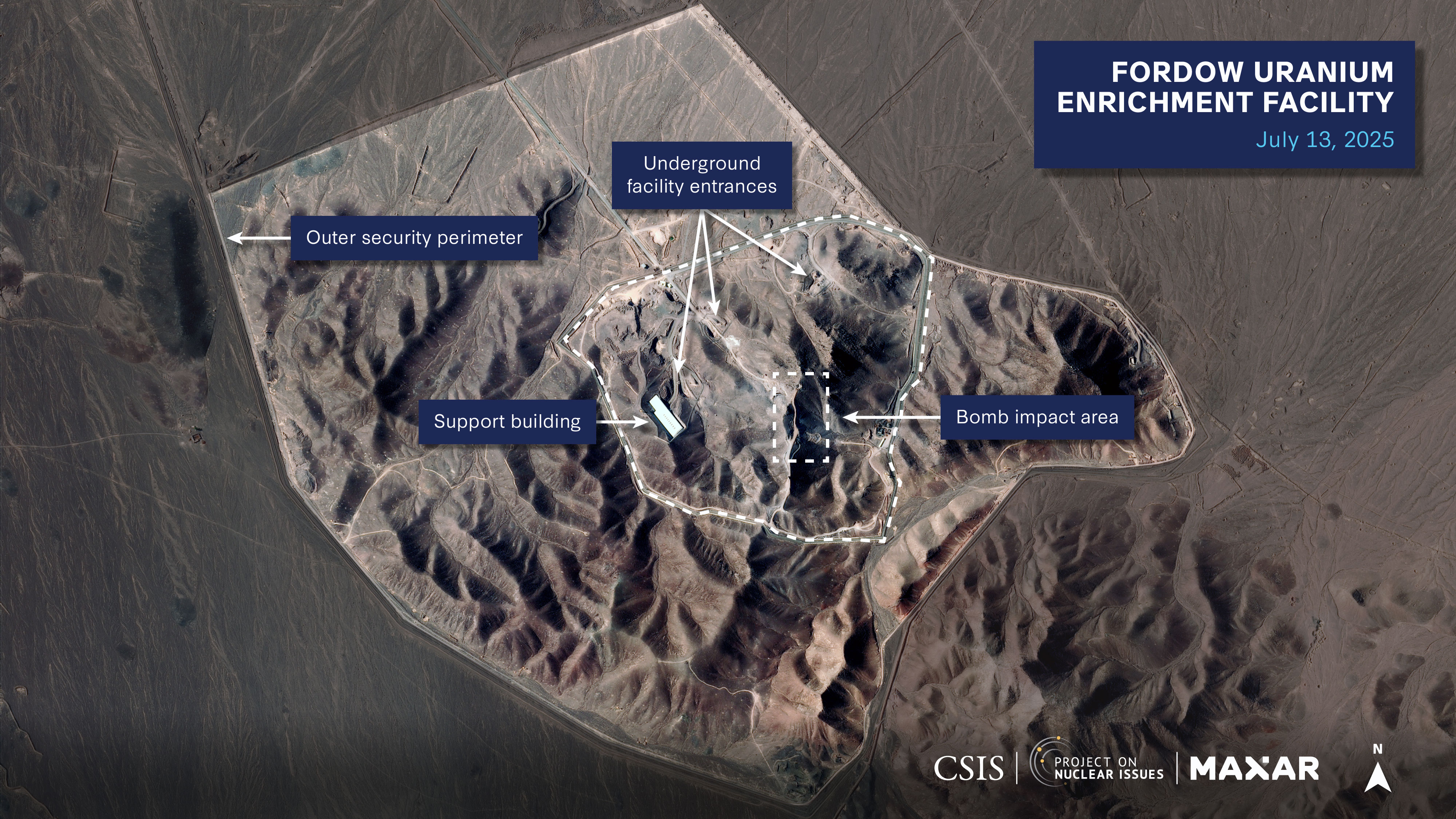
The Fordow uranium enrichment facility was built underground inside a large mountain. The United States struckFordow with 12 Massive Ordinance Penetrators (MOPs), leaving six craters. Imagery from after the strike indicates that the United States “double-tapped” each impact site, placing two MOPs on each crater. Based on previous satellite imagery of the construction of Fordow, it appears that the U.S. strikes targeted ventilation shafts that led into the underground facility.
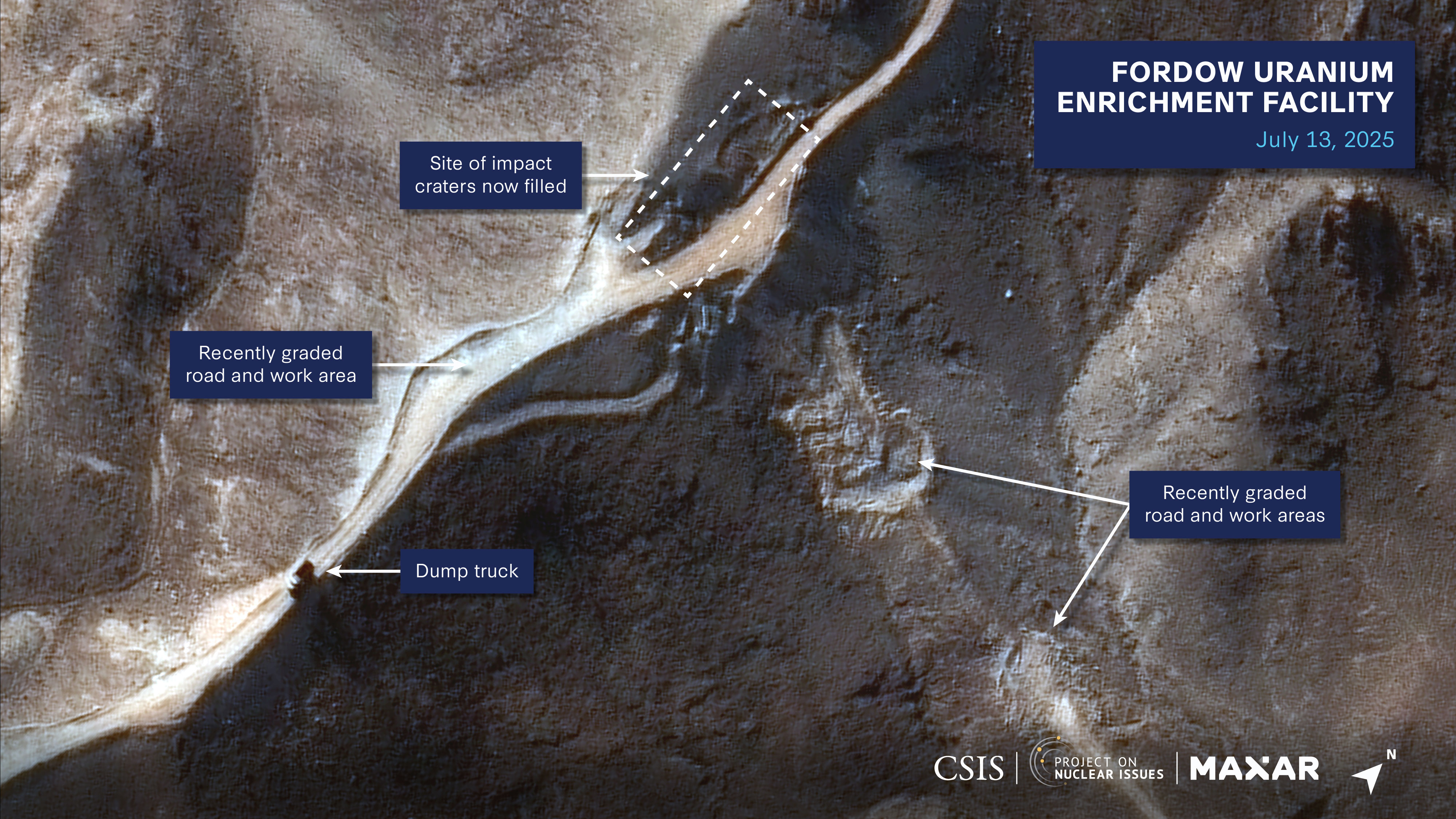
Satellite imagery does not reveal significant activity at Fordow to reestablish operations. Dump trucks and bulldozers are present in the images, and new dirt roads are being constructed around the facility. The impact craters from the U.S. strikes are being filled in, likely to prevent further collapse. This activity indicates that there is an ongoing effort to stabilize the site, but there is no dash to resume enrichment.
Remote Visualization
Remote Visualization
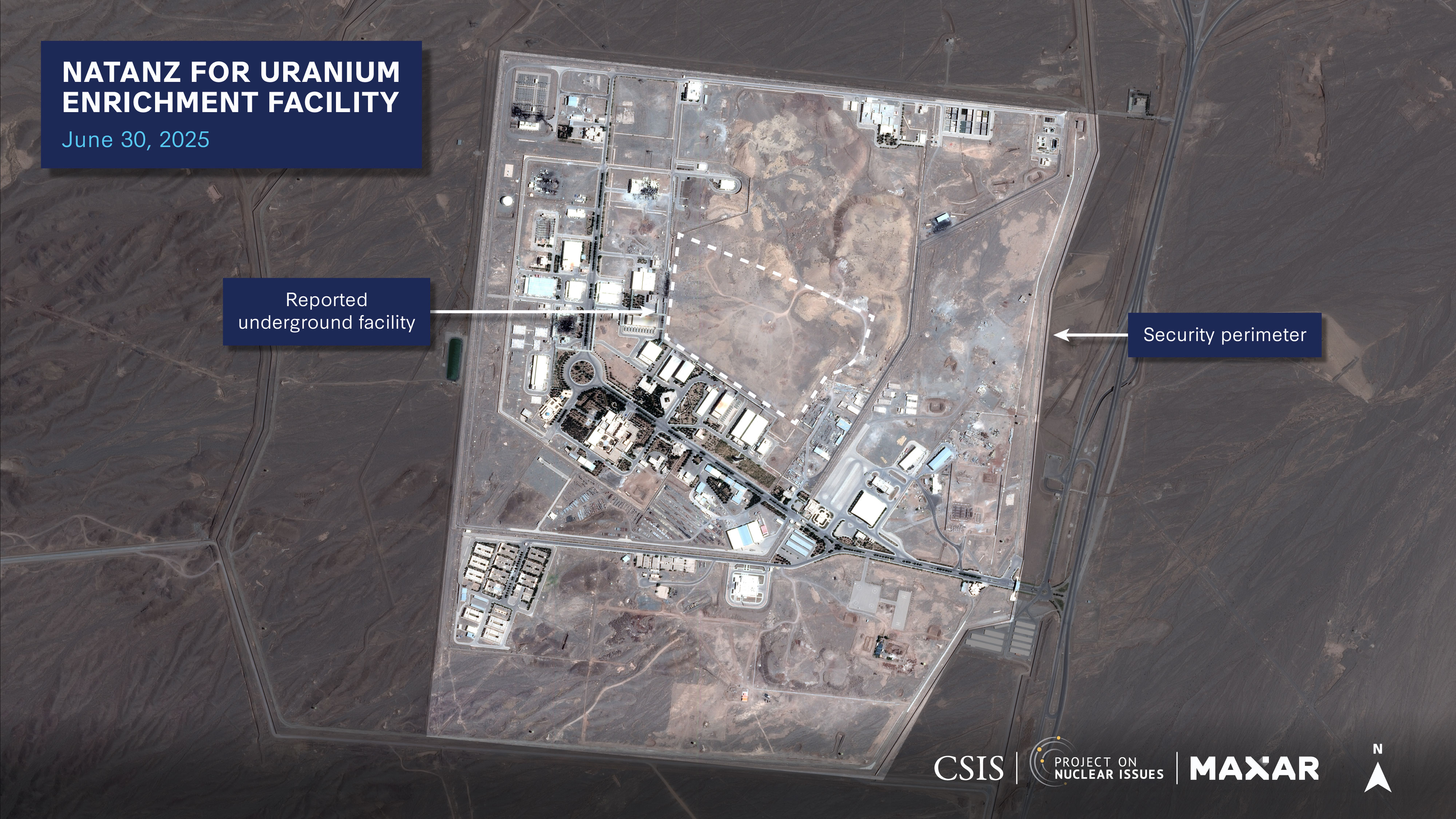
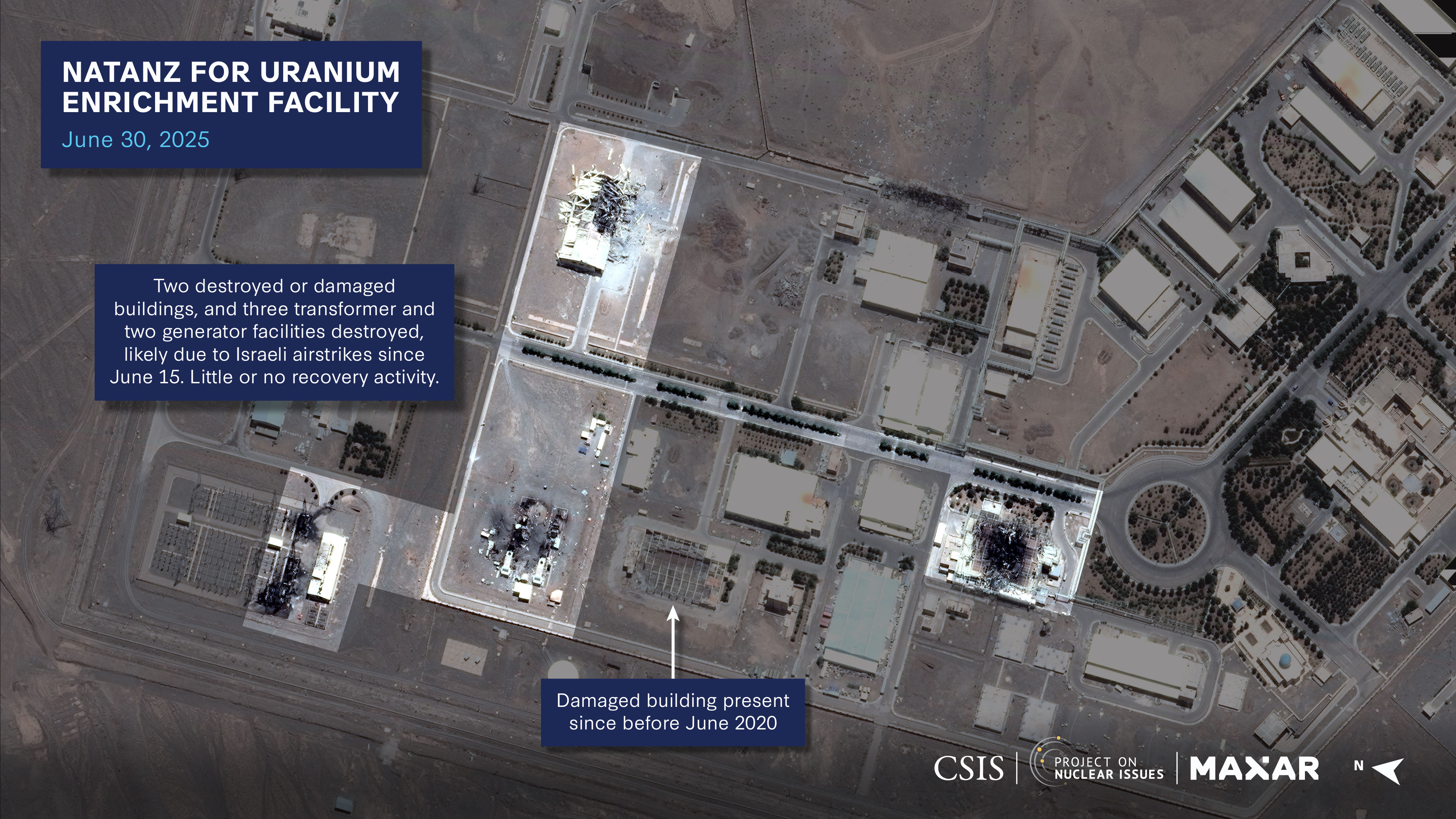
The underground Natanz enrichment facility was struck by two U.S. MOPs on June 22. Additionally, previous Israeli strikes targeted above-ground power transformers and generators at the facility and support buildings. The strikes targeted a small number of buildings, indicating that Israel had strong intelligence about critical site infrastructure.
Remote Visualization
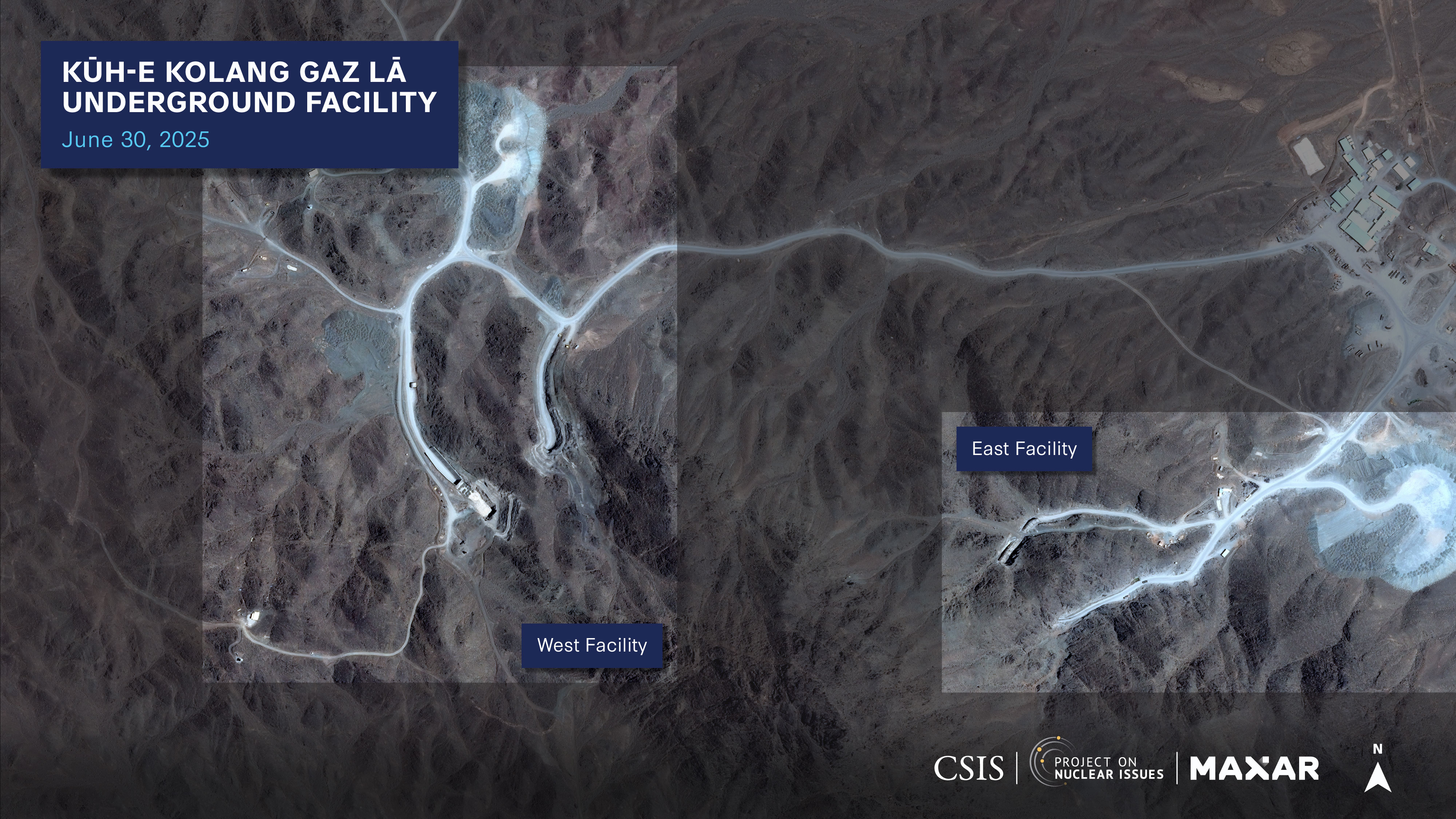
Two kilometers south of Natanz, however, activity at an underground facility called Kūh-e Kolang Gaz Lā or “Pickaxe Mountain” is still ongoing. Pickaxe Mountain was not targeted in the strikes and is undergoing considerable construction…However, there is considerable speculation that Pickaxe Mountain could house centrifuge parts and assemblies, or even hold Iran’s unaccounted for 400 kg of 60 percent enriched uranium. While open-source evidence cannot confirm what exactly is going on at Pickaxe Mountain, it is clear from satellite imagery that Iran has continued construction at an underground facility very close to the Natanz uranium enrichment site.
Remote Visualization
Remote Visualization
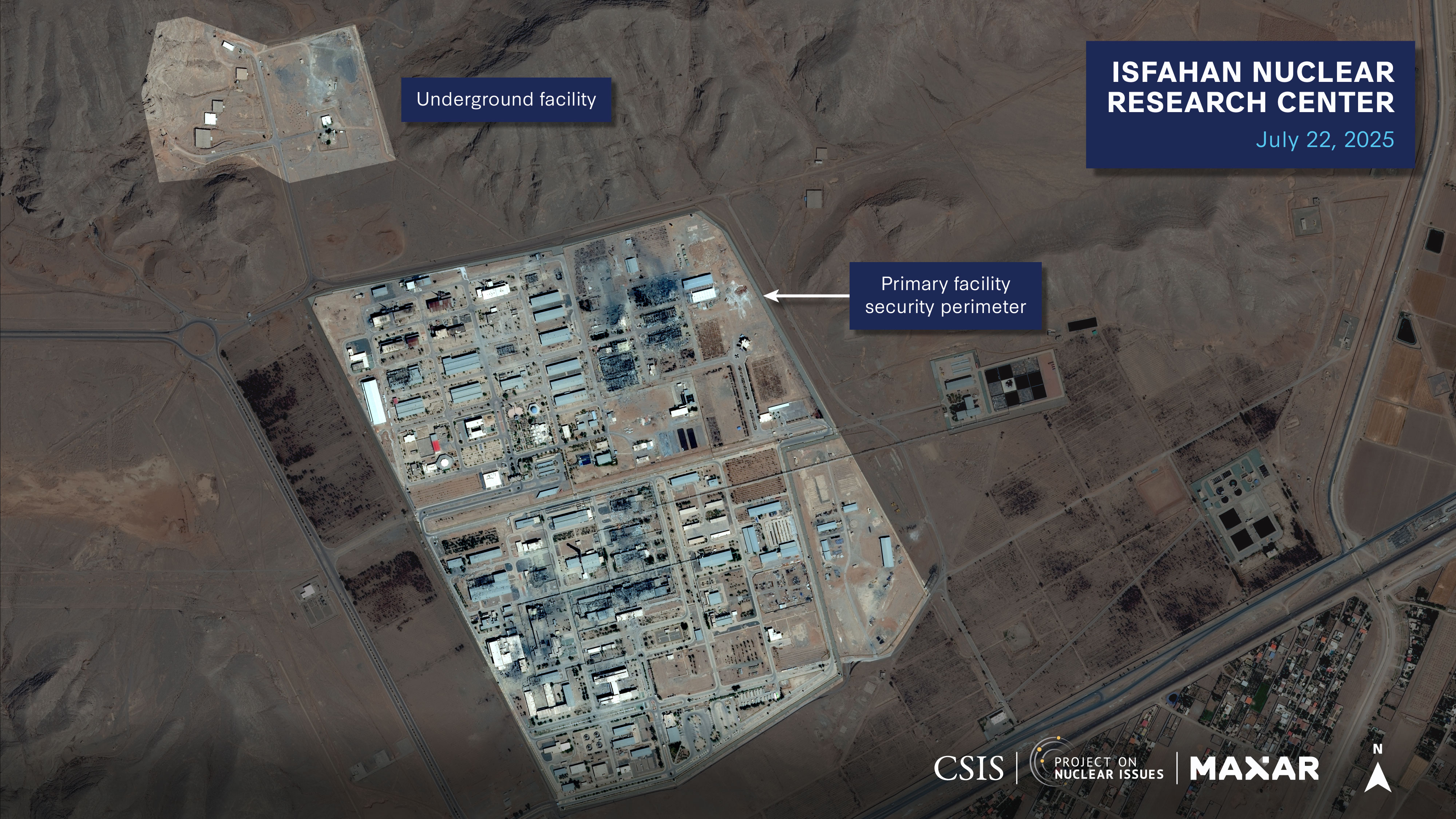
The Isfahan Nuclear Technology Center contains several buildings for uranium conversion...
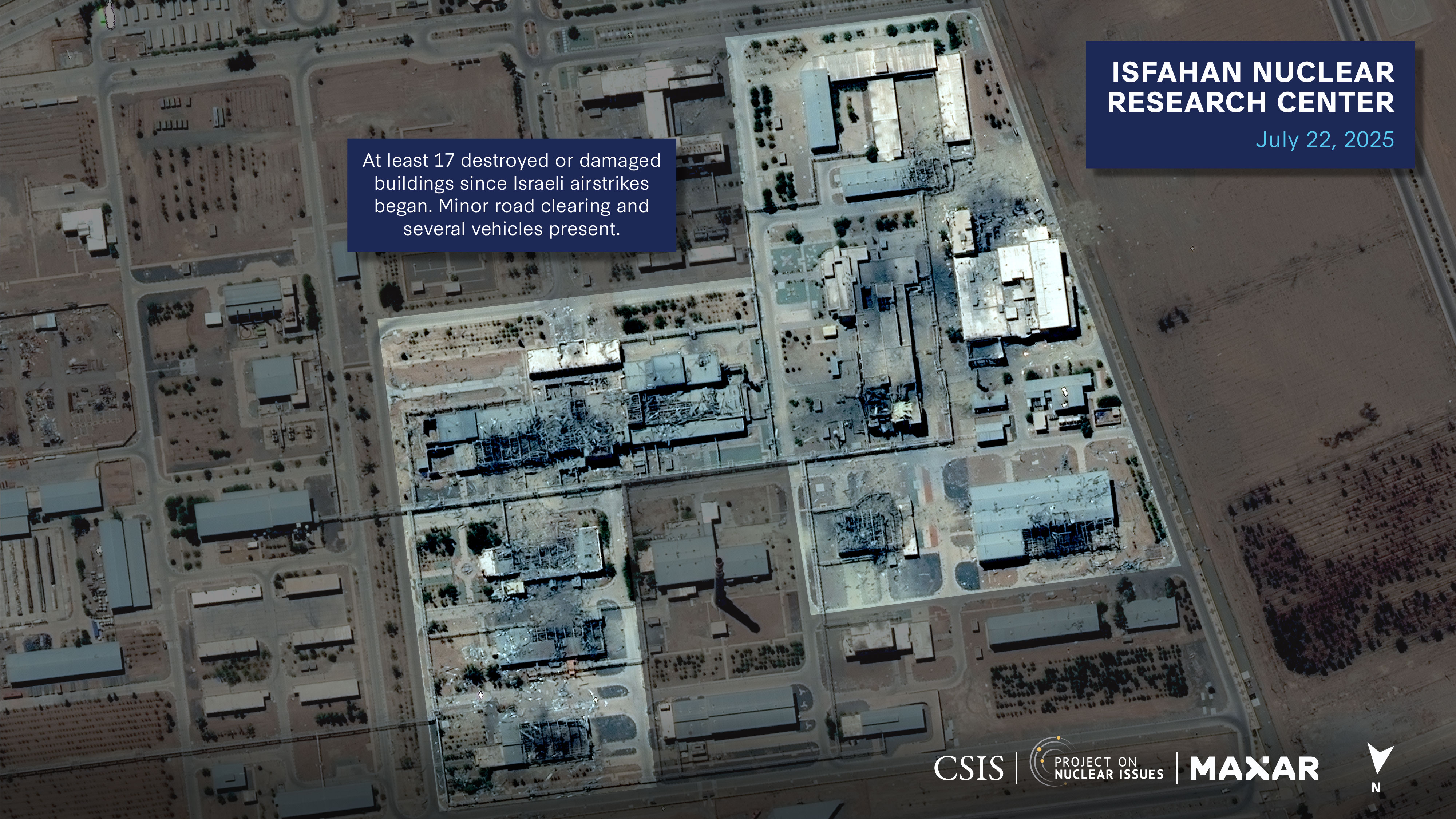
U.S. and Israeli strikes in June hit over two dozen buildings at the Isfahan Nuclear Technology Center. Satellite imagery from July 22 shows limited activity at the complex after the strikes. There is extensive damage at the site, and Iran has made some efforts to clear out roads and stabilize some structures....
Degradation of the Nuclear Scientific Base
Beyond the physical destruction of Iran’s nuclear technology centers, Israeli strikes in June inflicted significant damage to the knowledge base and personnel who work on Iran’s nuclear program. Israeli Ambassador Zarka told reporters that Israeli strikes in June killed at least 14 leading nuclear scientists, including 9 who were targeted in Israel’s initial strikes on June 13. Ambassador Zarka claimed that these scientists had knowledge of chemistry, engineering, and nuclear physics and were involved in dual-use research that has the potential for weaponization. This degradation of scientific personnel can have a profound impact on a weapon of mass destruction program. The loss of tacit knowledge—the unwritten, experiential expertise required for complex tasks like centrifuge operation, UF6 conversion, systems integration, or even nuclear weaponization—is difficult to replace but is often underappreciated. It takes years of specialized training and experience to learn how to build and operate complex machinery, like the centrifuges used for uranium enrichment…
Assessing Iran’s Ability to Rebuild
The imagery analysis points to three key findings about the impact of the strikes on Iran’s nuclear program and its ability to rebuild. First and foremost, the strikes imposed significant damage, particularly to Fordow, Natanz, and Isfahan, and essentially brought operations to a halt. Iran is stabilizing its facilities in Fordow and Isfahan, but there are no significant signs of the resumption of enrichment activity at the main sites. Second, the strikes did not completely eliminate Iran’s nuclear program, such as Pickaxe Mountain, where activity continues, and the underground facility near Isfahan, which could be the third enrichment site. And finally, there remain some key “unknowns” about Iran’s nuclear status. On June 24, Vice President JD Vance suggested that Iran likely still has possession of its existing stockpile of 400 kilograms of 60 percent enriched uranium. The location of the existing stockpile is unknown—it could be stored in an underground facility like the one northeast of Isfahan or Pickaxe Mountain near Natanz. The stockpile could also be scattered across several locations. Regardless of its location, the existing stockpile presents a large proliferation threat…
…The future prospects of Iranian nuclear proliferation will likely hinge on how quickly Iran can reconstitute uranium enrichment at its third enrichment facility. It remains unclear how large Iran’s existing stockpile of centrifuges and associated equipment is, or where these assets are stored. If Iran can rapidly mobilize this stockpile, it could covertly enrich its existing uranium reserves into a bomb. However, centrifuge manufacturing and assembly, along with the subsequent weaponization of a nuclear device, are complex tasks requiring a cadre of technically competent nuclear scientists and engineering personnel, who are now in increasingly short supply.
As two months have passed and we’ve had time to properly assess the damage, it’s no stretch to say these operations pushed back Iran’s nuclear program by years. How soon they can rebuild remains to be see if one for the fact the sanctions Joe Biden pulled from Tehran are back on, making funding and other resources problematic.
The other point that makes be confident in this assessment? If it wasn’t true, the NY Tripe would be screeching it from the front page, above the fold, every day. The curious non-incident. President Trump, Prime Minister Netanyahu, and the thousands of men and women who made this complex operation come off so well, thank you. The world owes you a debt of graduate, please keep up the good work.


No comments:
Post a Comment