
Showing posts with label Improvised Explosive Devices (IEDs). Show all posts
Showing posts with label Improvised Explosive Devices (IEDs). Show all posts
Friday, September 23, 2016


Sunday, September 18, 2016
Security Weekly: How to Counter Armed Assaults, December 3, 2015
In the aftermath of the IED attacks in New York and New Jersey (Sorry Mayor, there were not accidentally put there) STRATFOR had a good review for cops on the beat. Have a great weekend, be safe NY and NJ Blue.
How to Counter Armed Assaults is republished with permission of Stratfor.
How to Counter Armed Assaults
By Scott Stewart
In the wake of the Nov. 13 attacks in Paris and the Nov. 20 attack against the Radisson Blu Hotel in Bamako, Mali, I have been fielding a lot of press queries about countering the armed assault tactics used in both attacks. Since there seems to be so much interest in the topic, it seemed worthwhile to discuss both government and personal responses to armed assaults in this week's Security Weekly.
A Long History
First, it is important to realize that armed assaults employing small arms and grenades have long been a staple of modern terrorism. Such assaults have been employed in many famous terrorist attacks conducted by a wide array of groups, such as the Black September operation against Israeli athletes at the 1972 Munich Olympics; the December 1975 seizure of OPEC headquarters in Vienna, Austria, led by Carlos the Jackal; the December 1985 simultaneous attacks against the airports in Rome and Vienna by the Abu Nidal Organization; and even the December 2001 attack against the Indian parliament building in New Delhi led by Kashmiri militants.
In a particularly brutal assault, Chechen militants stormed a school in Beslan, North Ossetia, in September 2004, taking more than 1,000 hostages and booby-trapping the school with mines and improvised explosive devices. The attack, standoff and eventual storming of the school by Russian authorities after a three-day siege resulted in the deaths of more than 320 people, half of them children.
More recently, we saw armed assaults used in the November 2008 Mumbai attacks; the October 2014 attack against the Canadian National War Memorial and Parliament in Ottawa, Canada; the January 2015 Paris attacks against Charlie Hebdo and a kosher deli; and the July 2015 attack against an armed forces recruitment center and a Navy reserve center in Chattanooga, Tennessee.
In some instances, such as the December 1996 seizure of the Japanese ambassador's residence in Lima, Peru, by the Tupac Amaru Revolutionary Movement, the objective of the armed assault is to take and intentionally hold hostages for a long period. In other instances, such as the May 1972 assault on Lod Airport by members of the Japanese Red Army, the armed assault is a suicide attack designed to kill as many victims as possible before the assailants themselves are killed or incapacitated.
Many recent jihadist attacks have been the latter, and as such they more closely resemble domestic active shooter situations than a barricade or traditional hostage situation. Because of this, they must be responded to differently.
Dealing With Armed Assaults
The long history of armed assaults in modern terrorism has compelled many countries to develop specialized and highly trained forces to combat heavily armed terrorists. For example, it was the failed rescue attempt of the Israeli athletes in Munich that motivated the German government to create the elite Grenzschutzgruppe 9 (GSG 9), which would become one of the best counterterrorism forces in the world. The activities of the Provisional Irish Republican Army likewise helped shape the British Special Air Service into its role as an elite counterterrorism force. Beyond national-level assets, the threat of heavily armed criminals and terrorists has also contributed to the development and widespread adoption of highly trained police, SWAT and counterassault teams by many cities, states and other subnational governments across the globe.
In traditional barricade or hostage situations, the most common tactical response is for the first officers responding to the scene to establish a perimeter to contain the incident. They then wait for hostage negotiators and SWAT or other hostage rescue teams to arrive to handle the crisis. This response is effective for a prolonged hostage situation. However, in the second type of armed assault, it permits the attackers free rein to find and kill many more victims inside the established perimeter. Many times, the attackers are also suicidal and are not planning on surviving the incident.
In the United States, the April 1999 attack at Columbine High School in Littleton, Colorado, was a watershed event that changed the way authorities responded to the second type of armed assault. In the aftermath of Columbine, officials learned that while the police established the perimeter and waited, the two attackers continued to kill students inside the school. Clearly while a shooter was actively killing people, the police could not just sit back and wait for specialty forces to respond to the scene. Moreover, since it often takes time for the specialized units to mobilize and respond, such a delay can prove deadly.
Consequently, so-called active shooter protocols, which called for first responding officers to quickly form a team and then engage and neutralize the shooter as quickly as possible to save lives, were developed and adopted. Active shooter protocols have required police officers to undergo additional training and many police departments are now issuing officers rifles or shotguns so that they do not have to face an active shooter situation with a firepower disadvantage.
Stratfor has long said that ordinary police on patrol are an often overlooked but critical facet of national counterterrorism defenses. While spotting unusual behavior and conducting traffic stops are important, nowhere is the role of regular police officers more important than in responding to active shooter situations. Not only are street cops the most likely force to make first contact with attackers, but in many cases they are also the primary force called upon to stop them.
Officers employing active shooter protocols stopped attackers in the Chattanooga shootings, and in the October 2015 Umpqua Community College shooting in Roseburg, Oregon. In the Ottawa attack as well as the May 2015 attack against a provocative event in Garland, Texas, security personnel protecting the facility stopped the assailants. The police in Colorado Springs, Colorado, also employed active shooter protocol in the Nov. 27 shooting incident at a Planned Parenthood office. While one police officer was killed and four others were wounded, their rapid response undoubtedly saved lives.
Active shooter protocols rapidly spread to other First World countries through training literature and conferences. However, as evidenced by the 2008 Mumbai attacks and the September 2013 attack against the Westgate Mall in Nairobi, Kenya, in which security forces did not take active shooter counter actions and attackers were permitted to continue killing, it has taken a bit longer to get to security forces elsewhere. That said, the Malian and French special operations forces' actions during the Bamako attack and the Afghan government's response to several armed assaults in Kabul highlight that the concept is being spread to other governments through training programs such as the U.S. State Department's Anti-Terrorism Assistance Program and its Department of Defense equivalent, as well as through training provided by European and Australian forces.
In the United States, armed off-duty cops and civilians can also make a difference in countering armed assaults. In February 2007, for example, a heavily armed gunman who had killed five people in the Trolley Square Mall in Salt Lake City, Utah, was confronted by an off-duty police officer, who cornered the shooter and kept him pinned down until other officers could arrive and kill the shooter. The off-duty officer's actions plainly saved many lives that evening.
Individual Responses
But it is not just the authorities that need to respond to armed assaults. Ordinary citizens also need to learn to quickly respond to danger. Properly responding to danger actually begins well before the first shot is fired when people adopt a mindset that recognizes the world is a dangerous place and that they are ultimately responsible for their own safety.
Once a person understands the possibility of being targeted and decides to adopt an appropriate level of situational awareness, he or she will be mentally prepared to quickly realize that an attack is happening, something security professionals refer to as attack recognition.
The earlier a person recognizes that an attack is developing, the better chance he has to avoid it. But even once the attack has begun, a person can still keep it from being a successful one by quickly recognizing what is happening and getting away from the attack site by running or hiding — or fighting back if they cannot run or hide.
However, once a person has recognized that an attack is taking place, a critical step must be taken before he can decide to run, hide or fight: He must determine where the gunfire or threat is coming from. Without doing so, the victim could run blindly from a position of relative safety into danger. I certainly encourage anyone under attack to leave the attack site and run away from the danger, but one must first ascertain if he is in the attack site before taking action. Many times, the source of the threat will be evident and will not take much time to locate. But sometimes, depending on the location — whether in a building or on the street — the sounds of gunfire can echo, and it may take a few seconds to determine the direction it is coming from. In such a scenario, it is prudent to quickly take cover until the direction of the threat can be located. In some instances, there may even be more than one gunman, which can complicate escape plans.
Fortunately, most active shooters are not well trained. They tend to be poor marksmen who lack experience with their weapons. During the July 2012 shooting in Aurora, Colorado, James Holmes managed to kill only 12 people — despite achieving almost total tactical surprise in a fully packed movie theater — because of a combination of poor marksmanship and his inability to clear a jam in his rifle.
This typical lack of marksmanship implies that most people killed in active shooter situations are shot at close range. Thus, it behooves potential victims to move quickly to put as much distance between themselves and the threat. Even the act of moving, especially if moving away at an angle, makes one a much harder target for a poorly trained marksman to hit.
It is also important to think about and distinguish between concealment and cover. Items that conceal, such as a bush, can hide you from the shooter's line of vision but will not protect you from bullets the way a substantial tree trunk will. Likewise, in an office setting, a typical drywall construction interior wall can provide concealment but not cover, meaning a shooter will still be able to fire through the walls and door. Still, if the shooter cannot see his or her target, they will be firing blindly rather than aiming their weapon, reducing the probability of hitting a target.
In any case, those hiding inside a room should attempt to find some sort of additional cover, such as a filing cabinet or heavy desk. It is always better to find cover than concealment, but even partial cover — something that will only deflect or fragment the projectiles — is preferable to no cover at all.
There are many examples from the recent Paris and Bamako armed assaults of people who ran away from the scene of the attacks and survived. In the Bamako attack there were also many people who barricaded themselves inside their hotel rooms and hid until the authorities could rescue them. The August 2015 incident aboard a Paris-bound train provided a good example of potential victims who were trapped aboard a train car and fought back to end an armed assault.
Some people have mocked the simplicity of run, hide, fight. But as these cases demonstrate, all three elements of this mantra can and do save lives.
How to Counter Armed Assaults is republished with permission of Stratfor.
Monday, August 22, 2016
Wake up people, this is what we call savagery...
If you've seen the movie or the trailer for American Sniper, Chris Kyle had to shoot a boy, who looked less than ten year of age, as he approached an American squad. The kid was handed the bomb by a woman, presumedly his mother. A mother would send her child to his death. And Kyle, completely justified, had to fire the shot to send him to his grave. Chris Kyle had a conscious, unlike that woman. This is what we are dealing with.
Another example of how the savagery of our enemy is not to be underestimated. And a great example of the courage of the police in Iraq. Holding the boy and stripping him of the bomb. This is unreal.
‘ISIS child suicide bomber aged between 12 and 13’ was thwarted in Iraq
The dramatic moment an ISIS child suicide bomber ‘aged 12 or 13’ is stripped of his explosive belt by Iraqi police as terrorists use child bombers in horrifying new tactic
The boy, who was wearing a Barcelona football shirt with FIFA World Player of the Year Lionel Messi on the back, reportedly burst into tears as he was detained by Iraqi police in the city of Kirkuk, north of Baghdad, yesterday.
After being stripped of the explosive, he is still fighting.
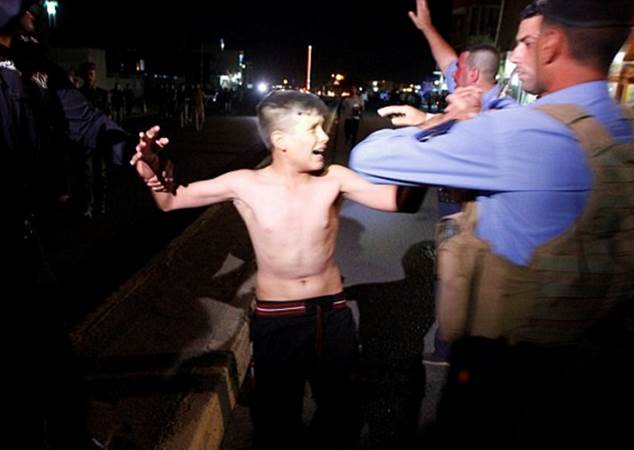
 |
| In a Barcelona football shirt from FIFA |
His arrest came less than 24 hours after another child suicide bomber killed at least 51 people and injured 100 more at a wedding party in Turkey.
It has led to fears children are increasingly being used by ISIS to carry out deadly attacks. Two other suicide bombers blew themselves up in Kirkuk on Sunday.Unbelievable. From the article.
The boy, who was wearing a Barcelona football shirt with FIFA World Player of the Year Lionel Messi on the back, reportedly burst into tears as he was detained by Iraqi police
Three people were injured in one while in another there were no casualties...
...‘There is a dangerous campaign tonight against Kirkuk,’ a security official told the network.
It has been claimed the boy was planning to blow himself up outside a Shia mosque. The belt was later detonated safely away from members of the public.
Earlier this year it was revealed that ISIS had released an app teaching the Arabic alphabet to its ‘cubs of the caliphate’ – using cartoon images of weaponry.
The terror group uses pictures of tanks, ammunition and swords to help children remember certain letters in its bizarre learning aid.
It is the latest move by ISIS aimed at indoctrinating children in its Iraq and Syria stronghold.
Videos have previously been released of boys – dubbed ‘Cubs of the Caliphate’ – being put through rigorous training regimes and even being ordered to carry out brutal executions.
Meanwhile, Turkish president Tayyip Erdogan said it was likely that ISIS was behind the attack which saw a bomber, thought to be aged between 12 and 14, blow up people dancing in the street at a party in the city of Gaziantep last night.
The boy was detained in Kirkuk, north of Baghdad, less than 24 hours after a child suicide bomber killed at least 51 people and injured 100 at a wedding party in Turkey...Give you an idea of what we are talking about, look at this explosion. That is what this kid, who didn't even have a hair on his chest, was carrying and willing to kill himself with:

Sobering, to put it nicely.
Thursday, June 16, 2016
Conversation: Europe's Terrorist Threat
Conversation: Europe&'s Terrorist Threat
Stratfor Vice President of Intelligence Fred Burton and Vice President of Tactical Intelligence Scott Stewart discuss the persistent and multifaceted jihadist threat in Europe. "Conversation: Europe's Terrorist Threat is republished with permission of Stratfor."
Stratfor Vice President of Intelligence Fred Burton and Vice President of Tactical Intelligence Scott Stewart discuss the persistent and multifaceted jihadist threat in Europe. "Conversation: Europe's Terrorist Threat is republished with permission of Stratfor."
Thursday, March 31, 2016
Security Weekly: Awareness Can Short-Circuit a Bomb Attack, March 31. 2016
By Scott StewartAwareness Can Short-Circuit a Bomb Attack COPYRIGHT: STRATFOR.COM
Bombs used in the March 22 attacks in Brussels displayed a degree of tradecraft not before shown by the Islamic State outside its core areas of operation. The bombings at the Zaventem airport and at a metro station in Brussels killed 35 and wounded more than 300, making them the deadliest jihadist bombing attack in the West in more than a decade.
The Brussels attacks broke the recent trend of moving toward armed assaults from bombings. The Brussels cell was able to conduct such a large bombing operation because one of its key members, identified by Belgian authorities as Najim Laachraoui, possessed advanced bombmaking tradecraft acquired from Islamic State trainers while he was in Syria. Laachraoui is also thought to have constructed the bombs used in the November 2015 Paris attacks.
Strangely, Laachraoui has been identified as one of the suicide bombers who attacked the airport in Brussels. It is rare for an organization's bombmaker to participate in a suicide attack — they are simply too valuable to waste — but it appears as if Laachraoui, under heavy police pressure, chose to go out intentionally rather than to risk being captured like his fellow conspirator, Saleh Abdesalam, who was arrested March 18. No matter Laachraoui's motive, it is good news that a well-trained bombmaker is out of the picture. However, the threat of jihadist bomb attacks against targets in Europe and elsewhere in the West did not die with Laachraoui, and authorities and citizens alike are left to wonder: How many other trained Islamic State bombmakers remain at large?
I've recently seen a reputable company write that if a terrorist plot gets to the bombmaking stage, it is too late to avert an attack. However, I strongly disagree with this claim. Even in the weapons acquisition or bombmaking stage of the terrorist attack cycle, terrorist operatives remain vulnerable, and plots can be thwarted if bombmaking activity is noticed and reported to authorities.
Indeed, unusual activity was noticed in the Brussels case, according to a March 26 story in The New York Times. The story noted that an overpowering chemical odor coming from Laachraoui's sixth floor apartment made the building's owner gag — and odd happenings at the apartment prompted another neighbor to call the police, but those reports were not investigated. The taxi driver who drove three of the attackers to the airport also noticed that his passengers acted strangely and refused to let him touch their suitcases, which reeked strongly of chemicals, but he did not take action until after the attacks.
These were all indications that very well could have resulted in the attacks being disrupted, but unfortunately, they did not. However, that does not mean that the next bombing cannot be thwarted by the telltale signs of bombmaking activity. Let's examine some of those indicators in more detail.
Beyond a Bleach Blonde
As al Qaeda in the Arabian Peninsula's Inspire magazine so famously stated, you can indeed "make a bomb in the kitchen of your mom." It truly is not difficult for a knowledgeable individual to mix up improvised explosives using a wide range of common household chemicals, including peroxide, acetone, chlorine and brake fluid.
It is important to recognize that when we say an explosive mixture or an explosive device is "improvised," that does not automatically mean the end product is going to be ineffective or amateurish. Like an improvised John Coltrane saxophone solo, some improvised explosive devices can be highly crafted, albeit deadly, works of art. That said, certain activities necessary to make bombs leave even proficient bombmakers open to detection by outside observers — and amateur bombmakers are even easier to spot if one knows what to look for.
To obscure bombmaking activity, explosive mixtures and device components are often manufactured in rented houses, apartments or hotel rooms. We have seen this in past cases, such as the December 1999 "millennium bomb" plot in which Ahmed Ressam and an accomplice set up a crude bombmaking factory in a hotel room in Vancouver, British Columbia. More recently, Najibullah Zazi was arrested in September 2009 and charged with attempting to manufacture the improvised explosive mixture triacetone triperoxide (TATP) in a Denver hotel room. In September 2010, a suspected lone assailant in Copenhagen accidentally detonated an explosive device he was constructing in a hotel.
Similar to clandestine methamphetamine labs, which are also frequently set up in rental properties or hotel rooms, makeshift bombmaking operations frequently use everyday volatile substances. Chemicals such as acetone, a common nail-polish remover, and peroxide, commonly used to bleach hair, can easily be found in stores. Fertilizers, the main component of the bombs used in the 1995 Oklahoma City bombing and the 1993 World Trade Center attack, are present in large volumes on farms or in farm-supply stores in rural communities. Hardware and paint stores sell acids and powdered metals.
However, the quantities of chemicals required to manufacture explosives far exceeds those required for most legitimate purposes. Because of this, hotel staff, landlords and neighbors can fairly easily notice signs that someone in their midst is operating a makeshift bombmaking laboratory. Obvious suspicions should be raised if, for example, a new tenant moves several bags of fertilizer into an apartment in the middle of a city, or if a person brings in gallons of acetone, peroxide or sulfuric or nitric acid. Furthermore, bombmakers use laboratory implements, such as beakers, scales, protective gloves and masks, not normally found in a hotel room or residence.
Additionally, although electronic devices like cellphones or wristwatches may not seem unusual in the context of a hotel room or apartment, signs that such devices have been disassembled or modified to have wires protruding should raise a red flag, as these altered devices are commonly used as initiators for improvised explosive devices.
Certain items that are less commonly used in household applications but that are frequently used in bombmaking include nitric or sulfuric acid; metal powders such as aluminum, magnesium and ferric oxide; and large quantities of sodium carbonate, commonly sold in 25-pound bags. Large containers of methyl alcohol, which can be used to stabilize nitroglycerine, are another indicator that a bombmaker may be present.
Fumes from chemical reactions are another sign of bombmaking activity. Depending on the size of the batch being concocted, the noxious fumes from an improvised explosive mixture can bleach walls and curtains and, as was the case for the July 2005 London attackers, even the bombmakers' hair. The fumes can even waft outside of the lab and be detected by neighbors, as they were in the Brussels case. Spatters from the mixing of ingredients such as nitric acid leave distinctive marks, which are another way for hotel staff or landlords to recognize that something is amiss. Additionally, rented properties used for bombmaking activity rarely look occupied. They frequently lack furniture and have makeshift window coverings instead of drapes. Properties where bomb laboratories are found also usually have no mail delivery, sit vacant for long periods and are occupied by people who come and go at odd hours and who are often seen carrying strange things — such as containers of chemicals or large quantities of ice, which is used to keep chemical reactions such as those used to synthesize TATP under control.
The components for the truck bomb used in the 1993 World Trade Center bombing were manufactured in a rented apartment in Jersey City. The process of cooking the nitroglycerine used in the booster charges and the urea nitrate used in the main explosive charge created strong chemical fumes that changed the wall paint color and corroded metal doorknobs and hinges. The bombmakers also spilled chemicals on the floor, the walls, their clothing and other places, leaving plenty of trace evidence for investigators to find after the attack.
More Clues to Spot Bombmakers
Given the caustic nature of the ingredients used to make homemade explosive mixtures and the volatile chemical reactions required to make things like nitroglycerin and TATP, creating the explosive can be one of the most dangerous aspects of planning a bombing attack. Indeed, Hamas militants refer to TATP as "the mother of Satan" because of its volatility and propensity to severely burn or kill bombmakers if they lose control of the chemical reaction required to synthesize it.
Because of this, it is important for medical personnel to pay attention to emergency room walk-ins with thermal or chemical burns who smell of chemicals and to report them to authorities in much the same way they do patients who appear to have been injured in meth lab accidents.
In January 1995, an apartment in Manila, Philippines, caught fire when the bombmaker in the 1993 World Trade Center attack, Abdel Basit (aka Ramzi Yousef), lost control of the reaction in a batch of TATP he was brewing for his planned attack against a number of U.S. airliners flying over the Pacific Ocean — an operation he had nicknamed Bojinka. Because of the fire, authorities were able to arrest two of Basit's co-conspirators and to unravel Bojinka and other plots against targets including Pope John Paul II and U.S. President Bill Clinton. Basit fled to Pakistan, where he was apprehended a short time later. This case serves to highlight the dangers presented by these labs to people in the vicinity — especially in a hotel or apartment building.
Another behavior that provides an opportunity to spot a bombmaker is testing. A professional bombmaker will try out improvised mixtures and components, like improvised blasting caps, to ensure that they are functioning properly and that the completed device will therefore be viable. Such testing may involve burning or detonating small quantities of the explosive mixture, or actually exploding the blasting cap or booster charge. The testing of small components may happen in a backyard, but the testing of larger quantities will often be done at a more remote place. In his diary, Norway bomber Anders Breivik noted how he had taken his bomb components to a remote location a good distance from the rented farmhouse where he built his bomb to test them. Therefore, any signs of explosions in remote places like parks and national forests should be immediately reported to authorities.
Obviously, not every container of nitric acid spotted or small explosion heard will be absolute confirmation of bombmaking activity, but reporting such incidents to the authorities will give them an opportunity to investigate. In an era when the threat of attack comes from increasingly diffuse sources, a good defense requires more eyes and ears than the authorities possess.
Subscribe to:
Posts (Atom)