USA
China Looks at U.S. Tech-Limiting Measures and Sees Gunboat Diplomacy
Highlights
- As China attempts to achieve technological parity for reasons of national security, the U.S. government will continue to deploy a wide array of tools against these efforts, particularly Beijing's attempts to obtain trade secrets illegally.
- These U.S. actions, however, will merely convince Beijing to break its dependence on Western technology by any means possible, since they vividly remind China about how a technologically superior West victimized it during the days of gunboat diplomacy.
- Fearful for its own future in the wake of Washington's actions, Russia will also strive to obtain technology by any means possible.
The last Opium War ended 176 years ago, but Beijing remembers the battle well — particularly the West's penchant for gunboat diplomacy. Memories of Western coercion and blockades have already prompted China to bolster the country's navy and take aggressive steps in the South China Sea to fulfill two of its overriding strategic imperatives: prevent any encroachment on the eastern coast and secure maritime trade routes...
Building a More Efficient World
At its heart, geopolitics is a study of relative advantages. Geographic features can hinder or empower a country in pursuing its imperatives such that, as Halford Mackinder put it, there is "no such thing as equality of opportunity for the nations." Nevertheless, geography is not deterministic; advances in technology can even the playing field or turn the tides for even the most geographically disadvantaged nation. Infrastructure offers a prime example of this phenomenon. Throughout history, infrastructure has been central to a nation's cohesion and economic growth, connecting countries to themselves and to one another. In fact, despite their many bitter differences, the two major-party candidates for the U.S. presidency found a semblance of common ground in the need to update their country's aging infrastructure.
But though the need for interconnection has been a constant, it has manifested in different ways over time. As the global economy changes with the advent of new technologies, so, too, does infrastructure. Inland rivers, railways and highways have all played a role in increasing the efficiency of moving goods and people through the years, taking advantage of or augmenting existing geographic features. Even seemingly small technological advances, such as the container ship, can revolutionize long-standing modes of transportation. Now, as the fourth industrial revolution unfolds, the demands on infrastructure will shift again, and with them, the global order.
Rivers: A Traditional Advantage
For centuries, inland rivers were the lifelines of nations and empires. Cutting from the top of Minnesota to the Gulf Coast of Louisiana, the Mississippi River is (literally) central to the United States and its enduring influence in the world. Along with its rich historical and cultural significance, the Mississippi River Basin offers the United States a wide swath of fertile land and navigable rivers, allowing the country an inexpensive means to transport goods within and beyond its borders. Inland waterways also underpinned the success of Northern European countries such as Germany and the Netherlands, though, unlike in the United States, the rivers and the economic competition they inspired divided the Continent rather than uniting it...
AFRICA
Pentagon to cut troops in Africa as focus shifts to China, Russia
WASHINGTON (Reuters) - The U.S. military will withdraw hundreds of troops focused on counterterrorism operations in Africa over the next several years to support the Pentagon’s increased focus on countering threats from China and Russia, officials said on Thursday.
Earlier this year, the U.S. military put countering China and Russia at the center of a new national defense strategy, the latest sign of shifting priorities after more than a decade and a half of focusing on the fight against Islamist militants.
“This realignment specifically projects to reduce forces by about 10 percent over the next several years - representing a fraction of the overall 7,200 DoD personnel operating in Africa,” Commander Candice Tresch, a Pentagon spokeswoman, told Reuters.
Tresch said the cuts would leave “counter-violent extremist organization” activities largely untouched in several countries, including Somalia, Djibouti and Libya...
ASIA
India Looks for a Strategic Edge in Its Indian Ocean Contest With China
Highlights
- China's increased presence in the Indian Ocean is driving India into a race for dominance in the region.
- India's broad security commitments prevent it from meeting its naval ambitions, forcing it to rely on other strategic measures to challenge China's penetration into the region.
- By taking advantage of geographic choke points, building up its influence with states inside and outside the region, and seeking closer cooperation with the United States, India is positioning itself to better challenge
Editor's Note: This assessment is part of a series of analyses supporting Stratfor's upcoming 2019 Annual Forecast. These assessments are designed to provide more context and in-depth analysis on key developments in the coming year.
Throughout most of India's history, its rulers have emphasized land forces over sea power. Their domains were faced with the persistent threat of invasion from the northwest as well as the specter of internal strife. But the European colonial invasions by sea provided a rude awakening, and in the immediate aftermath of independence, New Delhi focused on the need for a powerful navy. However, conflict with Pakistan, internal dissent and border clashes with China reinforced the need for powerful ground forces. And China isn't just testing India on the land; it is also pushing into the Indian Ocean. To meet this challenge, India is strengthening its navy while maximizing its strategic thinking...
EUROPE
UK to double F-35 fleet with 17-jet order, Defence Secretary announces
The multi-million-pound contract signed will see the UK own 35 stealth jets by end of 2022 with Britain manufacturing 15% of the overall global order for 255 aircraft.
The UK is set to double its number of world-beating F-35 stealth jets after ordering 17 more aircraft, Defence Secretary Gavin Williamson has announced.
The 17 new F-35B aircraft will be delivered between 2020 and 2022 and will complement the 16 British aircraft currently based at RAF Marham and in the US, as well as two additional aircraft which are already on order.
Overall, the UK has committed to procure 138 aircraft over the life of the programme...
...The 17 jets being ordered are part of a $6 billion contract for 255 aircraft being built for the global F-35 enterprise...
...As the largest operator of F-35s outside of the US, the acquisition of 17 more Lightning aircraft underscores our commitment to the programme. This new contract demonstrates how our Armed Forces are equipped by DE&S with the latest equipment and support.
News of this latest order comes as F-35B aircraft are currently embarked on HMS Queen Elizabeth for flying trials in the US, which continue to progress well. The fighter jets will be jointly manned by the Royal Air Force and the Royal Navy and can operate from land and sea, forming a vital part of Carrier Strike when operating from the Queen Elizabeth Class aircraft carriers.
LATIN/SOUTH AMERICA
Latin America's Auto Giants Strive to Secure Markets
Highlights
- Mexico's auto sector will remain oriented toward the United States, particularly in the wake of the signing of the United States-Mexico-Canada Agreement.
- Brazil will continue its quest to find new export markets, as Mexico did three decades ago.
- Brazil's incoming administration will try to persuade members of the Mercosur trading bloc to allow each member state to sign its own bilateral free trade agreements.
If Brazil succeeds in lifting Mercosur's trade restrictions, the country's auto sector will target developing markets in Asia, Latin America and Africa, where Brazilian-made vehicles would be most competitive.
When it comes to Latin American automotive production, two giants dominate the scene: Mexico and Brazil. Together, they produced 6.8 million light and commercial vehicles last year, representing around 7 percent of the globe's total output. The two are also heavily integrated into global automotive supply chains, as Mexico's auto sector is closely linked to the United States, while Brazil's auto sector has tight connections to Argentina. Historically, however, the Mexican and Brazilian automotive industries developed in vastly different geopolitical environments. Mexico is an export-oriented powerhouse, shipping nearly 70 percent of its finished vehicle production to the United States. Brazil, on the other hand, mainly focuses on supplying its huge domestic market. And thanks to the new United States-Mexico-Canada Agreement (USMCA), the future of Mexico's automotive market clearly lies in the same place as its recent past: the U.S. domestic market. Brazil, by contrast, will take steps to eliminate the domestic and regional obstacles that are complicating its efforts to expand its exports of cars and parts...
Trump administration prepares to add Venezuela to list of state sponsors of terrorism
The Trump administration is preparing to add Venezuela to the U.S. list of state sponsors of terrorism in what would be a dramatic escalation against the socialist government of Nicolás Maduro, according to U.S. officials and internal government emails.
The list is reserved for governments accused of repeatedly providing “support for acts of international terrorism” and includes only Iran, North Korea, Sudan and Syria.
Republican lawmakers led by Sen. Marco Rubio (Fla.) have pushed for the designation, citing Venezuela’s alleged ties to Lebanese Hezbollah, the Revolutionary Armed Forces of Colombia, or FARC, and other groups.
Republicans have long accused Venezuela of having ties to terrorist organizations. But experts have played down the threat and strength of those connections. They warn that a designation that does not offer concrete evidence could weaken the legitimacy of the U.S. list, which critics say already is applied inconsistently...
“I suspect this will be based on hearsay and sources of questionable integrity,” said David Smilde, a senior fellow at the Washington Office on Latin America.
AFGHANISTAN
Afghanistan’s Rivers Could Be India’s Next Weapon Against Pakistan
New Delhi is funding an ambitious dam near Kabul that could reduce water flow to its rival downstream. The project might spark the world’s next conflict.
Most of Afghanistan is currently experiencing a 60 percent drop in the rain and snowfall needed for food production. The rapid expansion of Kabul’s population, extreme drought conditions across the country, and the specter of climate change have exacerbated the need for new water infrastructure. But building it is politically complicated; the Afghanistan-Pakistan border region is defined by its complex maze of transboundary rivers and there is no legal framework in place to avoid major conflict between the nations.
It’s no surprise, then, that in the Chahar Asiab district of Kabul, on a tributary of the Kabul River, the Maidan, work is scheduled to begin soon on the Shahtoot Dam. The dam will hold 146 million cubic meters of potable water for 2 million Kabul residents and irrigate 4,000 hectares of land. It will also provide drinking water for a new city on the outskirts of Kabul called Deh Sabz. Afghanistan is finally, after decades of devastating wars, in a position to begin to develop its economy and electricity from hydropower.
But this ambitious development is fueling fears downstream in Pakistan that the new dam will alter the flow of the Kabul River and reduce the water flows into Pakistan that could severely limit the country’s future access to water. The Pakistani media outlet Dawn has reported that there could be a 16 to 17 percent drop in water flow after the completion of the Shahtoot Dam and other planned dams.
Beyond reducing water flow to Pakistan, the Shahtoot Dam has a unique capacity to escalate tensions in the region thanks to its funding from India.Beyond reducing water flow to Pakistan, the Shahtoot Dam has a unique capacity to escalate tensions in the region thanks to its funding from India. India has made major investments in Afghanistan’s infrastructure in recent years—from highway construction to repair of government buildings and dams damaged by conflict...
CHINA
China using ‘gait recognition’ to ID people
BEIJING — Chinese authorities have begun deploying a new surveillance tool: “gait recognition” software that uses people’s body shapes and how they walk to identify them, even when their faces are hidden from cameras.
Already used by police on the streets of Beijing and Shanghai, “gait recognition” is part of apush across China to develop artificial-intelligence and data-driven surveillance that is raising concern about how far the technology will go.
Huang Yongzhen, the CEO of Watrix, said that its system can identify people from up to 165 feet away, even with their back turned or face covered. This can fill a gap in facial recognition, which needs close-up, high-resolution images of a person’s face to work.
“You don’t need people’s cooperation for us to be able to recognize their identity,” Huang said in an interview in his Beijing office. “Gait analysis can’t be fooled by simply limping, walking with splayed feet or hunching over, because we’re analyzing all the features of an entire body.”
Watrix announced last month that it had raised $14.5 million to accelerate the development and sale of its gait recognition technology, according to Chinese media reports.
In South China Sea, a display of U.S. Navy strength — and a message to Beijing
ABOARD THE USS RONALD REAGAN — As fighter jets roared off the flight deck and darted above the South China Sea, visitors onboard the carrier USS Ronald Reagan raised their phones for the inevitable selfies.
Among those clicking souvenir images was a lieutenant general from the Chinese People’s Liberation Army, who was part of a VIP guest list as the carrier moved through contested waters.
The carrier — which docked last week in Hong Kong in a good-faith gesture from Beijing — also offered a snapshot into challenges for the Pentagon in the Asia-Pacific region as China builds up its own naval prowess and ramps up efforts to solidify territorial demands.
The United States seeks to keep its place as the dominant naval power across East Asia, where Washington and its allies believe Beijing is trying to reorder international rules and military alliances in place since World War II...
IRAN
Why Iran's Government Will Bear the Weight of U.S. Sanctions
Highlights
- Iran's economy will enter a sharp recession in 2019, but Tehran can capably manage any political fallout that may follow.
- Economically, Iran will emphasize prudent management and protection of precious hard currency reserves while boosting domestic investment through its public sector and trying to continue financial sector reform.
- While it focuses on economic survival in the face of sanctions, however, Iran will make only limited progress on much-needed longer-term reforms, such as strengthening the private sector.
Iran's squabbling political factions will try to take advantage of the economic environment, but in the face of the crisis, they will work together to prioritize regime preservation.
Editor's Note: This assessment is part of a series of analyses supporting Stratfor's upcoming 2019 Annual Forecast. These assessments are designed to provide more context and in-depth analysis on key developments in the coming year.
A year ago on Iran's black market, one U.S. dollar would bring 41,000 Iranian rials. Today, it would take more than three times as many rials, about 125,000, to buy a dollar. One year ago, Iran was free to export as much oil as it was capable of producing. Today, the United States has reapplied sanctions related to both Iran's oil exports, which provide about a third of government revenue, and its financial dealings. And while the White House has granted sanctions waivers to a few of Iran's oil customers, the waivers are only temporary, ensuring that Iranian oil exports will fall further in 2019.
To put it bluntly, 2019 will be disastrous for Iran's economy, perhaps even precipitating significant economic and social unrest, much like the start of 2018. But while the Iranian economy will bend under the weight of sanctions, they will not break the Islamic republic. Iran's leadership has a long history of dealing with sanctions and economic isolation, and 40 years of practice has made the government particularly adept at survival...
IRAQ
Iraq: Oil Prices Plunge as Kirkuk's Production Comes Back on Line
The Big Picture
Iraq's federal government and the Kurdistan Regional Government have squabbled over oil revenue and resources for years, and they are still not cooperating. As Iraq's oil production continues to increase, the OPEC member is adding more oil to a market that has already overcompensated for sanctions on Iran. Going forward, Iraq's increased production will give Saudi Arabia more reason to push for another global cut in production.
Rising supply has caused oil prices to plunge in the past seven weeks. And thanks to Iraq, that growth in supply will not let up. On Nov. 16, a temporary deal between Iraq's federal government and the Kurdistan Regional Government (KRG) enabled the export of oil from the disputed province of Kirkuk through the Kurdistan-Turkey pipeline for the first time since June 2017. For now, the amount of oil is about 50,000 barrels per day (bpd), but the deal aims to boost it to 100,000 bpd. However, if Kirkuk's export levels return to normal, then 200,000 to 400,000 barrels of Iraqi oil could make its way to export markets each day...
ISRAEL
NOTHING SIGNIFICANT TO REPORT
KOREAN PENNSULEA
S. Korea sends tangerines to North in return for mushrooms
In this Nov. 11, 2018 photo, South Korean soldiers prepare to load boxes of tangerines near South Korea's Air Force cargo plane C-130 at the Jeju International Airport on Jeju Island, South Korea. South Korea has airlifted thousands of boxes of tangerines to North Korea in return for the North's large shipments of pine mushrooms in September.(Park Ji-ho/Yonhap via AP)
SEOUL, South Korea (AP) — South Korea has airlifted 200 tons of tangerines to North Korea in return for shipments of pine mushrooms by the North in September, officials said Monday.
South Korean military planes flew to Pyongyang, North Korea’s capital, on Sunday and Monday to deliver the fruit from the southern island of Jeju, according to Seoul’s Defense Ministry. The airlifts are another sign that liberal South Korean President Moon Jae-in is moving ahead with efforts to improve ties with North Korea despite stalemated global diplomacy on the North’s nuclear program.
After a summit meeting between the Koreas in Pyongyang in September, North Korea gave South Korea 2 tons of pine mushrooms as a goodwill gesture. Pine mushrooms are white and brown fungi that are considered a healthy delicacy in both Koreas and other Asian countries. They are one of the North’s most prized regional products, and the country shipped them to South Korea in 2000 and 2007 after previous summit talks...
North Korea’s Yongbyon Nuclear Scientific Research Center: 5 MWe Reactor Unlikely Operating
Recent commercial satellite imagery of North Korea’s Yongbyon Nuclear Scientific Research Center indicates that although a minor flow of water could be detected from the pre-existing cooling water outfall pipe of the 5 MWe reactor, such a low flow is more likely indicative of residual waste heat removal from past reactor operations than any new reactor operations.
Dredging continues near the reactor’s secondary cooling system, and by November, that dredged material had blocked nearly all of the river channel serving the pump house. Minimal movements of vehicles and equipment have taken place around both the 5 MWe reactor and the Experimental Light Water Reactor (ELWR). Notably, between September 27 and November 2, new excavation had started along the road east of the 5 MWe reactor, the purpose of which is unclear.
RUSSIA
Finland, Norway press Russia on suspected GPS jamming during NATO drill
HELSINKI – Nordic governments are primed to raise suspected GPS jamming of military exercises and communications with Russia.
Finland and Norway intend to launch diplomatic discussions with Moscow over suspected GPS signal-jamming by Russia’s military over recent weeks that impacted areas in northern Norway where NATO-led Trident Juncture maneuvers were being conducted.
Norway’s defense intelligence agency said it tracked the source of the signal-jamming to a Russian military base on the nearby, heavily fortified Kola Peninsula. Finland’s military intelligence said Norway’s analysis mirrors its own investigations and evaluations.
Scrambled GPS signals were first detected during NATO’s large-scale Trident Juncture exercises in Norway at the end of October. Defense and civil aviation chiefs in Finland and Norway warned that the GPS jamming posed a serious risk to both military and commercial aircraft using the affected airspace in the High North.
Finland’s Ministry of Foreign Affairs (MFA) has presented the national parliament’s Committee on Foreign Affairs (CFA) a preliminary report on the jamming. The MFA is expected to furnish the panel with a more conclusive report by the end of November.
The GPS signal-jamming issue is being discussed with the Russian Federation “through diplomatic channels”, said Sari Rautio, director of the MFA’s unit for security policy and crisis management...
MIDDLE EAST GENERAL
In Iraq and Syria, Imagery of Nighttime Electricity Use Illuminates the Impacts of War
The outbreak of conflict in Syria in 2011, which quickly escalated to a full-blown civil war, has done tremendous damage to the country. One compelling way to visualize the devastation is using satellite night-light imagery.
Imagery that depicts electricity use at night is an illuminating tool that can be used to track population trends, economic developments and geopolitical shifts. One of the most widely known examples of this approach is the set of images that highlight the stark difference in nighttime electricity use between South Korea and the less-developed North Korea.
The image below represents electricity use in the Levant area of the Middle East by depicting the evolving intensity of night lights between 2012 and 2016. As millions of refugees fled Syria and warfare destroyed the country's electricity network, the night-light intensity in Syria dropped precipitously between 2012 and 2016...
Trump Ramped Up Drone Strikes in America’s Shadow Wars
In his first two years in office, Donald Trump launched 238 drone strikes in Yemen, Pakistan, and Somalia—way beyond what the ‘Drone President’ Barack Obama did.
The U.S. president inherited a remotely piloted weapon of death from his predecessor. In his earliest period in office, he used this lethal robot force promiscuously, sharply escalating attacks on suspected terrorists away from his declared wars. As time went on, his use of drone strikes in those places diminished.
Barack Obama? Well, yes. But a look at available statistics for drone strikes on America’s undeclared battlefield shows that this description also applies to Donald Trump.
In 2009 and 2010, Obama launched 186 drone strikes on Yemen, Somalia, and especially Pakistan. Donald Trump’s drone strikes during his own first two years on the three pivotal undeclared battlefields, however, eclipse Obama’s—but without a corresponding reputation for robot-delivered bloodshed, or even anyone taking much notice. In 2017 and 2018 to date, Trump has launched 238 drone strikes there, according to data provided to The Daily Beast by U.S. Central Command (CENTCOM) and the drone-watchers at the Bureau of Investigative Journalism in London...
The Threat Posed By Houthi Rebel UAVs
For several months, Houthi rebels in Yemen have made grandiose announcements that their unmanned aerial vehicles (UAV) are targeting and striking airports, oil refineries and military bases. The Saudi-led coalition fighting the Houthis dispute this, and there is little concrete evidence of the alleged attacks. But even though the threat has yet to be realized, it should not be dismissed.
The Houthis lack an effective manned air force and face an opposition with both formidable airpower and advanced air defenses in the form of Patriot missile batteries. To counter this, they rely on ballistic missiles and UAVs for offensive airpower.
In 2017, Houthi forces unveiled four types of small, supposedly home-produced UAVs, all of which appear to have been supplied by Iran. Among them are the Qasef-1 (Striker-1), a locally assembled version of the Iran Aircraft Manufacturing Industrial Co.’s (HESA) Ababil, with GPS guidance. It carries a 15-kg (33-lb.) kamikaze warhead that is said to have a range of 150 km (93 mi.). A study of a captured Qasef by Conflict Armament Research indicates that a key mission was to target the Patriot systems’ radar.
A key mission of the Houthi’s Qasef UAV is to target Patriot systems’ radar
Evidence does not support Houthi assertions that it struck UAE airports
This year, Houthis have continued to strike at the coalition. Last February, the rebels claimed to have attacked a Saudi Patriot Advanced Capability battery with a swarm of drones before destroying it with a ballistic missile. They followed this up two weeks later by stating they had destroyed a United Arab Emirates (UAE) Patriot battery near Marib. In both cases, the coalition forces denied any casualties but did report shooting down ballistic missiles...
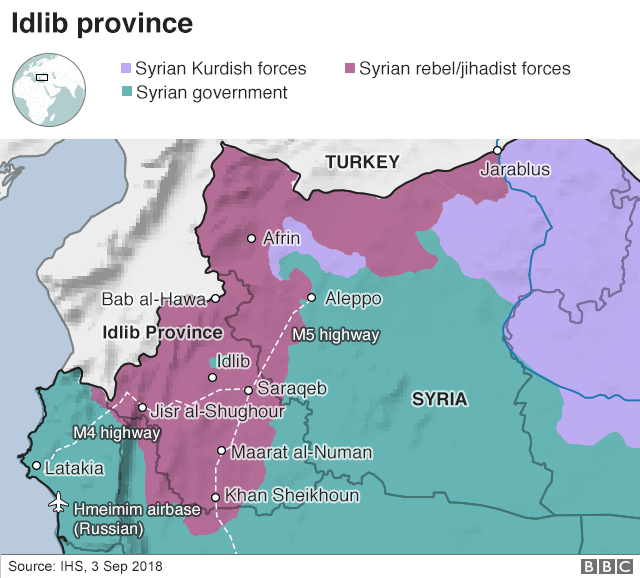
Syria war: Aleppo 'gas attack' sparks Russia strikes
Russia has carried out air strikes against Syrian rebels it accuses of launching a chemical attack on the government-held city of Aleppo.
Both Syria and its Russian allies say shells carrying toxic gas injured about 100 people late on Saturday.
State media showed images of Aleppo residents being treated in hospital as they struggled to breathe.
The rebels deny carrying out a chemical strike and say the claims are a pretext for an attack on opposition-held areas.
Parts of the Aleppo region, as well as the neighbouring provinces of Hama and Idlib, are controlled by Turkish-backed rebels and jihadists...
CYBER ISSUES
Visualizing the Geopolitics of Cyberspace
Access to the internet varies around the globe. Beyond the physical infrastructure required to connect, regional access depends largely on a country's policies and values. Equally, internet freedoms typically align with a country's level of political freedom...
INTEL GENERAL
NOTHING SIGNIFICANT TO REPORT
TERRORISM
NOTHING SIGNIFICANT TO REPORT
MISC
Why American Oil Hasn’tBeen a Total Game-Changer
The U.S. is now the world’s top producer, but Saudi Arabia still holds the key to crude prices.
The United States in recent years has stunned the globe by becoming the world’s biggest oil producer, a remarkable about-face for a country that a decade ago reeled from reliance on pricey imported crude. So why does it seem so hard to translate that so-called energy dominance from rhetoric into reality? President Donald Trump’s tweet-borne rage with the oil-price rollercoaster in recent months, and OPEC’s subsequent efforts to fix the market by adjusting the amount of oil it pumps, illustrates the frustration many in Washington feel when they see what looks like a huge U.S. energy boom failing to deliver on promises of dominance or independence.
But the reality is that the notion of energy dominance, as repeatedly trumpeted by the administration, is at heart a hollow idea. Even America’s position as the top producer in the world isn’t enough to shield it from rising prices, free it from Middle East entanglements, strangle foes with sanctions, or even give it many additional foreignpolicy tools. The ultimate irony is that what created the U.S. energy revolution—nimble, private sector companies using new technologies to extract previously untapped crude—keeps the United States from wielding its energy strength in the way that Saudi Arabia, Russia, and other big producers with state-owned firms willing to put geopolitics above profits do.
“Ironically, the precise strength of the U.S. energy sector—that it is driven by the market and not by a government—also means that it is not a stick to beat people with,” said Bruce Jones, the director of the foreign-policy program at the Brookings Institution...
Showing posts with label What's going on in the World Today. Show all posts
Showing posts with label What's going on in the World Today. Show all posts
Monday, November 26, 2018
What's Going On In The World Today 181126
HYPERLINKS MAY REQUIRE AN EMAIL:


.png?itok=CFD3Y9Su)




Sunday, January 28, 2018
What's Going On In The World Today-180128
HYPERLINKS MAY REQUIRE AN EMAIL:
USAPERSONAL NOTE: The article is long but worth the read. I'll also attach a post from earlier this year, a look in Military.com, of a potential -Day of Korean War II. Fugly is not the word.
USAF Spending Big On Technology Transition Projects
Jan 25, 2018 James Drew | Aerospace Daily & Defense Report
U.S. Air Force science and technology projects heading toward the “valley of death” should fear no evil in fiscal 2019, particularly if they relate to autonomy, directed energy, hypersonics, or low-cost and long-endurance aircraft.
The technology transition program, an Air Force budget line that funds advanced component development and prototyping, has grown exponentially since being established in fiscal 2014 and that trend is set to continue.
Funding for these projects has risen from $48 million in fiscal 2014 to almost $937 million this 2018 fiscal year, with Congress adding another $95 million to the president’s request for additional hypersonics, directed energy and long-endurance aerial platform experiments.
When the Air Force releases its budget program for fiscal 2019 in February, sources say to expect more strong support for the technology transition budget element (0604858). The funding is meant to shepherd promising technologies through the so-called valley of death, where laboratory experiments typically die if they are not immediately paired with an acquisition program for full-scale development and fielding. It achieves this by funding live component and platform tests to mature designs.
AFRICA
Chad: Government Cuts Internet To Hamper Protests
The Chadian government cut internet service, closed schools and deployed security forces to the capital city of N'Djamena in preparation for planned civil society protests against new austerity measures, Bloomberg reported Jan. 25. On Jan. 5, the government announced a plan to cut between five and 45 percent of wages for some public sector workers in order to comply with the International Monetary Fund wage ceiling that Chad agreed to in exchange for help paying off its debt.
ASIA
US to send aircraft carrier to Vietnam as ties between old foes deepen in response to rising threat of China
Decades after the US war in Vietnam, relations are increasingly anchored by shared concerns over China’s aggressive behaviour in the South China Sea
The proposed visit is scheduled for March at the central port of Da Nang, Vietnam’s defence ministry said in a statement. Such a visit by a US aircraft carrier could bring the most US forces to Vietnam since the conflict ended in 1975.
Freedom of navigation and access in the South China Sea will be critical to [Vietnam] economicallyU.S. DEFENCE SECRETARY JIM MATTIS
The arrival of a US aircraft carrier in Vietnam will be welcomed by an emerging network of countries that are nervously monitoring China’s military rise, particularly its assertive stance and island-building activities in the South China Sea. The busy waterway is a vital global trade route linking Northeast Asia with the Middle East and Europe.
In particular, the militaries of US, Japan, India and Australia are working more closely together as a “quad” of liberal democracies across what they now term the “Indo-Pacific” – moves driven by mistrust of China.
US Pacific Commander Admiral Harry Harris last week described China as a “disruptive transitional force in the Indo-Pacific” after meetings with Japanese and Indian military leaders in New Delhi.
India, Japan and Australia have all boosted military relations with Vietnam in recent years, with New Delhi providing advanced training for its emerging submarine forces and jet fighter pilots....
Preparing for a Rematch at the Top of the World
China and India faced off last year in a tense military standoff on the Doklam Plateau on the disputed Line of Actual Control (LAC) high in the Himalayas. Although the impasse was temporarily resolved in late August through a negotiated drawdown, it has been clear all along that the LAC will remain a contentious border because both countries will continue to seek an advantage in this difficult terrain.
Recent reporting, particularly in the Indian press, has highlighted how India and China are bolstering their infrastructure and forces along the LAC, including through the stationing of additional ground units near the plateau. Satellite imagery acquired by Stratfor working with its partners at AllSource Analysis helps illuminate the scope of these developments by looking at the air and air defense aspects of this strengthening of forces. Specifically, the analysis looks at four critical air bases, two Chinese and two Indian, that are within range of the Doklam Plateau. The imagery confirms that both China and India are pursuing a wide-ranging strategic buildup that has only accelerated in the wake of the Aug. 27 agreement...
Japan deploys first F-35A stealth fighter, with mission to keep tabs on North Korea
Japan on Friday has deployed its first F-35A stealth fighter, sending it to Misawa Air Base in the northeastern prefecture of Aomori to respond to airspace incursions and engage in surveillance of North Korea.
The Air Self-Defence Force plans to deploy nine more F-35As at the base in the next financial year from April to form a squadron of 10 fighter jets.
Defence Minister Itsunori Onodera told reporters: “The deployment of the high-performance F-35 aircraft is significant for Japan’s security at a time when neighbouring countries have been quickly building up their air force capabilities in recent years.”
Why America’s stealth jet forces should fear China’s new unarmed eye in the sky [1] An F-35 stealth fighter at a Mitsubishi Heavy Industries Ltd plant in Toyoyama, Nagoya Prefecture. Photo: Kyodo
The ASDF aims to eventually acquire a total of 42 F-35As, which are known for their ability to evade detection by radar. Manufactured by Lockheed Martin Corp, F-35A jet is Japan’s successor to the ageing F-4 fighter.
Japan has earmarked funds for purchasing long-range JSM missiles, capable of striking enemy bases, to be mounted on the F-35A air fleet.
But Onodera said: “The introduction of the missiles is not aimed at targeting enemy military bases. We rely on US strike capabilities for attacking enemy bases and this will remain unchanged.”
EUROPE
How Central Asian Energy Complements the Southern Gas Corridor
By Robert M. Cutler for Euractiv
It took the EU several years to move in a Central Asian direction for energy security after the US-sponsored project for a Trans-Caspian Pipeline (TCP) for natural gas fell apart in the late 1990s. Nevertheless, first through the 2004 Baku Initiative and then with the 2007 Strategy for a New Partnership with Central Asia, it began to take those steps.
The EU followed through with practical effect in 2011 when it initiated negotiations with Turkmenistan and Azerbaijan on TCP construction. Last June the Council of the European Union, evaluating the first decade of the EU Strategy for Central Asia, concluded that "the EU will continue to seek to extend the Southern Gas Corridor to Central Asia, and to further promote the EU's multilateral and bilateral energy cooperation" with the countries involved.
Key in this policy are not only the TCP but also the White Stream pipeline, planned to transport Turkmenistan's gas from the South Caucasus directly to EU territory, from Georgia under the Black Sea to Romania. The gas would then flow through existing infrastructure in Ukraine, Slovakia and Czechia to Germany and neighbouring countries. It can also feed new infrastructure being created, such as the Bulgaria-Romania-Hungary-Austria pipeline (BRUA).
AFGHANISTAN
NOTHING SIGNIFICANT TO REPORT
CHINA
Why America’s stealth jet forces should fear China’s new unarmed eye in the sky
China is developing a surveillance plane designed to be launched from the country’s newest aircraft carrier and fitted with a radar system to spot enemy stealth jets, military observers say.
State media confirmed for the first time on Monday that China was building its first carrier-borne early-warning plane called the KJ-600.
The announcement comes as the United States has deployed F-35 stealth jets to bases in Japan and other parts of the Asia-Pacific over the last year, challenging China’s air defences in the region.
Chinese military observers said the KJ-600 would be fitted with an advanced active electronically scanned array, or AESA, radar which could enable it to spot stealth aircraft such as US F-22s and F-35s.
Beijing-based military expert Li Jie said the new surveillance plane could also become a command centre in the air...
IRAN
Hacking: Another Weapon in the Asymmetrical Arsenal
Scott Stewart
Iran's Islamic Revolution could play out, in part, online. On Jan. 4, the Carnegie Endowment for International Peace published a report describing the country as a "third-tier cyberthreat." The report's authors note that despite Iran's success with cyberattacks such as Shamoon and a spear-phishing campaign that hit Deloitte and several other companies, Iranian attacks generally feature poor tradecraft. As a result, investigators haven't had much trouble tracking cyber operations back to the Islamic republic, whether because the attack code contained Farsi terms or because its associated IP address traced to Iran. Iranian spear-phishing attacks, likewise, frequently suffer from their perpetrators' poor command of the English language.
But even if its capabilities pale in comparison with those of Russia or China, Iran is still a cyberthreat, albeit a third-tier one. The Carnegie Endowment's report about the country's adoption and use of an asymmetrical weapon such as hacking called to mind the way governments and their agents have come to embrace and employ terrorism. Looking at the manner in which state sponsors, proxies and non-state actors have practiced terrorism can offer a useful framework for understanding how countries could turn hacking into a more dangerous tool of asymmetrical warfare...
IRAQ
NOTHING SIGNIFICANT TO REPORT
ISRAEL
NOTHING SIGNIFICANT TO REPORT
KOREAN PENNSULEA
Limited Strikes on North Korea Would Be an Unlimited Disaster
There’s no clear upside — and plenty of potential downsides — to punching Pyongyang in the nose.
Luke O'BrienJanuary 22, 2018, 10:09 AM
Many commentators across the national security community, such as Edward Luttwak, Michael J. Green, Matthew Kroenig, Oriana Skylar Mastro, and others, have the same bright idea for how to get North Korean leader Kim Jong Un to swear off further ballistic missile and nuclear warhead testing: Punch him right in the metaphorical nose.
The idea is that by hitting the right — and largely symbolic — target inside North Korea, we can find a sweet spot of escalation that’s light enough not to goad the North into a major war but painful enough to make them think twice about further testing of weapons of mass destruction. To quote one proponent, “Limited strikes should be targeted carefully and focused on North Korea’s specific provocation. A good start would be to take out the next North Korean intercontinental test missile on its launch pad.” As for the risk of a response, “If Kim can be deterred, as [critics of a strike] suggest, he will react in a way that risks few lives and leave
The allure of a punitive strike on North Korea is its seeming simplicity. North Korea continues its missile testing, or opts to detonate another nuclear device in a test shaft, and the United States fires a few missiles and fixes the problem. But this conclusion comes from a series of bad assumptions. We assume that the North Korean regime can detect with any realistic degree of confidence that a limited strike is in fact limited. We assume that North Korea will only analyze the costs and benefits of retaliating based on the merits of a fleeting crisis. And we assume that Kim Jong Un’s power is limitless and that he has none of his own constituencies to placate in the hours and days after a strike.
These assumptions are shaky at best. North Korea’s early warning network, fragile enough that a clean strike seems somehow viable, is more likely apt to encourage Pyongyang to take more aggressive action. Kim doesn’t have to consider just the ensuing hours and days after a strike, but also many years (and presumably other crises) in the future. And Kim is riding a tiger, and opting to blink will likely lead to his being thrown and eaten....


RUSSIA
NOTHING SIGNIFICANT TO REPORT
SYRIA
NOTHING SIGNIFICANT TO REPORT
MIDDLE EAST GENERAL
Saudi Arabia: The Crown Prince's Corruption Crackdown Is Over, for Now
When a Saudi public prosecution official announced the end of the anti-corruption campaign, it looked more like the end of a first phase than the end of an era. The splashy infographic posted on Twitter left big questions about the corruption campaign's future, as well as the status of Saudi billionaire Alwaleed bin Talal. Released in English, the announcement was almost certainly aimed at reassuring international investors. As the Saudi government gears up for an initial public offering of Saudi Aramco stock sometime this year or next, investors are looking for stability, transparency and certainty...
MISC
Stratolaunch's Gigantic, Rocket-Hauling Aircraft Could Fly in 2019
But by then, no one may care.
According to National Geographic, a full-grown male African elephant (Loxodonta africana) masses up to 7 tons. In contrast, Stratolaunch's "Roc" -- the massive rocket-hauling carrier aircraft that the space company unveiled at the end of May -- weighs in at 250 tons.
Despite the difference in size, I suspect we'll soon discover that Stratolaunch's Roc is just a gigantic white elephant, too. Here's why.
Stratolaunch is a creation of Microsoft co-founder Paul Allen. Its new Roc is built by Northrop Grumman (NYSE:NOC) subsidiary Scaled Composites. The plane, essentially designed as a scaled-up (pun intended) version of Orbital ATK's (NYSE:OA) Stargazer project, is intended to fly to high altitude and there release a rocket that will ignite in the sky and blast its payload the rest of the way into orbit.
Whereas Orbital ATK uses a modified Lockheed Martin (NYSE:LMT) L-1011 aircraft as its carrier aircraft, though, Stratolaunch has designed an entirely new aircraft to fulfill this purpose. A beast of a machine with a 385-foot wingspan (wider than a football field is long) and sporting six Pratt & Whitney PW4000 engines (the same engines that power a Boeing (NYSE:BA) 747), the Roc stands 50 feet tall and measures 238 feet from nose to tail. It's so big, it needs 28 wheels to support its weight as it trundles down the runway.
In flight, the Roc is designed to sling a rocket between its two fuselages, carry it to 35,000 feet, and there release it to blast off into space -- at which point the Roc would return to land and load up with another rocket for launch.
Regarding rockets
Speaking of that rocket, there is one small issue with Stratolaunch: There don't currently seem to be any rockets of the size it wants to carry that are suitable for air launch.
The Roc is designed to carry rockets weighing up to 275 tons, you see. (Thus, between the plane's 250-ton empty weight, 125 tons of aviation fuel for the plane itself, and a further 275 tons for the payload, the Roc would weigh 650 tons at takeoff -- about the same mass as an Airbus A380 fully loaded with passengers.) But Stratolaunch hasn't yet found a rocket of that size that can launch safely from midair.
Failing that, the latest plan is to have Stratolaunch instead carry "multiple" (three are depicted in Stratolaunch's artist depictions) Orbital ATK Pegasus XL rockets and deploy them in series.
Here's another problem with Stratolaunch: Using a huge airplane to help launch even "multiple" small rockets seems to defeat the purpose of building the huge airplane in the first place. After all, there are already at least two companies (Virgin Orbital and Orbital ATK itself) with aircraft that are suitable for air-launching small satellite rockets.
Plus, Orbital's Pegasus XL rockets only mass about 25 tons each. So even if Roc can carry and launch three Pegasus XL rockets at a time, in so doing, it would utilize only 75 out of its 275-ton lift capacity. Simply put, Roc is overkill for this purpose.
A solution in search of a problem
This, in turn, leads us to consider another problem with Stratolaunch. Namely, the company boasts that Roc has a "payload" capacity of 275 tons -- which sounds like a lot. After all, the biggest payload that SpaceX's famous Falcon 9 reusable rocket can carry to low earth orbit is 22.8 tons. The Lockheed Martin-designed Atlas V rocket operated by United Launch Alliance maxes out at 18.85 tons, while the Boeing-designed Delta IV tips the scales at 28.37 tons of capacity.
But this doesn't mean that Stratolaunch's Roc is 10 times more capable than its nearest ground-launched rocket competitor -- far from it. You see, the Roc's "275-ton payload" refers to the size of the rocket the Roc will carry. The ultimate payload -- the satellite that that rocket itself would put in orbit, is much smaller.
How much smaller? Multiply the Pegasus XL's 0.443-ton payload times the three Pegasi the Roc might be able to carry, and it looks like the most payload Roc can put in orbit is about 1.3 tons -- about 93% less than Lockheed's Atlas, 94% less than SpaceX's Falcon, and 95% less than Boeing's Delta.
Better never than late?
With stats like that, it's hard to see how Stratolaunch can hope to compete with any of these companies. And it gets worse. At the same time as Stratolaunch is trying to compete with SpaceX, Boeing, and Lockheed in the market for large satellite launches, space companies are gravitating toward launching more, smaller satellites instead -- and a new generation of small space-launch companies is springing up to serve this market.
So, what's the upshot for investors here? At last report, Stratolaunch was believed to have invested $300 million in getting the Roc ready for testing. As of last week, this investment has finally produced a plane, but Stratolaunch isn't expected to actually be ready to launch rockets before 2019 at the earliest.
By then, the Roc could already be obsolete -- and en route to extinction.

Thursday, January 25, 2018
What’s Going On In The World Today-180124
HYPERLINKS MAY REQUIRE AN EMAIL:
USA
Alleged CIA China turncoat Lee may have compromised U.S. spies in Russia too
The arrest last week of a former CIA officer suspected of spying for China exposed one of the most significant intelligence breaches in American history. But the damage is even worse than first reported, sources familiar with the matter tell NBC News.
A secret FBI–CIA task force investigating the case concluded that the Chinese government penetrated the CIA's method of clandestine communication with its spies, using that knowledge to arrest and execute at least 20 CIA informants, according to multiple current and former government officials.
American officials suspect China then shared that information with Russia, which employed it to expose, arrest and possibly even kill American spies in that country, said the current and former officials, who declined to be named discussing a highly sensitive matter. The possible sharing with Russia has not previously been reported.
Those sobering findings, sometime after the inquiry began in 2012, led the CIA to temporarily shut down human spying in China, and to overhaul the way it communicates with its assets around the world, according to former government officials familiar with the case.
It was a shocking blow to an American spy agency that prides itself on its field operations. There was also a devastating human cost: Some 20 CIA sources were executed by the Chinese government, two former officials said — a higher number of dead than initially reported by NBC News and the New York Times. Then an unknown number of Russian assets also disappeared, sources say.
Eventually a top secret joint FBI-CIA task force investigation led authorities to suspect that former CIA case officer Jerry Chun Shing Lee had been spying for China. Lee, 53, was arrested this week and charged, not with espionage, but with a single count of possessing classified information.
U.S. officials told NBC News they don't believe Lee ever will be charged as a spy, in part because they don't have all the proof they might need, and in part because they would not want to air the evidence they do have in a public courtroom...
The Pentagon Wants Its Nuclear Tomahawks Back
The Trump administration will embark on a “big-league” revival of the U.S. nuclear complex after decades of decline by reviving production of plutonium cores for new warheads and reintroducing a sea-launched cruise missile, among other plans.
A leaked draft of the 2018 Nuclear Posture Review confirms what has been foreshadowed by U.S. military leaders over the past year: America will respond to the growing might of the nuclear forces of China and Russia, as well as emerging threats from North Korea, by broadly modernizing its outdated nuclear arsenal of Cold War-era bombers, submarines, missiles and nuclear-certified tactical fighters.
The draft policy, if adopted, would “move forward without delay [and] seek opportunities to accelerate” every key modernization program set in motion by the previous administration. This includes the Columbia-class submarine, Northrop Grumman B-21 bomber, Ground-Based Strategic Deterrence ballistic missile, Long-Range StandOff cruise missile, dual-capable Lockheed Martin F-35A Joint Strike Fighter and B61-12 guided free-fall bomb...
AFRICA
NOTHING SIGNIFICANT TO REPORT
ASIA
NOTHING SIGNIFICANT TO REPORT
EUROPE
NOTHING SIGNIFICANT TO REPORT
AFGHANISTAN
NOTHING SIGNIFICANT TO REPORT
CHINA
Who Would Lose More in a U.S.-China War of Reciprocity?
The United States spent 2017 laying the groundwork needed to aggressively pressure China on trade and investment in 2018. Now it appears the pressure is on. On Jan. 17, InsideTrade reported that the administration of U.S. President Donald Trump is contemplating setting up a system of reciprocity on Chinese foreign direct investment in the United States. Under that system, the United States would treat Chinese investment into U.S. sectors the same way China treats U.S. investment into its analogous sectors. It would fall to Chinese investors to prove their desired investments would be allowed under Chinese investment rules.
Rather than limit Chinese investment, the Trump administration seems to want to force China to change its investment policies — which it has been slowly doing albeit at levels far below those expected. The risk Washington is taking, however, is enormous. The plan could face significant legal challenges internationally and domestically. And it could also harm U.S. businesses depending on Chinese investment or those with investments in China at risk of Chinese reciprocation...
...Chinese Foreign Minister Wang Yi told his North Korean counterpart, Ri Yong Ho, in a meeting in the Philippines on Aug. 6 that Pyongyang should stop carrying out nuclear and missile tests, BBC reported...
IRAN
U.S. Sanctions Abet Iranian Internet Censorship
If the United States wants to stand behind the next #IranProtests, it should liberalize rules that impede access to cutting-edge tools against repression.
President Donald Trump has threatened to pull out of the Iran nuclear agreement if Tehran does not agree to renegotiate its terms this spring. But rather than tear up the nuclear agreement, the Trump administration should work to support the next #IranProtests — which would be far more likely to bring change to Tehran than would a U.S. withdrawal from the nuclear deal.,,
For the Iranian Internet, It's High Speed, High Control
Highlights
Iran has learned its lessons from the Green Movement of 2009 to hone a better system of managing the flow of information within the country.
Instead of shutting down the internet at the first sign of trouble, Iranian authorities have developed a system of separating approved domestic web activity from sources of potential subversion.
President Hassan Rouhani promised a freer internet in his last election campaign, but his plans have been largely co-opted by conservatives operating a new national cyber network.
The storm has passed, and Iran's internet is starting to return to all systems go. When people in cities across the country began protesting a litany of issues at the end of last month, Iran's leaders did what many countries have done when confronted with such a situation: They imposed restrictions on the internet. But unlike some countries that have reached for a sledgehammer to swat a fly, Iranian officials didn't opt for an absolute shutdown of the country's internet. Instead, they resorted to more nuanced measures that showed they have succeeded in developing a far more sophisticated infrastructure to manage the web since the country last experienced such turmoil in 2009.
The emergence of the internet and other communications platforms has led to an unprecedented increase in the access to information, but such developments have led countries to pursue measures to control and filter the digital flow. China has developed one of the world's most comprehensive internet control mechanisms with the Great Firewall, and now Iran has its own monitoring success story. Iran's National Information Network may lack the name cachet of the Great Firewall, but its performance in strangling access to opposition content during the most recent protests proved that Iran is hard on China's heels in terms of controlling the flow of information. What's more, the network might just strengthen the hand of Iranian conservatives in co-opting President Hassan Rouhani's attempts to foster a more open Iranian internet.
IRAQ
NOTHING SIGNIFICANT TO REPORT
ISRAEL
NOTHING SIGNIFICANT TO REPORT
KOREAN PENNSULEA
Security at the 2018 Winter Olympics
RUSSIA
Has Russia’s Robotic Nuclear Torpedo Surfaced?
The prospect of a quiet, long-range drone that can obliterate a port is unnerving enough. That it comes amid Russia's newfound assertiveness only adds to U.S. concern.
In 2015, Russia television "accidentally" showed a glimpse of plans for a proposed new 100-megaton autonomous torpedo designed to destroy American ports and poison the coastline of any adversary it targets. Analysts were left wondering whether the blueprints were a sign that Moscow was returning to the good old days of bizarre Cold War weapons development—or just bluffing to keep the Yankees off balance.
The U.S. government still appears to believe that the weapon is a real Russian program, according to a leaked draft of the Trump administration's forthcoming Nuclear Posture Review obtained by the Huffington Post.
Jeffrey Lewis, a scholar at the Middlebury Institute of International Studies, first noticed a brief reference to the weapon in a section of the report listing "New Nuclear Delivery Vehicles Over the Past Decade." The grainy, photocopied graphic shows the outline of "Status 6," an abbreviation of Russia's designation for the weapon, alongside the acronym "AUV"—short for autonomous underwater vehicle—in a column detailing sea-based nuclear modernization efforts of Russia and other countries over the past seven years. The review also references Russia's development of a "nuclear-armed, undersea autonomous torpedo" that matches the description of the weapon originally shown on Russian TV.
Little is known about the oceanic dirty bomb outside of its brief debut in Russian media. A November 2015 Channel One broadcast covering a meeting between Russian President Vladimir Putin and senior military officials briefly showed a slide with an artist's rendering of the weapon—a glimpse described as an accidental leak of classified information by the Kremlin and assessed by some Russia watchers as an entirely intentional threat from Moscow.
H.I. Sutton, Covert Shores
The slide asserts that the drone can travel at a speed of more than 100 knots for as far as 10,000 kilometers, while sporting a 100-megaton nuclear warhead. Noting that “an important object of war is against the economy in coastal regions," it claims the "Status-6 Oceanic Multipurpose System" is capable of "guaranteeing mortal damage to the territory of countries, creation of zones of radioactive pollution unfit for carrying out military, economic and other activities."
A year later, the Washington Free Beacon carried a report claiming that the Pentagon had detected a Russian Sarov-class submarine carried out a test of the Status-6 weapon in November 2016. An intelligence assessment leaked to the outlet affirmed that the weapon, known to the Defense Department as "Kanyon," would carry megaton-class nuclear warheads.
The prospect of a new quiet, long-range drone that can swim up to the U.S. coast and obliterate a port along with the environmental viability of the surrounding areas was unnerving enough. That it came amidst Russia's newfound assertiveness to challenge the West only added to the concern among American policymakers...
SYRIA
Turkey has sent six howitzers and tanks with military vehicles to its Kilis province, which borders the Kurdish-controlled Afrin region of Syria, Reuters reported Aug. 5.
MIDDLE EAST GENERAL
NOTHING SIGNIFICANT TO REPORT
MISC

Wednesday, August 24, 2016
What's Going On In The World Today 160824
HYPERLINKS MAY REQUIRE AN EMAIL:
USA
The NSA Has a New Disclosure Policy: Getting Hacked
On Monday, when tech executives arrived in their offices, just days after a mysterious group of hackers released what they claimed were a set of NSA hacking tools, a familiar and frustrating pattern was taking shape. America’s premier signals intelligence agency had once again discovered unknown flaws in products used to secure computer networks around the globe, but instead of telling the manufacturers, the NSA pocketed those flaws, like skeleton keys that would let them open doors to others’ networks whenever and wherever they wanted.
If the tools released by the group known as the “Shadow Brokers” are legitimately from the NSA — and security researchers and agency veterans say that they appear to be — the agency now faces a fresh round of questions about how the breach occurred and when the agency found out.
That’s because the data released by the Shadow Brokers contained what are known as “zero days,” software flaws that are unknown to the manufacturer of a piece of software or hardware, and thus flaws for which no patch is even in the works.
Stockpiling such vulnerabilities is part of an international arms race in cyberspace. Last weekend’s dump exposed what is likely a small part of the American arsenal of such high tech battering rams, and it has reignited a debate among security researchers about whether the government should be stockpiling them, or if it should be revealing those vulnerabilities to manufacturers to make American networks more robust…
AFRICA
NOTHING SIGNIFICANT TO REPORT
ASIA
Japan eyes fighter drone, seeks record defense budget amid China assertiveness
Japan aims to develop a prototype drone fighter jet in two decades with private sector help in a technology strategy that focuses on weapons communications and lasers, according to a document seen by Reuters.
The plan will be announced this month when the Defense Ministry also unveils its request for a record budget of 5.16 trillion yen ($51 billion) for fiscal 2017, as tension rises in the East China Sea and North Korea steps up its missile threat, government officials with direct knowledge of the matter said.
The military technology plan calls for first developing an unmanned surveillance aircraft in the next decade and then an unmanned fighter jet 10 years later, the document showed.
The rise of 2.3 percent over this year's budget of 5.05 trillion yen marks the fifth successive annual increase sought by the ministry, which is keen to stiffen Japan's defenses as North Korea upgrades its ballistic missile technology…
…The defense ministry's request covers the 100 billion yen cost to upgrade Japan's PAC-3 missile defense system, said one government source, who declined to be identified, as he was not authorized to speak to the media.
Such an upgrade would roughly double the missile system's range to more than 30 km (19 miles), other sources have said.
The budget proposal also includes the cost of production of the Block IIA version of the Standard Missile-3 system being jointly developed with the United States to shoot down missiles at higher altitudes, the source added.
The ministry will also allocate budget funds to acquire an upgraded version of the F-35 stealth fighter, made by U.S. company Lockheed Martin Corp, the source said…
South Korea's 'Razor Reef' Deters Illegal Fishing
Summary
Since an international tribunal ruled in July on maritime control in the South China Sea, countries in the region have become more focused on protecting and managing the maritime resources that will continue to shape relations throughout the Asia-Pacific. Now, South Korea is placing some 80 new artificial reefs near the islands along the Northern Limit Line, the maritime extension of the Demilitarized Zone that divides the Korean Peninsula. The reefs offer a creative solution to a complex problem, enabling Seoul to manage dwindling fish stocks, curtail illegal Chinese fishing and address the potential for future confrontations with North Korea all at the same time...
North Korea: Missile Test-Launched From Submarine
North Korea launched a submarine-based ballistic missile off its east coast on Aug. 23, the South Korean military said, Reuters reported. The launch coincides with annual joint military exercises between the United States and South Korea that are currently underway. This was just the latest in a series of missile launch tests by North Korea, which has long pursued a strategy of nuclear deterrence.
EUROPE
European Banks' Struggles Will Continue
MEXICO/LATIN AMERICA
Cuba: Iranian Foreign Minister Promises Stronger Ties With Havana
Iranian Foreign Minister Javad Zarif said his visit to Havana on Aug. 22 would begin a new chapter in Iran-Cuba relations, Reuters reported. The trip is the first stop on his six-day tour of Latin America, which will include meetings in Chile, Nicaragua, Bolivia and Venezuela. It follows Cuban Economy Minister Ricardo Cabrisas' visit last week to Tehran, where he met with Iranian President Hassan Rouhani. Iran is trying to improve its foreign trade now that sanctions against it have been lifted. Zarif's Cuban counterpart congratulated Iran on reaching a deal on its nuclear program and reiterated Cuba's support for all countries seeking to develop nuclear energy. Cuba and Iran both have had conflict-ridden relationships with the United States and have been accused by the United States of sponsoring terrorism.
Central America: El Salvador, Honduras and Guatemala To Launch Anti-Gang Force
The leaders of El Salvador, Honduras and Guatemala signed an agreement Aug. 24 in San Salvador to establish a joint force that would combat organized crime and drug trafficking, Reuters reported. The new force would mount coordinated operations, enhanced by shared intelligence and expedited extradition procedures. No details were released about the composition of the force. The three Central American nations are beset by violence among its criminal groups, which have spurred migration north to the United States.
AFGHANISTAN
Afghanistan: Truck Bomb Explodes Outside Hotel Compound
A truck bomb claimed by the Taliban detonated outside of a hotel used by foreign contractors in Kabul early Aug. 1, causing heavy structural damage to a nearby empty compound but failing to inflict damage on its target, police officials said, Reuters reported. The blast, which killed the driver, took place just outside the Northgate Hotel. Two other attackers were reportedly shot dead by police in an ensuing firefight, during which officials say one officer was killed and four others were wounded. The Taliban, which often exaggerates the damage caused by its attacks, said the bombing caused dozens of casualties. Even after recently replacing fallen leader Mullah Akhtar Mansoor, the Taliban has sustained its insurgency.
CHINA
China: World’s First Quantum Communication Satellite Launched
China launched the world’s first quantum communication satellite into space early on Aug. 16, Xinhua and the South China Morning Post reported. The government hopes the satellite will facilitate “hack-proof” communications between space and the ground, particularly Beijing and the Xinjiang capital of Urumqi. According to the report, quantum communication boasts ultra-high security as a quantum photon can neither be separated nor duplicated, making it impossible to wiretap, intercept or crack the information transmitted through it. China is following in its neighbors' footsteps, and its emergence as a global force in technology development is only a matter of time.
China's first indigenous aircraft carrier nearing completion
Airbus Defence and Space imagery showing the Type 001A hull in dry dock at Dalian. The hull is largely complete, with just one aircraft elevator, superstructure, and some deck sections left to be added. Source: CNES 2016, Distribution Airbus DS/© 2016 IHS
Airbus Defence and Space imagery captured on 11 August 2016 shows significant activity related to China's People's Liberation Army Navy (PLAN) projects at Dalian Shipyard, including the assembly of the country's first indigenous aircraft carrier (CV), the Type 001A, and the production of Type 052D guided-missile destroyers (DDGs).
The imagery shows that, with the addition of the bow section and other exterior components, the assembly of the Type 001A CV is nearly complete. Two of the component fabrication areas adjacent to the dry dock are largely clear of materials, indicating that work on the Type 001A hull is nearing an end. Few uninstalled components remain present, including the forward aircraft elevator.
Additional components awaiting installation relate to the superstructure. Two modules, consisting of portions of the forward and aft sections of the superstructure, can be seen in one of the component fabrication areas.
Apart from sections of deck plating, which remain uninstalled to facilitate access to internal areas, the superstructure is the final significant external feature awaiting installation. The presence of superstructure modules suggests installation could occur in the near term.
Across the harbour from the Type 001A's dry dock, work on Dalian's three Type 052D DDG hulls is progressing. One hull remains in dry dock, with two pier side. The first hull is visibly complete and is undergoing sea trials, while the second hull, launched on 3 August 2016, awaits the installation of various components.
Berthed at the northern end of the ship yard, the second hull lacks many sensor and weapon fittings. Notably absent are the forward 130 mm gun, the forward vertical launch system, and various sensor fittings, including the Type 366 radar mounted atop the bridge.
IRAN
NOTHING SIGNIFICANT TO REPORT
IRAQ
NOTHING SIGNIFICANT TO REPORT
ISRAEL
Obama to Israel: Our Tax Dollars Won’t Go to Your Defense Contractors
Washington and Jerusalem are about to ink a groundbreaking arms package, but it hinges on ending sweetheart deals for Israel’s defense firms.
Obama to Israel: Our Tax Dollars Won’t Go to Your Defense Contractors
The United States and Israel are close to clinching a massive 10-year arms deal, but Washington is pushing to scrap a coveted provision that has allowed Israel to pump hundreds of millions of dollars directly into its defense industry…
Israel: Hezbollah behind explosives found near Lebanon border
Defense official says 3 charges discovered by farmer in Metulla last month were to be used in attacks against IDF, civilians
Explosive devices discovered in a field by a farmer near the northern town of Metulla last month were smuggled into Israel from Lebanon by Hezbollah, Israel Radio reported Sunday.
An unnamed defense official told the radio station that the three makeshift charges uncovered in a field were likely meant to be used in attacks against Israelis.
It wasn’t clear who was meant to collect the devices, though the Lebanon-based terror group has recently ramped up efforts to recruit Palestinian operatives from the West Bank, the Gaza Strip, and within Israel using social media.
Last week, Israel’s Shin Bet security service revealed that in recent months it had broken up two Hezbollah terror cells and arrested nine local members of the organization.
Hezbollah operatives from the group’s Unit 133 — its foreign operations unit — working out of Lebanon and Gaza were recruiting operatives through Facebook to carry out suicide bombings and ambush Israel Defense Forces patrols in the West Bank. They received funding from Hezbollah, and some members had begun preparing explosive devices for use in attacks, the Shin Bet said in an August 16 statement.
The terror operatives were arrested earlier this summer, but information about the case was kept under a court-issued gag order. The Shin Bet has credited the operation with thwarting a number of terror attacks against Israeli targets in the West Bank and Israel.
In response to Hezbollah’s recruitment efforts, Israel’s ambassador to the UN Danny Danon called on the international organization to formally recognize Hezbollah as a terror group.
“The international community must condemn Hezbollah’s attempts to harm innocent Israeli civilians, and the Security Council must finally designate Hezbollah a terrorist organization,” Danon said last week in a statement.’r

RUSSIA
Putin's Chance to Change History
Twenty-five years ago, an unsuccessful coup attempt, known as the August Coup, was launched by a group of hawkish Communist Party members and security elites against Soviet President Mikhail Gorbachev, in what was widely seen as one of the key moments that led to the collapse of the Soviet Union. The coup's ring leaders, known as the Gang of Eight, were dissatisfied with Gorbachev's liberalization plans and the balancing act between the Soviet republics and Moscow. Similar conversations are being had in Moscow today — and within the Kremlin are very familiar divides.
SYRIA
What Russia's Aircraft Are Doing in Iran
Satellite imagery from Aug. 17 shows the continued presence of Russian military aviation at Hamedan air base, west of Tehran. A number of Su-34 fighter-bombers are present, with four aircraft located close to each other at the eastern end of the airfield. Photographs posted online Aug. 15 showed at least three Russian Tu-22M3 strategic bombers (also known by their NATO reporting name, Backfire) at the air base. Moscow and Tehran have officially confirmed the presence of Russian military aviation assets in Iran. Having previously used the base as a refueling stop, the Russian aircraft now appear to be conducting operations from there, striking targets in Syria since Aug. 16...
MIDDLE EAST GENERAL
NOTHING SIGNIFICANT TO REPORT
MISC
NOTHING SIGNIFICANT TO REPORT

Subscribe to:
Posts (Atom)