Police Work, Politics and World Affairs, Football and the ongoing search for great Scotch Whiskey!

Showing posts with label Space. Show all posts

Friday, October 16, 2020

Some serious nerd porn...

More unrealistic than the original.

Back in the 70s, Gerry and Sylvia Anderson had two science fiction series that did not last long in their initial run, but have lived for eternity in the TV afterlife, syndication. First was UFO, set in the 80s (the show was broadcast in 1970-71) where aliens kidnapped humans, and Supreme Headquarters Alien Defense Organization battled them. The alien ships were fought single man "Intercepters."

UFO Intercepter 


Well, time went on, the Intercepters were replaced by Hawks,

The Hawk, originated in UFO, but only scene in Space 1999 episode "War Games."


and the series was succeeded by Space 1999. Another piece of nerd porn, gone before its time.

While channel surfing the net, I found this other piece of nerd porn, combing the two series to a degree. Watching it, the thing is more unrealistic than the original concept of Space 1999. But still, it's fun to watch. Enjoy.

Wednesday, August 5, 2020

Next trip to the moon...

A few days back, our first manned mission since 2010, the SpaceX Dragon returned from the International Space Station. Elon Musk, thank you sir. NASA and the other bureaucracies said it would take 12 years and over 20 billion to get back to space. You and your company did it in 6 years for 1 billion. Well done. I know you will make money of this, as well as the other companies. Virgin Galactic has the SpaceShip2 in testing, hopefully to take paying customers soon.

Now the next major goals are the Moon again, and then Mars. As of right now, only the US has put men on the moon (and liberals, only Richard "R" Nixon's name is engraved on the plaques there...hope that burns!), but other nations and companies are working on the return. Here are some great pics and ideas. Enjoy.
Lunar Exploration Missions To Preface U.S. Artemis Launch | Aviation Week Network


Blue Origin Human Landing System

Blue Origin is developing a Human Landing System (HLS), to support the U.S.’ planned 2024 crewed Moon landing. Blue Origin’s team includes Lockheed Martin, Northrop Grumman and Draper. Blue Origin leads work on the HLS descent element; Lockheed, the reusable ascent element; Northrop, the transfer element that delivers the landing system from a high to a low lunar orbit for the final descent; and Draper, the guidance and avionics elements. Blue Origin, owned by Amazon CEO Jeff Bezos, was awarded a $579 million fixed-price contract under the solicitation, which is more than half of the $967 million set aside in NASA’s fiscal 2020 budget for HLS development...

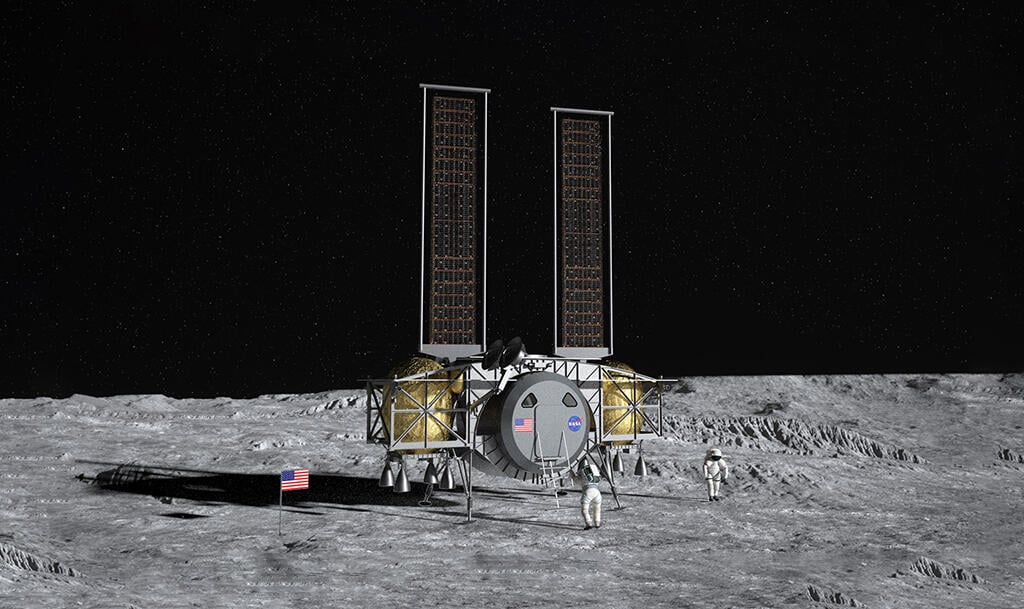
Dynetics two-person lunar lander

Dynetics, a subsidiary of Leidos, is making a two-person crew module that would allow for astronauts to live on the Moon’s surface for about a week. It also has been designed to ferry four suited crewmembers from the Moon to an orbiter and back...


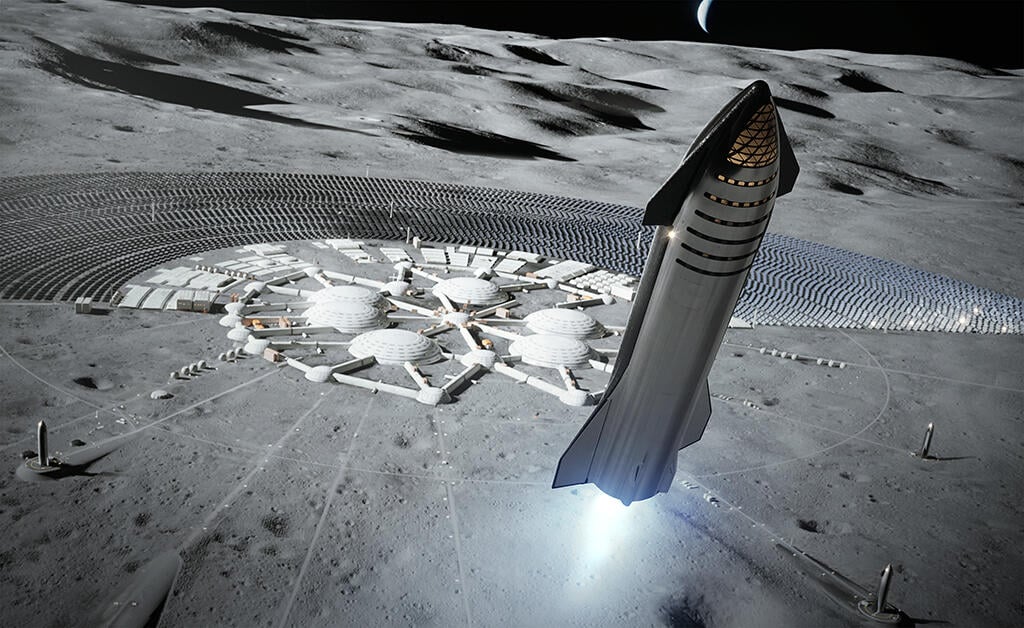
SpaceX Starship launch system

NASA has given SpaceX $135 million to develop a variant of its Starship launch system. The rocket would bring astronauts from lunar orbit to the Moon’s surface and back. But the company envisions the Human Landing System as having the ability to ferry astronauts from Earth, with the spacecraft to be refueled by a Starship parked in low Earth orbit and then carrying on to lunar orbit...

...iSpace Hakuto-R lunar lander

Japanese Private Mission

The Japanese company iSpace plans to perform its first Hakuto-R mission, a soft landing on the Moon, in 2021. If successful, iSpace would be the first private Japanese company to land on the lunar surface.

India’s Chandrayaan-3

India had been planning to launch a third mission to explore the Moon by the end of 2020 or early 2021. Delays due to the COVID-19 pandemic are likely to push the launch on a Geosynchronous Satellite Launch Vehicle Mk. 3 further into 2021...


Volatiles Investigating Polar Exploration Rover

Astrobotic has several NASA contracts—the latest one was awarded in June and is to deliver the Volatiles Investigating Polar Exploration Rover to the lunar south pole in 2023 to search for water ice. The company already has two efforts underway as part of NASA’s Commercial Lunar Payload Services program, including one to deliver the Peregrine lander in 2021 and another to produce a 13-kg (29-lb.)...


Intuitive Machines lunar lander

Intuitive Machines has a NASA Commercial Lunar Payload Services agreement and plans to launch a lander in October 2021 on a SpaceX Falcon 9 to a site on the Moon’s northern hemisphere. The mission will carry five science and technology payloads selected by NASA to help with its plan to put humans on the Moon in 2024...


Masten Space Systems XL-1 lunar lander

Masten Space Systems has contracts to launch, land and oversee the operations of eight science payloads in 2022 under NASA’s Commercial Lunar Payload Services effort. It will integrate the experiments on its XL-1 lander...

Progress. And the efforts seem to be more thanks to capitalism than government contracting. Quark would be so proud!

Monday, December 11, 2017

These are the Voyages of Voyager I and Voyager 2

One of the few useful things from the Carter years, the launch of Voyager 1 on September 5, 1977. Ironically, Voyager 2 was launched on August 20, 1977. They were initially planned to go into the Jupiter area, but they have made it to the outer edge of the our solar system. 60 Minutes did a great story on the Voyagers a couple of months ago, and it's worth a few minutes of your time.

NASA fired up Voyager 1’s backup thrusters for the first time in 37 years

NASA is getting really good at squeezing every last bit of life out of its hardware. It recently extended the Dawn spacecraft’s mission over Ceres for a second time, while New Horizons is on its way to check out a small icy body called 2014 MU69 in January 2019. Yesterday, NASA announced that it has successfully fired up four of Voyager 1’s backup thrusters, which haven’t been used since 1980, which should extend its life by a couple of years.

Voyager 1 is the only human-made object flying outside of our solar system, and it’s still communicating with Earth by way of the Deep Space Network, which allows engineers to send it instructions. The probe currently uses its attitude control thrusters to make tiny corrections — firing for only milliseconds at a time — to rotate it to point its antenna towards Earth. However, since 2014, engineers have found that those thrusters have been wearing down, and aren’t as effective.

The JPL’s engineers began to look into alternatives, and found a new way to steer the spacecraft: the probe’s trajectory correction maneuver (TCM) thrusters. These are located on the back of the spacecraft and are identical to the thrusters that they’ve used so far. The last time these thrusters were active was in November 1980, when the probe zipped by Saturn. They haven’t been used since then, and on Tuesday, the Jet Propulsion Laboratory fired them up for the first time, and discovered that they worked. According to Voyager project manager Suzanne Dodd, the reactivated thrusters should help extend the life of the probe for another “two to three years.”

The team will switch over to the TCM thrusters in January, but there is a drawback: they require heaters to operate, which will draw on the probe’s limited power. The team will use the thrusters until they can no longer use the heaters, and will then switch back to the attitude control thrusters that they’ve been relying on. The JPL will also test out the TCM thrusters on Voyager 1’s twin, Voyager 2, although NASA says that that spacecraft’s attitude control thrusters are in better shape.

Well, we're not up to Voyager 6 yet, so we should not be worried about the VGER coming to attack us in the 23rd Century.

Sunday, December 18, 2016

China air power....

Some interesting looks at China's power projection assets. I wrote my master's thesis on the rise of China and her threat to the West. They are investing a fortune in bringing power projection up to American standards and here are two example, a new fighter and space operations.


The Mighty Dragon: A Symbol of China's Maturing Air Force

Forecast

China's new stealth fighter, the J-20A Mighty Dragon, showcases the Chinese air force's remarkable progress over the past two decades.

Nevertheless, significant deficits in equipment and training will continue to hamper further advances.

China will focus its efforts on resolving bottlenecks, including lags in engine development and insufficient combined-arms drills, as it seeks to build up its air force in the coming years.
Analysis

Two sleek Chinese stealth fighters streaked across the skies over Zhuhai on Nov. 1, marking the official debut of Beijing's brand new J-20 Mighty Dragon jet. One of the only fifth-generation stealth fighters ever built, the aircraft's unveiling is a symbol of the impressive progress China's air force has made over the past two decades. The stealth fighter's design, however, also contains several important weaknesses, a reminder of the limitations in military aviation China is still struggling to overcome…

Better, but Imperfect

Just 20 years ago, the bulk of the Chinese air force consisted of vintage aircraft from the 1950s and 1960s. Now, China is on track to become the second country in the world to field a fifth-generation stealth fighter, a rather remarkable feat. As it is currently designed, the J-20 is a large fighter jet that boasts a considerable payload and fuel capacity, making it well-suited for operations requiring travel over long distances. Moreover, the aircraft is equipped with cutting-edge stealth technology, KLJ-5 Active Electronically Scanned Array radar, and infrared search and tracking systems.

…But the Mighty Dragon is not without its flaws. Chief among them is the fact that it is underpowered: Chinese engineers expect the jet to someday run on the powerful WS-15 engine, but since it is still in development, initial batches of J-20 aircraft will likely be forced to make do with a modified version of the weaker Russian AL-31F engine. Because these engines cannot adequately support a heavy fighter like the J-20, they will reduce its ability to maneuver in combat. Furthermore, the Mighty Dragon is not as clandestine as other fifth-generation stealth fighters, such as the American F-22. (The latter is what is known as an all-aspect stealth fighter, boasting low detectability from all angles, while the J-20 has low detectability only from the front.)

A Work in Progress

The Mighty Dragon's strengths and weaknesses are emblematic of the Chinese air force's modernization at large. On one hand, Beijing has much to be proud of when it comes to its air capabilities. China is putting ever more capable fighter jets into production, including significantly upgraded versions of older models such as the J-10B, J-16 and J-11D. Meanwhile, it is also overhauling its bomber force, and new aircraft such as the H-6K are already being mass-produced. China is in the process of expanding its air-launched missile stockpile as well, and U.S. Gen. Herbert Carlisle has cited Beijing's development of variants such as the PL-15 beyond-visual-range missile as a compelling motive for Washington to improve its own air-to-air missiles. Finally, China is increasing its strategic and tactical transport capabilities.

Nevertheless, the Chinese air force still has a long way to go in a number of areas. Delays in engine development are slowing the evolution of transport and bomber aircraft as well as fighter jets. China is also well behind other major powers, such as the United States and Russia, in building a comprehensive aerial refueling force. (Currently, it has too few aerial refueling tankers to service its large fleet.) Moreover, Beijing continues to rely on imports of foreign warplanes as it hashes out the final details of its own domestically made machines. In fact, it bought 24 Su-35 fighter aircraft from Russia just last year.

…Elevating the skills of air and ground crews will take time and effort, and China still has many deep-seated structural issues to resolve. Historically, flight squadrons and ground-based anti-aircraft units in China have trained separately. It has been only within the past few years that the air force has started to incorporate large, multiservice air exercises into its curriculum…


A Test of China's True Intentions in Space

Summary

Beijing is in the process of modernizing and enhancing its space launch capabilities. During the week of June 27, China carried out the inaugural launch of its Long March 7 system, part of a new generation of rocket systems that include the Long March 5 and Long March 6. The Long March 7, using the most powerful rocket ever built in China, will be the workhorse of the nation's future space missions, eventually carrying taikonauts and supplies into orbit for its planned space station. Though the launch was a notable achievement, the secondary payload it carried — the Aolong-1 or "Roaming Dragon," a small satellite designed to collect space debris with a robotic arm — has stirred up familiar speculation about the true nature of China's space program.

Analysis

Like the United States and Russia, China recognizes the importance of space to modern military warfare. In the nearly 10 years since it conducted its first successful anti-satellite weapons (ASAT) test, Beijing's interest in cultivating an array of ASAT capabilities has been well known. Now, some observers speculate that the Roaming Dragon may be another step in that direction.

Hidden Intentions?

As an ASAT, the Roaming Dragon's design marks a significant departure for Beijing. China's previous ASAT tests involved kinetic kill vehicles, which destroyed satellites on impact and spread potentially destructive debris into orbit. By contrast, the Roaming Dragon's robotic arm would avoid creating debris by grabbing an adversary's satellite….

…China's Roaming Dragon highlights the dual nature of most space technologies. A space debris collector is programmed to capture any object of a certain size. In addition to the debris it is designed to pick up, the satellite would also gather other objects of comparable size. So, though perhaps not as efficient as a dedicated ASAT system, the Roaming Dragon could fill a covert anti-satellite function, while ostensibly operating as a benign debris collector. At the same time, however, China may be more interested in the Roaming Dragon as a means to grab uncooperative, unresponsive or dead satellites.

Scrutiny in Space

Whatever the satellite's intended purpose, China is far from the only country testing systems with such applications. Japan launched the Space Tethered Autonomous Robotic Satellite-2 (STARS-2) in February 2014 to test a space tether of sorts planned for a future system that will use a giant net to collect space debris. NASA, meanwhile, is backing early research and development for space debris removal concepts, and it has been suggested that the U.S. X-37B space plane, whose activities are classified, may also collect space debris or satellites. These space programs are also implementing strategies for tracking and monitoring space debris.

…Regardless of Beijing's intentions for the Roaming Dragon, China's space policy, like that of the United States, is multifaceted, encompassing anti-missile systems and exploratory space missions alike. Consequently, China's space program — like all space programs — will always feature a tinge of ambiguity...

Wednesday, May 18, 2016

Geopolitical Weekly: Avoiding a War in Space, May 17, 2016

By Omar Lamrani

Space is becoming more congested, contested and competitive. Since the Soviet Union put the first satellite, Sputnik I, into space in 1957, no nation has deliberately destroyed another's satellite in orbit. But there is a growing possibility that battles may soon be waged in space.

Although the militarization of space started long ago, a number of technological developments and tests over the past decade show that the race toward its weaponization is accelerating. Driven by Washington's dominance of and strategic dependence on space, U.S. rivals are working to develop and deploy anti-satellite weapons (widely known as ASATs). The technology, which began to be developed during the Cold War, has become an area of intense competition for the world's most capable militaries over the past decade.

For the United States, being the leader in military space technologies provides immense advantages. At the same time, its outsize reliance on those technologies entails risks. The current unequal dependence on space, the United States fears, could give adversaries incentive to attack its infrastructure in orbit. Washington is therefore pushing to bolster its capabilities and is preparing for the possibility that a future conflict could escalate into space. As the militarized space race continues, the United States will stay focused on deterrence. A war in space would be devastating to all, and preventing it, rather than finding ways to fight it, will likely remain the goal.

An Unequal Dependence

Washington's dependence on space infrastructure reflects the United States' dominance in space. The tyranny of time and distance inherently hinders the United States' ability to deploy its military across the globe. But the space domain effectively helps the country to overcome the limitations, allowing for enhanced force projection. As a result, the U.S. military relies heavily on its orbital assets for navigation, intelligence collection, precision targeting, communication, early warning and several other crucial activities.

The great advantages that space assets afford the United States have not gone unnoticed by its potential rivals. Though China and Russia, for instance, also rely on space, they are less dependent on their space assets than the United States is. First, neither nation has as much in orbit. In addition, because both put greater focus on their immediate geographic regions, they can use more conventional tools to achieve their objectives. For instance, Beijing, by virtue of geographic proximity, could rely on its ground-based radars and sensors in a conflict in the Taiwan Strait. The United States, on the other hand, would have to lean on its satellites to support a response in the same area.

Despite the United States' superior ability to strike at enemy space constellations — groups of similar kinds of satellites — competitors may determine that the resulting loss of space access would be worthwhile if they could severely degrade U.S. space access. And while the United States is the most proficient nation in space-based warfare, there are limits to its abilities. Satellites in orbit follow predictable movements, have restricted maneuverability and are difficult to defend from an attack.

There is little doubt that a full kinetic strike on U.S. satellites, which would inflict physical damage, would invite a devastating response. But tactics designed to degrade the satellites' abilities, rather than to destroy their hardware, could be deemed less escalatory and therefore perhaps worth the risk. These include jamming signals, hacking operational software and dazzling (temporarily blinding) or permanently disabling sensors. Calculating the risk of nonkinetic strikes, which would create little physical damage and could even be reversed, a potential foe would take into account the United States' hesitance to escalate a conflict in space, given its heavy dependence on orbital technology.

Reinforcing Deterrence

If the United States wants to preserve its primacy in the face of increasing threats to its strength in space, Washington will need to invest in strategies to deter attacks on its orbital assets. The first step in strengthening space deterrence is to ensure proper attribution: The United States cannot hold its enemies accountable for attacks if it does not know who initiated them. But the vastness of space, along with the difficulty of obtaining physical evidence from attacked satellites, can make responsibility hard to prove.

To that end, the United States is investing in a second-generation surveillance system, known as Space Fence, to track satellites and orbital debris. Slated to begin operating in 2018, Space Fence uses ground-based radars that give it 10 times the detection capability of its predecessor, the Air Force Space Surveillance System. In addition, the United States has been working with a classified satellite defense technology called the Self-Awareness Space Situational Awareness system, which reportedly will be able to pinpoint the source of a laser fired at a satellite.

Redundancy and shielding can also deter limited attacks against satellites. The innate redundancy of large satellite constellations could make attacking them too risky; such an assault would fail to significantly impair U.S. space control while still inviting retaliation. Meanwhile, more widespread use of resistant antenna designs, filters, surge arresters and fiber-optic components, which are less vulnerable to attack, is already being explored to further shield satellites from jamming, dazzling and blinding.

Finally, the United States can work alongside its global partners and allies to convey the idea that a full-blown battle that would destroy orbiting satellites would be bad for all of humanity. Reinforcing this message and openly tying it to a powerful U.S. response could further bolster deterrence.

Preventing a War in Space

While the United States works to discourage hostilities in space, in no small part to ensure its enduring advantage there, Washington is also taking more steps to plan for the contingency of a war in space. The Department of Defense has nominated the secretary of the U.S. Air Force as the initiative's principal adviser, tasked with coordinating space-related efforts across the military. Late last year, the United States also established the Joint Interagency Combined Space Operations Center at Colorado's Schriever Air Force Base. The center facilitates information sharing across the national security space enterprise and has already run a number of wargame scenarios to simulate conflict in orbit.

Furthermore, the Pentagon has added $5 billion to its space programs budget in 2016, pushing the total to about $27 billion. The budget provides for spending on technologies and tactics that can help the United States mitigate and recover from a space attack. One effort, spearheaded by the Operationally Responsive Space Office, aims to develop small satellites and associated launch systems that can be built and deployed quickly and cheaply. (For the most part, the current U.S. fleet consists of large, sophisticated and expensive satellites, some of which cost billions of dollars and take years to construct.)

As part of this endeavor, the office has directed the development of a standardized but modular satellite chassis that allows for multiple payload variations. The result is increased flexibility, as well as lower costs and quicker turnaround in production. Developing a less expensive and more efficient way to launch replacements for destroyed or disabled systems is the next step. With that in mind, the Operationally Responsive Space Office is funding the development of the Spaceborne Payload Assist Rocket-Kauai (SPARK) launch system, designed to send miniaturized satellites into low-Earth and sun-synchronous orbits. In its efforts to rapidly launch swarms of miniaturized satellites on the cheap, the U.S. military is also looking to leverage the private sector. Companies such as Virgin Galactic (with the LauncherOne) and the Rocket Lab (with the Electron Vehicle) have expressed keen interest in the initiative.

The small satellite revolution promises the speedy replacement of disabled satellites in the event of attack — theoretically securing the U.S. military's use of space constellations in support of operations during a conflict. Small satellites are not a magic bullet, however; key satellite functions will still depend on bulkier and more complex systems, such as the large but critically important nuclear-hardened command-and-control mission satellites. Many of these systems involve hefty antennas and considerable power sources.

Given that access to orbit may not be guaranteed during a war in space, the United States has also been exploring alternative ways to perform some of the core functions that satellites now provide. At this stage, high-flying unmanned aerial vehicles with satellite-like payloads offer the most advanced alternative. But considering the vehicles' vulnerability to sophisticated air defenses, their lower altitude and endurance relative to orbital satellites, and their limited global reach, this remains a tentative solution at best.

Overall, the United States is getting far more serious about the threat of space warfare. Investment in new technologies is increasing, and the organizational architecture to deal with such a contingency is being put in place. In the race between shield and sword, however, there is no guarantee that offensive ASAT capabilities will not have the advantage, potentially denying critical access to space during a catastrophic celestial war.

The High Cost of a War in Space

Increased competition in space is reviving fears of a war there, one with devastating consequences. Humanity depends on space systems for communication, exploration, navigation and a host of other functions integral to modern life. Moreover, future breakthroughs may await in space, including solar energy improvements, nuclear waste disposal and extraterrestrial mining.

A war in space would disable a number of key satellites, and the resulting debris would place vital orbital regions at risk. The damage to the world economy could also be disastrous. In severity, the consequences of space warfare could be comparable to those of nuclear war. What's more, disabling key constellations that give early launch warnings could be seen as the opening salvo in a nuclear attack, driving the threat of a wider conflagration.

While the United States and other nations are taking measures to better prepare for a potential war in space, their emphasis will likely remain on deterrence. This is an important notion to understand, not only for potential U.S. enemies but also for the United States itself. For instance, it is conceivable that technological advancements in the coming decades could allow the United States to recover militarily from a space clash more quickly than the ever-more space dependent China or Russia. In such a scenario, the costs that a space war would have for the world as a whole might be enough to dissuade Washington from launching its own space attack.

Avoiding a War in Space is republished with permission of Stratfor.

Saturday, August 25, 2012

The definition of The Right Stuff


When I look at the men and women in our (formerly) great Space Program, I am reminded of the phrase, "If I have seen further is is because I have stood on the shoulders of giants." This man was a giant and further comment is not needed.

RIP Neil Armstrong. God do we need men like you now!

Tuesday, April 17, 2012

Farewell Discovery....

As she heads to the National Air and Space Museum, a final salute to the oldest shuttle in the fleet. You did good.

Space shuttle Discovery makes final takeoff

CAPE CANAVERAL, Fla. (AP) — After three decades of space service, NASA's oldest and most traveled shuttle, Discovery, began its new life as a museum relic Tuesday with one final takeoff.

Discovery departed Florida's Kennedy Space Center at daybreak Tuesday aboard a modified jumbo jet bound for Washington, where it will become a Smithsonian exhibit.

Nearly 2,000 people — former shuttle workers, VIPs, tourists and journalists — gathered along the old shuttle landing strip to see Discovery off. A cheer went up as the plane taxied down the runway and soared into a clear sky.

The plane and shuttle headed south and made one last flight over the beaches of Cape Canaveral — thousands jammed the shore for a glimpse of Discovery — then returned to the space center in a final salute. Cheers erupted once more as the pair came in low over the runway it had left 20 minutes earlier and finally turned toward the north.

A similar flyover was planned over the monuments in the nation's capital, later in the morning.

Discovery — the fleet leader with 39 orbital missions — is the first of the three retired space shuttles to head to a museum. It will go on display at Dulles International Airport in Virginia, taking the place of the shuttle prototype Enterprise. The Enterprise will go to New York City.

Endeavour will head to Los Angeles this fall. Atlantis will remain at Kennedy...

I remember in 1981 I was a high school sophmore, watching Discovery land and feeling proud. Thanks Discovery for many a proud moment in the last 30 years.

Monday, April 9, 2012

Candidates in Orbit

I posted last summer on the end of the shuttle program and how depressing it was to see America grounded like this. Well PJ O'Rourke has a good point or there on this.
Candidates in Orbit

The late, great U.S. space program.

P.J. O'Rourke

We’ve had some fun with space policy in the 2012 presidential race. Saturday Night Live, the Daily Show, candidate debates, and other forms of low comedy had us all laughing at Newt Gingrich’s proposal for moon statehood. Ron Paul said, “I think we should send some politicians up there.” So it would be a blue state, and there goes Republican control of the Senate. Mitt Romney said, “If I had a business executive come to me and say they wanted to spend a few hundred billion dollars to put a colony on the moon, I’d say, ‘You’re fired.’ ” Ha, ha. A president, a Congress, and a number of wives have tried to fire Newt, and he’s still on the job.

But fun with space policy is about all we’ve had. Space is not an issue in this election. There are good reasons it should be. NASA is cheap. Its budget is $17.7 billion, one-fourth the budget for the Department of Education, which ought to​—​considering the state of public schools, where none of the kids can do this math​—​give its money to NASA.


And less than the 26 billion for the Department of Energy...and we get a hell of a lot more of it than the 8.1 bill we spend for the TSA or DHS.

National prestige is important, even if our current president doesn’t know it. China is trying to become America without democracy while America is trying to become France without cheese calories.

Couldn't have said it better...

We’ve gained technological advantages from our space program, and not just Tang and Teflon but satellite radio for listening to Howard Stern, GPS telling Mitt Romney how to get to Washington without going by way of the moon, the foam that protects skulls in football helmets and keeps my little linebacker from becoming any dumber than 8-year-olds already are, the cordless drill to facilitate household DIY projects, and the scratchproof sunglasses my wife wears to conceal eye-rolling at the way the bookshelves tilt. The hang glider, that California fool-killer, owes its “para-wing” to NASA research on returning payloads to Earth. Then there’s hazardous gas sensors, filtration devices for kidney dialysis, flame-resistant clothing for firemen, and the Hubble telescope. The Hubble’s imaging problems turned out to be the same problems doctors had looking for tumors in mammograms. Someone you love is alive today, not because of a NASA success, but because of a NASA failure​—​a design flaw in the Hubble telescope. 

Again, well said. The Law of Unintended Consequences has really worked with NASA to the betterment of this country and the world. For Obamacare or the stimulus....nothing intended or unintended is good.

Also, the first rule of tactics, military and diplomatic, is to hold the high ground. It gets no higher than outer space. And space keeps the politically powerful distracted with grand, visionary projects. Otherwise they’d be tempted to meddle in our personal affairs and might​—​who knows?​—​start subjecting us to full body searches at airports or telling us which health insurance policies to buy.

But the U.S. space program is short of machinery, muddled about goals, and low in morale. The space shuttle has been retired. Thousands of NASA employees and contractors lost their jobs. We have no way to get a man into space except by asking Vladimir Putin, “Mother Russia, May I?”

The Bush-era Constellation program, with its moon and Mars capabilities, was canceled. Neil Armstrong called the decision “devastating.” The Augustine Commission, an Obama administration panel of scientists, retired astronauts, and aerospace experts chaired by former Lockheed Martin CEO Norman Augustine, judged Constellation to be hopelessly behind schedule, underfunded, and over budget. I’m glad they didn’t judge me.

The new Space Launch System or SLS, the heavy launch vehicle that will replace Constellation’s Ares I and Ares V rockets, won’t be ready for a manned flight until at least 2021. Where the SLS will go is, as it were, up in the air. Lunar orbit? Asteroid? Lagrange point? (A Lagrange point is the place between two gravitational bodies where an object is held stationary in perfect equilibrium.) What if Jack Kennedy had declared we were going to put a man on a Lagrange point by the end of the decade? The nation would have been inspired to watch ballet in a suburb of Chicago...

The rest of the article is worth the read. And I pray we get someone in office who can put our space program back on trace. No Mr Obama, the purpose of NASA is not Muslim outreach. Oh, BTY, the advances in math, etc came not from the Muslim world but the Arab World. After Islam took control the of the Middle East their contributions of science and match kinda dwindled.

Tuesday, November 15, 2011

The Earth from the International Space Station

I wonder if they ever get bored looking at this. I really love the lightning at 1:20 and 3:20.


Earth | Time Lapse View from Space, Fly Over | NASA, ISS from Michael König on Vimeo.

Brings to mind this map from National Geographic:

I have an older version of this map next to my bar. As you're getting drunk it shows what you mean in the big picture!

Thanks to The Hayride for the link. Have a great day.

Sunday, June 13, 2010

Another great achievement from the Obama regime

From a kid who grew up with the space program and being inspired by the it, thanks B Hussein Obama...

Boldly going nowhere: Nasa ends plan to put man back on Moon
Nasa has begun to wind down construction of the rockets and spacecraft that were to have taken astronauts back to the Moon — effectively dismantling the US human spaceflight programme despite a congressional ban on its doing so.

Legislators have accused President Obama’s Administration of contriving to slip the termination of the Constellation programme through the back door to avoid a battle on Capitol Hill.

Constellation aimed to build upon what was arguably America’s greatest technological achievement, the first lunar landing of 1969, by launching new expeditions to the Moon and to Mars and worlds beyond. Mr Obama proposed in February that it should be scrapped because it was “over budget, behind schedule and lacking in innovation”, but he has met opposition in Congress, which has yet to approve his plan.The head of Nasa, Major-General Charlie Bolden — an Obama appointee — has now written to aerospace contractors telling them to cut back immediately on Constellation-related projects costing almost $1 billion, to comply with regulations requiring them to budget for possible contract termination costs.

The move has been branded a “disingenuous legal manoeuvre” and referred to Nasa’s inspector-general for investigation. “It’s bordering on arrogance by the Administration to boldly and brazenly go forward with this approach. It shows a blatant disregard for Congress,” said the Republican Congressman Rob Bishop, of Utah, whose constituency stands to lose thousands of jobs. Two weeks ago the Senate passed legislation that compels Nasa to continue work on Constellation unless Congress directs otherwise. That legislation is due to be signed into law by Mr Obama this month while Congress continues its deliberations over his proposal to cancel the current space space progamme....

An independent review panel appointed by Mr Obama last year concluded, however, that without an extra $3 billion a year Constellation was on an “unsustainable trajectory”. In his proposed budget for the 2011 fiscal year, unveiled in February, Mr Obama made it clear that there would be no extra money for its continuation. The proposal has yet to clear Congress.


Excuse me...independent review panel appointed by Mr Obama...that is a contradiction in terms worse than military intelligence. And three billion a year...that's a rounding error on health care nationalization.

“The Administration has no planning, no programme and no idea — they’d just have these things happen mysteriously,” Mr Bishop said. “Rockets aren’t something that Wal-Mart puts on its shelves. You have to have a plan for how you get from A to B, and Obama has just said we’ll work it as we go along and maybe some day we’ll end up on an asteroid or the Moon or somewhere. The bottom line is, those ‘maybes’ will never happen.”


Unfortunately they do have a plan...called killing our manned space program. And in this he's doing his best. What a waste.