Police Work, Politics and World Affairs, Football and the ongoing search for great Scotch Whiskey!

Showing posts with label Firearms. Show all posts

Sunday, March 12, 2023

How not to do your job.

When I was 18 years old, a very wise Army Master Sergeant told me something I have remembered my entire life. “Thiac, the loudest noise you will ever hear in your life is the sound of an ‘unloaded’ weapon firing.” 


Alex Baldwin, learn this before you go back on stage. Also, something else I was taught before that, “There is no such thing as an ‘unloaded’ firearm.” The point, always treat any firearm as it is loaded, and no one gets hurt. 


Guns are not toys, and should never be treated as such. I’ve said this before, cops can be our worst enemy. See this article from South Carolina:


S.C. deputies disciplined after 'horseplay' during training leads to officer being shot

One deputy fired a blank round from his simulation firearm, then a colleague shot back with a loaded gun


GREENVILLE COUNTY, S.C. — A South Carolina deputy fired a blank round — then a colleague shot back with a loaded gun, officials said.

The real bullet “inadvertently” hit the first deputy, sending him to a hospital with a foot injury, according to the Greenville County Sheriff’s Office. Now, about two weeks after officials said they began investigating the act of “horseplay” that went awry, several deputies face suspension…

...The case dates to Feb. 22, when officials started an investigation. During a “controlled” training exercise in Abbeville County, deputies used blank rounds and had access to a simunition gun, which uses fake ammunition.

“It was discovered that after the training exercise, GCSO deputies were securing their equipment when one of the deputies discharged a blank round from a simunition gun in what was determined to be horseplay,” the sheriff’s office wrote. “In response, another deputy discharged his weapon, inadvertently striking the deputy in the foot, forgetting he had already transitioned back to his duty weapon…”

…The sheriff’s office put the two deputies on administrative leave before they reportedly were disciplined for “careless use of a firearm” and “improper handling of a firearm.”

“Both deputies have been given a 10-day suspension, placed on the Performance Improvement Plan, and will undergo remedial training,” the sheriff’s office wrote.

Also, a supervisor accused of not properly monitoring weapons is expected to be suspended for three days and faces additional training, according to officials.

Both my two agencies, when we train with Blue Guns or Sim Guns, no real weapons are allowed anywhere near the training site. Hell, generally pocket knives are not allowed to prevent inadvertent injury.


Thankfully the deputy will recovery, and the men will be “reeducated” on a simple task. And thank you sheriff setting and enforcing a standard.


Wednesday, December 21, 2022

A look at an interesting issue with carrying concealed.

I've been carrying a weapon almost constantly for a quarter century. Part of the job, and with the surge in crime recently, I'd rather have and not need, then need and not have. My normal off duty is an Sig P365, in a hip holster with one extra magazine slot. For other occasions I have a shoulder holster with two 15 round magazines. Better have more ammo than not enough.

I found this article recently and it brings out a good point on carrying extra magazines. The reason is not running out of ammo. It's in case you have a jam.

Why You Should Carry More Than One Magazine

When choosing to carry a concealed firearm, gun owners are often faced with a number of decisions…How best to carry? What type of holster makes the most sense for everyday carry (EDC)? One question that is frequently asked at gun stores and during firearms training classes is “Why should I carry more than one magazine?” The answer isn’t as simple as it may seem.

Contrary to what we see in movies or on television, the need for more than one magazine is rarely due to simply running out of ammunition. In fact, according to FBI statistics, on average, in most defensive situations, gun owners only discharge three rounds over three seconds from a distance of three yards. This is known as the “rule of threes.”

The real reason it’s important to carry an extra magazine is because of potential gun stoppages related to a magazine malfunction. No matter what gun you own, pistol magazines have a lifespan and wear out over time. Feed lips and followers can become worn, springs lose their strength, and the magazine itself can get dented or dinged from training. Part of the responsibility of gun ownership involves the regular inspection of your firearm before use. However, unlike a car for example, there’s no check engine light on a magazine to let you know it’s time for maintenance. It will simply stop functioning and in a defensive scenario, there’s no sound worse than the click of the trigger with no bang. Simple checks on your magazine like pushing the follower up and down to ensure it functions, or even checking to see that it’s clear of dirt or carbon build up, will go a long way towards ensuring your pistol functions properly every time.

The primary magazine is the one loaded in your pistol. Primary magazines are typically smaller in size to make concealment easier and to prevent printing. What’s printing? That’s when the outline of your gun visibly displays on your clothing when concealed. A backup magazine can usually be concealed in locations that will not print. Popular EDC gear choices include a belt-mounted magazine pouch or a pocket magazine carrier. It is important to ensure that your backup magazine is secure and located in the same place each time you carry concealed. This will also allow you to carry a magazine with a higher capacity because of the vertical position of the backup magazine, making it easier to conceal and access in a reload situation.

Gun stoppages aren’t necessarily caused by magazines, either. If your pistol isn’t regularly cleaned or maintained, you could have issues such as double feeds or stove pipes. Regularly lubricating your gun and replacing the recoil spring every 3,000 rounds are two key preventative measures that responsible gun owners employ to maintain their firearms...

I will say you can never maintain your weapons too much, but the point about the springs is notable. Never considered the recoil spring, but it makes sense. I did get off my ass a few years back and replace the springs in all of my duty magazines (ten in all) for my duty Sig 229 40 caliber. Great article and excellent points on how to safety carry, and be ready when needed. 

Tuesday, November 8, 2022

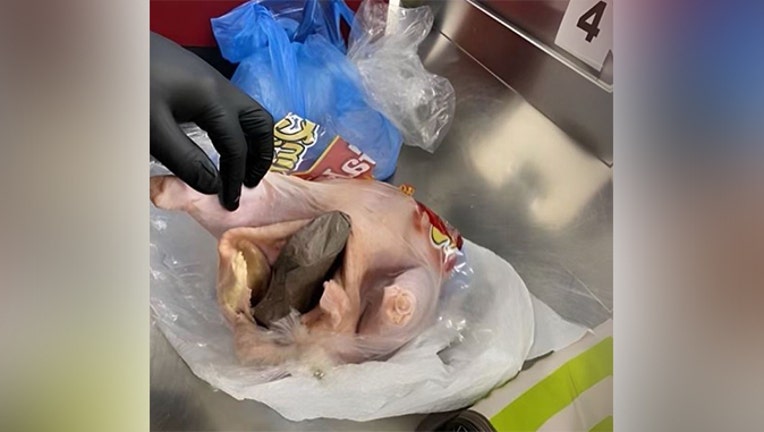
Something you don't see every day...a gun in a chicken in luggage on an airplane.

 I've travelled on airlines countless times with my firearm. By that I mean it's in my checked luggage. Simple to do, have it unloaded in a locked case, declare it when you check your baggage, and the TSA agent has to verify it's unloaded. 

Well, never thought of this technique to carry my weapon. 

TSA agents find gun smuggled inside raw chicken


A TSA agent finds a gun wrapped in a package inside a raw chicken. (Photo courtesy of the Transportation Security Administration)

FORT LAUDERDALE, Fla. - A person going through a airport checkpoint got caught trying to smuggle a gun inside a raw chicken and was called out by the Transportation Security Administration on social media.

Photos shared on the agency’s Twitter page shows agents removing a gun wrapped in a bag inside the chicken. "There’s a personal fowl here. Our officers at Fort Lauderdale-Hollywood International Airport (FLL) @FLLFlyer made this very raw find. We hate to break it to you but stuffing a firearm in your holiday bird for travel is just a baste of time," the TSA captioned. 

Air travelers bringing guns into Florida airports is becoming an alarming trend. So far this year, the TSA reported that passengers have brought 700 guns to checkpoints, including 120 seized at Fort Lauderdale-Hollywood International Airport. The agency noted in these incidents that most of the guns confiscated by agents were loaded and had ammunition in the chamber.

The TSA shared on its website that unloaded guns can be carried in a locked hard-sided container as checked baggage only. Guns and ammunition also have to be declared at the ticket counter. 

A TSA agent finds a gun wrapped in a package inside a raw chicken. (Photo courtesy of the Transportation Security Administration) 

...According to the TSA, passengers that bring an unloaded gun with accessible ammunition to a security checkpoint face a fine or civil penalty. The agency can impose civil penalties of up to $13,910 for each violation.


I think I need a new lock for my case. And no, it won't be from the meat aisle.  

Thursday, October 10, 2019

America arms Mexican gangs, film at 11...

Many cliche's, accepted as fact, permeate the national discussion right now. The usual suspects in the "global warming" crowd scream we must control CO2 emissions, as they are poisoning the planet. When you point out that without CO2, plants would quickly die, and mammals (e.g. humans) would soon follow, they are incredulous. The scientific fact of the Oxygen Cycle seems to escape them.

Now we have this, comes back up every few years. The Mexican gangs are murdering countless people south of the border, and it's the fault of American gun makers. From the LA Times:
Guns from the United States are stoking a homicide epidemic in Mexico

The sun had not yet risen when dozens of gunmen stormed into the town of Ocotito in southern Mexico and started shooting.

Salvador Alanis Trujillo tried to fight back, but his shotgun was no match for their assault rifles. So he and his family fled.

This rugged stretch of Guerrero state had always been a little lawless, home to cattle rustlers and highway bandits. But by the time the gunmen seized Ocotito in 2013, the region was overrun with dozens of criminal groups battling for territory.

There was another key difference: The criminals were now packing AR-15s, AK-47s and other weapons of war.

Mexico is in the grips of a deadly arms race.

It began as part of an escalating conflict among major criminal groups, and it accelerated in 2006 after Mexico’s military went to battle with the cartels.

Today, millions of weapons are in private hands — in direct violation of Mexico’s strict gun laws.

Some of those firearms once belonged to the military or police and were sold into the underworld. But the vast majority were smuggled from the world’s largest gun market: the United States.

The arms buildup has helped fuel record levels of violence. Last year, Mexico saw 20,005 gun homicides — nearly seven times as many as in 2003.

Impunity in Mexico, where 95% of killings go unpunished, has spurred more people to take up arms — and carry out their own justice.

After Alanis was forced to abandon his property, which he had bought with savings from a stint as an auto mechanic in North Carolina, he went to state authorities for help.

When none arrived, he and others who had been displaced formed what they describe as a community police force — and began acquiring the most powerful guns available on the black market.

The group’s aim is to eventually take back Ocotito, a town of 6,000 at the base of a verdant mountain range, using an arsenal that includes dozens of machine guns.

In the meantime, Alanis and his group — the United Front of Community Police of the State of Guerrero — have been steadily taking territory.

They say they are cleansing the countryside of predatory gangs, a mission that they acknowledge sometimes employs the same brutal tactics of their enemies.

Salvador Alanis Trujillo, founder of the United Front of Community Police of the State of Guerrero, a vigilante group

They have incurred, and inflicted, many losses in a conflict that Alanis said can only be described as a “civil war.”

“The assassins that kill us are Mexican,” said Alanis, 40. “And the people we shoot are Mexican.”

As for the weapons, that’s another story. He pointed to the words stamped on the barrel of a Colt Match Target assault rifle slung across the chest of a teenage fighter: “HARTFORD, CONN, U.S.A.”

“We kill each other,” he said. “And you send the bullets...”

No question, you kill each other. I might remind you if the guns were not available, there are knives, rocks, etc to use. Ever since Cain and Able, man has killed man. But this is an excuse for the murders south of the border.

I've been a subscriber to STRATFOR.COM for over twenty years, and a few years back they had a great point on this belief that America is shipping 90% of all weapons used in Mexican wars. To borrow a phrase, everything is accurate. But none of it is true.
Security Weekly- .Mexico's Gun Supply and the 90 Percent Myth February 10, 2011

By Scott Stewart

For several years now, STRATFOR has been closely watching developments in Mexico that relate to what we consider the three wars being waged there. Those three wars are the war between the various drug cartels, the war between the government and the cartels and the war being waged against citizens and businesses by criminals.

In addition to watching tactical developments of the cartel wars on the ground and studying the dynamics of the conflict among the various warring factions, we have also been paying close attention to the ways that both the Mexican and U.S. governments have reacted to these developments. Perhaps one of the most interesting aspects to watch has been the way in which the Mexican government has tried to deflect responsibility for the cartel wars away from itself and onto the United States. According to the Mexican government, the cartel wars are not a result of corruption in Mexico or of economic and societal dynamics that leave many Mexicans marginalized and desperate to find a way to make a living. Instead, the cartel wars are due to the insatiable American appetite for narcotics and the endless stream of guns that flows from the United States into Mexico and that results in Mexican violence.

Interestingly, the part of this argument pertaining to guns has been adopted by many politicians and government officials in the United States in recent years. It has now become quite common to hear U.S. officials confidently assert that 90 percent of the weapons used by the Mexican drug cartels come from the United States. However, a close examination of the dynamics of the cartel wars in Mexico — and of how the oft-echoed 90 percent number was reached — clearly demonstrates that the number is more political rhetoric than empirical fact.

By the Numbers

As we discussed in a previous analysis, the 90 percent number was derived from a June 2009 U.S. Government Accountability Office (GAO) report to Congress on U.S. efforts to combat arms trafficking to Mexico (see external link).

According to the GAO report, some 30,000 firearms were seized from criminals by Mexican authorities in 2008. Of these 30,000 firearms, information pertaining to 7,200 of them (24 percent) was submitted to the U.S. Bureau of Alcohol, Tobacco, Firearms and Explosives (ATF) for tracing. Of these 7,200 guns, only about 4,000 could be traced by the ATF, and of these 4,000, some 3,480 (87 percent) were shown to have come from the United States.

This means that the 87 percent figure relates to the number of weapons submitted by the Mexican government to the ATF that could be successfully traced and not from the total number of weapons seized by Mexican authorities or even from the total number of weapons submitted to the ATF for tracing. In fact, the 3,480 guns positively traced to the United States equals less than 12 percent of the total arms seized in Mexico in 2008 and less than 48 percent of all those submitted by the Mexican government to the ATF for tracing. This means that almost 90 percent of the guns seized in Mexico in 2008 were not traced back to the United States...


Not about to claim there are no firearms of American origin in the hands of Mexican gangs right now. God knows our border is wide open. But it's not the wild number of 90%. It's often easier to buy the weapons on the black market, and ship them in from overseas. Not to mention if it's stolen from an American owner, it's not the fault of the American manufacturer, or the person it was stolen from.

The LA Times does not show itself well when it's "journalism" is less than what is expected of a high school paper. Hopefully the gangs in Mexico will be controlled at some point in the future. However, this falsehood doesn't help in any way.


Friday, June 29, 2018

Good look at the BUG.....

Back Up Gun.

Last year PoliceOne was nice enough to publish an article of mine on police equipment. One thing I highly recommend was a back up weapon, as you can have faith, the worse case scenario will show up. You will have a weapon failure, or you loose your primary weapon, or your "strong" hand is injured. So what do you do? He's a good look at why a back up weapon is not a luxury, but a necessity.
Why every police officer should carry a backup gun

...That topic is backup guns for law enforcement officers.

In my friend's program, after the mandated qualifications are completed, there's a training session that focuses on skills development. The training topic changes each month, and this time the emphasis was on backup guns (or “BUGs,” as many shooters call them).

It disappointed me to hear my friend report that a sizable number of the officers showed up without a backup gun, and had to borrow one from him to complete the training. These officers police a city that's part of a large urban metroplex with high levels of criminal activity, and while the agency encourages officers to carry a BUG, quite a few of them don't.

There was a time in law enforcement when it wasn't all that common for officers to carry BUGs, but those days are far behind us … or at least they should be. We now have a long track record of backup gun saves in law enforcement, and unfortunately, we also have too many examples of officers who desperately needed a backup gun, but didn't have one available.

I’ve written before about my belief that law enforcement is experiencing a repeat of the conditions of the 1960s and 1970s, and how we need to pay attention to the lessons of that era. One of those lessons was the vital importance of having a backup gun on duty. There's simply no excuse in this day and age (outside of a foolish, prohibitive agency policy, which should be changed immediately) to be on duty without a backup gun on your person. It's a critical element of officer safety that cannot be ignored, so if you're not carrying a BUG, you need to fix that now...
And I would add, a long gun of some type, shotgun or rifle.
...When Murphy shows up at a gunfight

Most of the officers on my friend's agency who choose not to carry BUGs cite inconvenience as the principal reason. I hear this sometimes from the officers I know and work with too, and I often wonder if they’ve considered how inconvenient it might be if their duty weapon stopped working in a fight?

Guns are machines, and machines have a nasty habit of quitting on you when you when it's most inconvenient. The air conditioner always breaks during the hottest week of the year, the garbage disposal always breaks on Thanksgiving, and the car always gets a flat when you're wearing your suit.

Your gun isn't much different. Springs and pins break, magazines choke, and ammunition fails to feed, fire and eject. Latent defects pop up unexpectedly, and guns get hit and damaged by enemy fire. Murphy is a real pain, and he likes to show up at gunfights.

Aside from simple mechanical failure or damage due to enemy fire, consider these additional ways your duty gun could become unusable in a fight:

It could run out of ammo;

You could drop it;

You could lose it in a crash or a fight;

It could be taken from you;

Your body position could prevent you from drawing it (on your side in a fight, seated in a car);

Your injuries could prevent you from getting to it, or getting it out of your holster;

Your opponent could be holding your arm to block your access to it;

Your security holster could trap it due to malfunction, contamination, or damage;

In all of these situations, a BUG that could be accessed with your non-dominant hand could keep you in the fight, and save the day. Consider it an insurance policy against your primary weapon going down.

Critical backup gun considerations

It was distressing, but not surprising, to hear my friend report that several of the backup guns that were brought to training failed to properly function for the officers.

In some cases, the firearms had not been properly maintained and malfunctioned because they had not been properly cleaned or lubricated by their owners. Every firearms instructor I’ve ever known has a story about the guns they “fixed” – often to their student's amazement – with a drop or two of oil placed in the right spots. Same with the horror stories of guns filled with carbon, rust, sludge, pocket lint, cookie crumbs and asteroid dust that were rescued with a few passes of a toothbrush or a clean patch. The compact nature of backup guns, and the places in which they're carried, make them even more susceptible to these hazards. These smaller guns have tight tolerances and are less forgiving of neglect, so they need to be properly maintained to ensure reliability. Don't make me give you the lecture about maintaining your life-saving, rescue equipment, OK...?

I recommend to my rookies to clean, at least lube, every duty weapon every weekend. Fifteen minutes of dirty work may prevent a serious malfunction.
...My friend noted that the choice of carry mode and the location of carry created problems for some of his officers. In a now-familiar pattern, he saw cases where a semi-auto pistol’s magazine release button was inadvertently activated when the gun was carried in a left side pocket. When it got bumped, the magazine partially dislodged, turning the gun into a single shot. Interestingly, it also happened to an officer who carried in a right side pocket as well, even though the magazine release was against the leg. My friend tells me he's made a good business of modifying magazine buttons for officers to make them lower profile, and it doesn't look like that's going to change anytime soon.

The little guns are extremely vulnerable to shooter-induced malfunctions, and plenty of those were evident during my friend's training. A combination of big hands and a little gun can easily lead to body parts interfering with the operation of the slide, or controls being inadvertently operated during recoil. The delicate balance between slide velocity and magazine responsiveness in an auto pistol becomes even more dicey in the small guns, so they require a strong shooting platform for maximum reliability – something that can be hard for the shooter to provide with the reduced contact area provided by the short and thin grips common to this class of gun, which may allow only one or two fingers to wrap around the grip.

The little BUGs are more sensitive to ammunition selection, as well. The tight tolerances and delicate balance between slide velocity and magazine response place strong demands on ammunition, exacerbating small differences in pressures, bullet weights and bullet ogives. You can't be haphazard in your selection of BUG ammunition, and need to test it thoroughly to ensure it will run reliably in your gun...
Personally, I use a Ruger LCR snub nose 357 revolver. No exposed hammer or other part that will snag when you desperately need a weapon.

Good article on a critical issue, with the likes of terrorist groups like BLM hanging around.

Monday, April 16, 2018

A sign of liberty in the Rocky Mountain High state....

I lived in Colorado from 1989 to 1992, and like California, the state's physical beauty is breathtaking. I took the family there this last summer and they were astonished at the Rocky Mountains, Pike's Peak, and Garden of the Gods, among other things.

However, over the last 25 years Colorado has been invaded by libtards from states like California, and unfortunately they are bringing their crazed ideas with them. And Boulder is known for it's crazy ideas, and now they've passed another one. They want to ban "assault rifles," whatever the hell that is.

I found this article oner the weekend and it's interesting:

To Boulder’s anti-gun bigots, I will not comply with your hate law

My home town of Boulder is about to define me as a criminal if I do not disarm or move.

Let this column serve as a public notice, I will not comply.

I was raised in Colorado and moved to Boulder in 1984, graduated from CU there and stayed. I proudly represented Boulder on the RTD Board of Directors. My late daughter rests in a Boulder cemetery. I plan to be laid to rest beside her when my time comes. All that to say my roots are deep in my hometown.

But to be who I am, to be true to my values I hold dear, I must choose to leave or go to jail.

Boulder prides itself on promoting inclusion, diversity and tolerance. And there was a time it lived up to those now-empty words — a time when Boulder was diverse enough to welcome such opposites as the beatnik, Buddhist Naropa Institute and Soldier of Fortune magazine.

But it’s getting very clear Boulder doesn’t want my type in their lily-white, homogeneous town...

Remember, it's inclusive and tolerant for their kind of people, not for others.
Boulder City Council is on the verge of passing a sweeping anti-gun ordinance, laughably called an assault weapons ban. So loosely written, this ordinance would ban the first gun I ever owned, a simple .22 caliber rifle, the same type most farm boys get on their twelfth birthday. Its sin? It can be fitted with a pistol-grip or a folding stock...

...The Anti-Defamation League and The Gay and Lesbian Fund sponsors a program plastered throughout Boulder schools call “No Place For Hate.” They ask students to make a resolution of respect: “I will seek to gain understanding of those who are different from myself.”

But Boulder’s council has done nothing to understand the culture and values of gun owners and little to understand much more than the cosmetic aspects of guns.

Boulder has become a place for hate.

Should this ordinance pass, it will require me to permanently move my guns out of Boulder. What a spectacularly privileged, Boulderesque idea. Only in Boulder and Aspen is there an assumption that you’re wealthy enough to have a second home or storage in another city.

You can’t keep your soon-to-be-illegal guns at a friend’s house in another city either. The new 2013 anti-gun state laws say you can only do that for three days before you’ll both be criminals.

If I can’t afford to move my guns out, which I can’t, I am to destroy them or surrender them. There is a possibility council might take pity and let me keep my own property by creating the state’s first database of people whose values they do not understand or respect...

...Jon Caldara, a Denver Post columnist, is president of the Independence Institute, a libertarian-conservative think tank in Denver.

The rest of the article is worth reading, but I'm drawn to the part where a city is requiring a citizen to turn in a legal item, a firearm, or destroy them. They are denying a citizen his personal property without compensation. Granted, I have not read the full text of the proposed legislation, but this seems like a serious violation of the Constitution's "takings" clause. Per Amendment V, "...nor shall private property be taken for public use, without just compensation." Then again, when has the Constitution been a hindrance to liberals.

Thursday, February 8, 2018

And I thought gun buybacks were idiotic.....

One of the classic cases of stupidity from the Bubba Clinton/Janet Reno years was buying back guns in the bigs cites. Basically you could walk up to a city official, hand over a gun, and get cash, or store card, or soemthing else of value. No questions asked. More than a few criminals dumped their weapons the used in crimes for some quick cash. Also, some things were shown by a study:
...So why don’t buybacks get guns off the street? For one thing, according to Alex Tabarrok, professor of economics at George Mason University, it’s impossible to significantly reduce the number of guns in a community with buyback events that collect, on average, fewer than 1,000 firearms. “In the United States, there are hundreds of millions of guns,” he says. “And even if a city buys up some of them, that’s not going to have any effect on how many guns people actually have. People can still go out and buy more guns.”

Moreover, the firearms that cities do collect aren’t likely to be the types used in crime. “The main drawback to gun buyback programs is that they tend to get junk guns or guns that have been with a family for a long period of time,” says James Pasco, executive director of the Fraternal Order of Police. “They’re not catching the nine-millimeter and forty-caliber semiautomatic handguns that are so prevalent in violent crime today...”

Well, not to be outdone with stupidity, we again have Baltimore:
Baltimore City Council Supports ‘GunBail’ Proposal

BALTIMORE – In a case of short-sighted thinking on display, the Baltimore City Council is resolved to support a proposal to accept weapons off the street in lieu of bail from an inmate booked for a criminal offense. The disagreeable part of the protocol is this: They are asking law enforcement to in essence “look the other way” regarding evidence that might be obtained from the firearm.

If I understand the proposal correctly, a defendant could be booked on a criminal offense, knowingly submit a firearm used in a homicide, and suddenly he has limited immunity because evidence obtained from the weapon could not be used against him in court.

Trevor Brooks, a convicted murderer who attended a Silicon Valley entrepreneurship program after getting out of prison forged the idea, reported The Baltimore Sun.

He wants to allow people use an app to turn in guns and make bail. Given the choice between giving up a gun or sitting in Central Booking, “they’re going to turn the guns in as fast as they can,” Brooks said...

Pardon me, I need a drink. I can only handle so much stupidity at a time.
­

Wednesday, December 21, 2016

Off duty carry...

I started carrying off duty from the time I had my badge. From my younger days, someone told me about a gun. "It's like blood, air or a parachute. You don't need it unless you need it really bad."

Found this story from Police Magazine (linked through Texas Police News) and it gives so things to think though.
4 key considerations for off-duty carry

The topic of off-duty carry is too big an issue to ignore, especially when it is so starkly presented in the news headlines of the day

An off-duty Philadelphia Police Officer was shot Friday while he shielded his son from gunfire. Angelo Romero and his two-year-old son were caught in the crossfire of a gunfight between a two rival groups of suspects aged between 15- and 18-years-old. Romero was shot in the hand. His son was not injured. Romero is recovering and is expected to be OK.

Philadelphia Police Commissioner Richard Ross later said, “He was just so, so lucky.”

At the time of the incident, Romero was unarmed. This fact raises once again the never-ending discussion about off-duty carry. What follows is in no way a criticism of Romero, whose actions that afternoon were truly heroic. But the topic of off-duty carry is too big an issue to ignore, especially when it is so starkly presented in the news headlines of the day. News like Officer Romero’s bravery last week creates an opportunity to revisit training and other consideration for off-duty carry. Here are four things to think about.
1. Choosing your equipment

An off-duty gun is like a parachute. When you need it, you really, really need it, and nothing else will do. Like a parachute, you want to be sure that you’re packing the best possible equipment.

In an ideal world, you will be permitted to carry your duty weapon while off-duty, but we do not live in an ideal world. For many officers, their off-duty gun ends up being a different model, if not even a wholly different manufacturer than their on-duty rig.

The good news is that smaller and more-concealable versions of existing duty guns have recently come to the market. The Glock 43 and the Smith and Wesson M&P Shield are both excellent single-stack 9mm auto pistols with mechanics that mirror their bigger brothers which sit on the hips of hundreds of thousands of American police officers.

Make a very deliberate decision about location of carry (appendix, hip, ankle) and be sure you select the best possible holster for you. There are countless good options in both leather and Kydex. I’m not a fan of pocket carry (for a host of reasons), but if that’s your selection, an absolute must is getting a pocket holster from Sticky.

You can elect to add a laser-grip from Crimson Trace, or upgrade your sights to a high-visibility option such as is available from HIVIZ Shooting Systems. Both options can lead to better performance.

Be sure to spend top-dollar for the best possible ammo — cheap ammo is for plinking — and purchase a couple of spare magazines and mag pouches.

Remember that the easiest element in off-duty carry is the shopping trip to your local firearms dealer.

Things only get much, much more difficult from there — starting with training.

I have several and the ammo is changed out yearly. Ammo is cheap, your life is not.
2. Committing to training

Simply carrying a gun off-duty is not enough — one must vigorously train to use it safely and effectively. This means putting hundreds — perhaps thousands — of rounds downrange, and doing so on regular and ongoing basis.

Bring your new off-duty set-up to the company range — assuming that’s within policy, of course — and get busy. Your marksmanship training may begin with the “dot-torture” drill or some other high-intensity accuracy drill. Move on to the “who’s your buddy” drill or some other hostage-shot exercise.

Practice drawing and moving to cover simultaneously. Practice drawing and shooting from a seated position — as if at a restaurant. Practice your verbalization skills.

Whenever possible, train with a buddy — so much the better if your buddy is a firearms instructor — because having someone present to observe and critique your work is very valuable. You may even elect to attend private training from a certified instructor who specializes in CCW tactics. Be sure to do your homework on the school and the instructor — there are some snake oil salesmen out there.

When you are at home, practice dry-fire manipulations and everything else that goes into running your gun at the highest possible level. Do your mental preparation with scenario visualizations and when/then thinking.

Remember to include your family in your training. They don’t necessarily have to go to the range with you — although that is also an option to consider in the event that you go down in the fight and they have to defend themselves. Develop a language between you and your spouse and you and your kids so when you suddenly yell ‘Get behind me!’ or ‘Get away from me!’ they instantly know what to do.

Train your family to immediately call 911 in the event of an off-duty shooting. They should be able to calmly but quickly describe your appearance, your location and your firearm.

Remember, when the time to preform arrives, the time to prepare has passed.

Real good point about the family. A friend was in a restaurant in New Orleans when he noticed some suspicious people want into the restaurant they were in. After about five seconds he knew what was up, told his family "Get under the table!" and moved out to handle the threat. Yes, the three were armed and were about to rob the place. When he heard "Police! Freeze!" they ran.
3. Picking your battles

Sometimes, the battle picks you, and armed response is the only way to reasonably believe that survival of yourself or an innocent victim is possible. Recall that when 43-year-old Traci Johnson was about to be beheaded at a Vaughan Foods processing plant in 2014, the company’s chief operating officer — an off-duty Oklahoma County Sheriff’s Deputy named Mark Vaughan — shot and killed the attacker, saving Johnson’s life.

However, there are cases in which you are at such a tactical disadvantage that an armed response actually puts you in more danger than other options — most notably, seeking cover.

Remember that in Philadelphia on Friday, Romero was not the intended target — he and his son simply were caught in a lousy place at a lousy time. Had he been packing, and had he started uncorking rounds at the two warring groups, he and his son could well have become bullet magnets — not a good situation when you’re outnumbered and carrying little more than a single-stack 9mm or a six-shot .38 revolver.

Moving away from the fray and seeking solid cover is a viable option that simply must not be forgotten when you find yourself heavily outnumbered or outgunned.

Further, consider the fact that there are instances when an off-duty officer’s best course of action is to make the best possible witness for investigators. For a sheepdog, this can be a very difficult thing to do, because sheepdogs are creatures of action, not passivity. But getting into an off-duty beef can be a one-way ticket to another career, or a civil lawsuit, or both.

This reminds me, one of the most important things to have in your pocket in the event of an off-duty shooting is the name and telephone number of a good attorney. This is a relationship that has to be established when you first make the decision to carry off duty. Have this programed into your contacts list on your phone.

Excellent advise about a lawyer.
4. Welcoming the cavalry
If you’re off-duty and you get into a shooting, as soon as the gunfire ends, you should prepare to immediately comply with commands of arriving uniformed officers. When the threat has been neutralized, reholstering the gun or even setting it on the ground is a good way to prevent a tragic blue-on-blue situation when the good guys get to the scene.

Once the uniforms get there, they run the show and you do your best imitation of a compliant citizen. Put yourself in the shoes of those arriving uniforms. Would you want a guy in plain clothes waving a badge and a gun around at a “shots fired” scene?

A suggestion made by my academy staff was once the calvary arrived is to have your badge or ID out next to your gun. That is where the cops will look at. Being able to verify you're a good guy is important.
Doug Wyllie is Editor at Large for PoliceOne, responsible for providing police training content and expert analysis on a wide range of topics and trends that affect the law enforcement community...

Wednesday, August 31, 2016

The need for a long gun....

I've been on patrol since 1999 and I've carried a Remington 870 since I've worn a badge. In 2000, I attended the Patrol Carbine course and soon afterwards started carrying a Ruger Mini-14 for a rather stupid reason. After taking a low light rifle course in 2012, I moved to the AR-15. Nothing against Ruger, they make a very good product, but if I'm in a firefight I need bullets quick and the magazines don't interchange.

Now here is an excellent article from PoliceOne on the need for patrol carbines. Thank you Mr. Rayburn.
Here's why all police need a patrol rifle

We need to take our equipment and training to the next level in order to be a step above everyone else when it comes to our rifle skills

With all the current attacks on law enforcement, some would say that "times sure have changed" — but they haven’t. There’s always been this underlying disdain for law enforcement, and not just by the criminal element within our society. We’ve all dealt with "respectable people" who turn into vicious animals given the right stimuli. Whether that be drugs, alcohol, or just getting a speeding citation.

The homeowner doesn’t curse the firefighter who comes to put out the fire. How many of you have been cursed out by the homeowner who called to make a complaint against someone else? How many of you have had to lock up the complainant? I’m guessing probably more times than you can remember.

After Sept. 11 we were all heroes and people somewhat respected law enforcement, but that faded quickly, just like it always does. There have been other times in our history where we’ve been on top, but the public soon forgot about us and what we stand for. After all, it’s called a thankless job for a reason.

This is not the first time in our history we’ve faced a criminal element that’s been well organized, well-funded, well-armed with heavy duty firepower, and hell bent on harming law enforcement.

Go back to the early 1930s when we faced the likes of Bonnie and Clyde, and "Machine Gun Kelly." For Bonnie and Clyde the weapon of choice was the BAR — a Browning automatic rifle. For "Machine Gun Kelly," it was the Thompson machine gun. These criminals are still idolized and romanticized to this day, but can you recall the names of the officers murdered by Bonnie and Clyde? In case you were wondering they were, Eugene C. Moore, Holloway D. Murphy, and Edward B. Wheeler.

Back then law enforcement saw a need to at least match the firepower of these gangsters by adopting the same firearms used against officers. Agencies all across this country went out and purchased BARs, and Tommy guns, to try and give their officers a fighting chance. It was a BAR that helped bring down Bonnie and Clyde. Some departments still have their old Tommy guns in their armories, or on display in the department.

We also faced well-armed, well-funded, well organized, and violent criminals in the 1980s with the rise of crack cocaine. Law enforcement was getting outgunned on the streets of our inner cities, so we had to upgrade our old six shooters to semi-automatic handguns, to give us a fighting chance. During this same period some agencies, bi
g and small, purchased MP5s and other sub-guns for their officers and tactical teams. Some tactical teams in smaller agencies were born in the 1980s out of necessity to deal with these well-armed drug gangs that were infiltrating and operating in their communities.

After the 1997 North Hollywood shoot-out, in which two heavily armed and armored bank robbers were eventually killed after an extended gunbattle, agencies across the country saw a need for the patrol rifle. Shortly after, departments across the country started purchasing rifles for their officers. Some other agencies were lucky enough to be able to obtain rifles through the government’s DRMO program. Once again we saw a need for better firepower and we filled that need.

The need for patrol rifles

The time has come once again for us to fill a need, and that need is a patrol rifle for every unit, and for every officer who goes out the door. Being able to predict when and where the next ambush-style attack against law enforcement is going to happen is next to impossible. The same is true for the next San Bernardino-style terrorist attack.

Because we can’t predict when and where these violent criminals — armed with heavy duty firepower — will strike next, we need to be prepared for them at all times. That means every officer, regardless of rank, title, or position, needs to have a patrol rifle available to them at all times, and they need to be trained in the proper use of it.

We, as law enforcement officers, need to adopt the same mindset as that of the Marine Corps when it comes to job titles. In the Marine Corps, everyone, regardless of rank, is a rifleman first and foremost. The "job" he does in the Marines comes second. We’re civilian law enforcement, so our "job" to protect and serve comes first, but we need to have the mindset that each and every one of us is also a rifleman. We need to be equipped and trained as such.

As law enforcement officers, we don’t ever want to be outgunned or out trained. We saw in Baton Rouge and Dallas that some of these criminals can be former military who possess military training. The possibility of encountering a terrorist, who has had some formal training from a foreign source, is also real. We need to take our training to the next level, to be a step above everyone else when it comes to our rifle skills.

That training needs to include urban rifle skills. The 300-yard shot on the range is nice, but the realities of the street dictate that we learn to use the patrol rifle in close quarters. The reality of the street is that officer involved shootings, even those involving rifles/long guns, happen at much smaller distances.

Think about this for a minute. The last time you pulled your patrol rifle out of your car, was it for a 300-yard shot, in the dark, where you could barely make out the perpetrator? Or where you involved in a vehicle stop where the distance was a few car lengths, if that? Maybe you were entering a building, where the distance was in feet, not yards.

Our training needs to reflect the realities of the street. We need to be able to shoot accurately while moving. We need to be able to identify cover, and how to properly use it with a rifle, because in some cases it’s different from using cover with your handgun. Every officer needs to be trained in single officer, two man, and multiple officer movement and tactics.

As we saw in Dallas, you need to go on the offensive to either take out the bad guy, or at least pin him down until other resources arrive. Those other resources could mean additional personnel, a sniper, an armored vehicle, or in the case of Dallas, a robot equipped with an explosive device. Either way, you have to take the fight to the bad guy, especially if the bad guy’s actions demonstrate that he’s hell bent on taking out as many civilians or law enforcement officers as he can.

Whether facing a lone gunman, or multiple terrorists, they are the same types of people we’ve faced before. The winds haven’t changed; it’s the same harsh wind that’s been blowing in our faces all along. We’ve dealt with it in the past, and we’ll deal with it again in the future.

We just need to recognize the threat so we can better arm and better train our officers. We also need to understand now, more than ever, we are all riflemen.

About the author

Michael T. Rayburn has more than 30 years of experience in the law enforcement field, and is an internationally recognized expert in the areas of Vehicle Stops, Officer Safety, and Firearms Tactics and Training. Rayburn is an adjunct instructor at the Smith & Wesson Academy, has written numerous articles for various police magazines and Law Enforcement related web sites, and is the author of four books, "Advanced Vehicle Stop Tactics," "Advanced Patrol Tactics," “Combat Gunfighting,” and “Combat Shotgun.”

Age and experience have shown the wisdom of being uniform and having a lot of rounds. I carry two magazines (not clips you libtards) on the rifle and three more in my emergency bag. Along with ten more shotgun shells and 24 rounds of .40 cal.

Guns and ammo are like shoes for a lady. Can't ever have too many! :<)

Friday, July 1, 2016

American Thinker post

American Thinker was good enough to post an article of mine on Wednesday, June 29.  Please enjoy and comment.

Yes, I stole the title from 1981’s Absence of Malice, but it is accurate.  And true.
In the immediate aftermath of the Orlando nightclub shooting, a very close friend of mine posted an article on how this man was a “self hating homosexual” and used a Gawker article as the reference. Gawker. Granted, not exactly The Onion, or it’s older cousin, the New York Times, but not the greatest source.  From the story:
Orlando Shooter Was Reportedly a Regular at Pulse and Had a Profile on Gay Dating App
Mateen, his father explained the next day, had repeatedly been angered by the sight of two men kissing. But according to witnesses, (emphasis mine) Mateen was also a regular at the club and exchanged messages with at least one gay man on a gay dating app…
According to witnesses.  To witnesses.  The author put this propaganda out less than 48 hours after the attacked ended, while the scene is still being processed, the people shot have not been interviewed, but “the witnesses” are the only thing that mattered.  Or put more specifically, the witnesses the author wanted to cite.  Well, looks like the “witnesses” got it wrong (emphasis mine):
FBI investigators say they have found no evidence that Orlando shooter had gay lovers
Since the shooting at an Orlando nightclub last week that left 49 people dead, reports have emerged that gunman Omar Mateen frequented the gay club, used gay dating apps and had gay lovers.
But the FBI has found no evidence so far to support claims by those who say Mateen had gay lovers or communicated on gay dating apps, several law enforcement officials said…   
…In seeking to verify the reports, federal agents have culled Mateen's electronic devices, including a laptop computer and cellphone, as well as electronic communications of those who made the claims, law enforcement officials said.
So far, they have found no photographs, no text messages, no smartphone apps, no gay pornography and no cell-tower location data to suggest that Mateen — who was twice married to women and had a young son — conducted a secret gay life, the officials said…
In the immediate hours after Orlando, one news source after another screamed, “The shooter was using an AR-15!” and it could be used for “automatic fire.”  From the New York Times:
A firearm that the authorities said was used on Sunday in a mass shooting at a nightclub in Orlando, Fla., s a descendant of one of the world’s most widely distributed and familiar infantry weapons, and a type of rifle that has been involved in previous mass shootings in the United States.
Chief John Mina of the Orlando Police Department said the gunman’s weapons included a handgun and an “AR-15-type assault rifle…”
…It fired a small-caliber, high-velocity bullet — a .223 — that was also considered revolutionary. The rifle was capable, via a selector lever, of semiautomatic or automatic fire.
Only it was not and it is not. The young radical Muslim, Omar Mateen, used a Sig-Sauer MCX. But even then the Washington Post gets it wrong.  From their article correcting this false information: 
The gun the Orlando shooter used was a Sig Sauer MCX, not an AR-15. That doesn’t change much.
Orlando shooter Omar Mateen used the assault-style rifle Sig Sauer MCX to kill at least 49 people, authorities say. Here's what you need to know about the guns some are calling "the gold standard for mass murder….”   
…On Monday night, officials clarified that the rifle Omar Mateen used in the shooting was not an AR-15, but a Sig Sauer MCX rifle.
Not to mention the AR-15 (which stands for ArmaLite Rifle, not “assault rifle” or “automatic rifle”) does not fire fully automatic unless illegally modified.  Its cousins, the M-16 or M-4 can fire fully auto (depending on the model), but they are used by military and police. 

Sounds to me like people are making conclusions with limited knowledge of the events on the ground, or basic background information. And that is to be excepted.

In the initial investigation of a major event, journalists (snicker) often want to be first, if not true. I’ve often told family and friends that after an incident like this, or an officer involved shooting, do not take the initial reports as gospel, especially of people with an agenda or grudge. See Brian Ross, ABC News, speaking with former Clinton Minister of Propaganda, Clinton Fund donator and ABC New hack George Stephanolpoulos in the minutes after the Tucson, AZ shooting of Congresswoman Gabby Giffords:
Stephanolpoulos: I’m going to go to Brian Ross. You’ve been investigating the background of Jim Holmes here. You found something that might be significant.
Ross: There’s a Jim Holmes of Aurora, Colorado, page on the Colorado Tea party site as well, talking about him joining the Tea Party last year. Now, we don’t know if this is the same Jim Holmes. But it’s Jim Holmes of Aurora, Colorado.
Stephanolpoulos: Okay, we’ll keep looking at that. Brian Ross, thanks very much.
On August 9, 2016, a large black male robbed a storeowner in Ferguson MO, then attempted to take a police officer’s weapon.  After charging the officer, who was half the young man’s size, the officer justifiably shot him. In the immediate aftermath Mike Brown’s criminal partner lied to anyone he could, saying Officer Darren Wilson, “Shot him like a dog…”, as Brown tried to surrender. Three autopsies, numerous investigations by local, state, federal and media agencies, all supported Officer Wilson’s statements. But never let the facts get in the way of a good story. An aside point I’ve made of the Wilson-Brown incident.  The over 100 witness who came forward after Brown was shot by a police officer would have never said anything if the “Gentle Giant” had been shot in the middle of the street by another gang banger. But the fact a white cop did the shooting gave them their 15 minutes of fame.

With little evidence of criminal acts, Baltimore State’s Attorney Marilyn Mosby charged six police officers with multiple felonies, including murder, after having the reports on the case for less than two days.  After blatantly attempting to poison the jury pool with her announcement, while doing excellently in the court of public opinion, she has so far not done well in the court of law.  Of three cases, two acquittals and one hung jury.

In the immediate hours after a neighborhood watch volunteer shot and killed a 17-year-old suspended high school kid in Sanford Florida, the media broadcast pictures of the late Treyvon Martin, showing a junior high school football player.  For some reason they decided not to publish recent photos available from his Facebook page, showing him smoking pot, using gang signs and playing with a pistol.  In the hours of this incident coming on the nation scene, the term “White Hispanic” was coined (never used before or since, to my knowledge) and Zimmerman was only known by a six year old booking photo, not the picture that night showing multiple injuries to his head.
The points of this narrative:  One, the national media is not interested in accuracy or truth, but in getting the story out first.  Two, it should fit a template, e.g., the nation is racist, law enforcement is prejudiced, and they will frame their narrative accordingly (black male was shot, it was because the “white” Hispanic is racist, there is racism all over the country).  Three, the people doing the reporting have little knowledge of the facts they are discussing, such as what is the difference between an AR-15 and M-16, or “automatic fire” and “semi-automatic fire”, and “define what is an assault weapon” (hell, so ignorant they should run for Congress).

Finally, crime investigations and justice are slow, deliberate processes.  What is “known” in the immediate passion of the event is often completely wrong at best or a bold faced lie at worst (see “Hands Up! Don’t Shoot!). And reporters have little (if any) more access to facts than the general public.  They just have a wider broadcast system. The problem is they are often partisan, possess limited knowledge of the subject and don’t have the wisdom to hold back when they don’t know something. The press is the only profession that has defined constitutional protection and has a legitimate purpose, to serve as the “loyal opposition” to the government.  It would be nice to see them working like a profession and serving their actual purpose.

Michael A. Thiac is a police patrol sergeant and a retired Army intelligence officer. When not patrolling the streets, he can be found on A Cop’s Watch. 

Thursday, June 9, 2016

Hand training for pistol...

Saw this and I gotta get one! Oh Beth! :)
ProHands Announces New Tactical Model for Handgun Accuracy


ProHands, the inventors and manufacturers of hand exercisers for athletes, musicians, and rehabilitation have announced the company's first model designed specifically for shooters.

ProHands Tactical is a training tool for handgun professionals designed as an effective way to train for accuracy outside the range. With the laser sight mounted onto the PRO edition, shooters now have the ability to train their entire hand, wrist, and forearm to lock on the target. ProHands Tactical is designed to quickly improve accuracy and control and develop muscle memory, dexterity, endurance, and the strength critical for recoil management, weapon retention, and subject control.

ProHands Tactical may be purchased at Prohands.net or Amazon (SRP $44.95) and is available in four tensions: Light (5 lbs per finger), Medium (7 lbs per finger), Heavy (9 lbs per finger), and X-Heavy (11 lbs per finger). The set includes a patented "PRO" hand exerciser, two removable spring-stabilizer plugs, a mount, a high-quality red laser sight, and general instructions.

The ProHands line of exercisers is different because of their ability to isolate and strengthen each finger individually using patented spring-loaded piston technology. Since 1990, ProHands have been used globally by professional athletes, fitness trainers, strength coaches, musicians, and medical/rehabilitation facilities....

Friday, May 13, 2016

Real life pistol training...with real bullets...

I've done training with "blue guns", modified pistols with chalk rounds, with my rifle (unloaded and with the bolt removed) and a laser gun. But this is incredible.


New gun training program in Eastpointe uses real bullets, scenarios

It's a first of its kind shooting exercise and it's right here in metro Detroit.

EASTPOINTE, Mich. (WJBK) - Imagine experiencing first-hand what it's like to dodge bullets. Would you be ready to fight back?

A new gun training program uses real guns and real bullets to give trainees a feel for what it's like to be in a real gun fight.

"It is the next evolution of training and it's as close to real as you can possibly get," says Bill Kucyk, the owner of Action Impact Gun Ranges. Kucyk will soon roll out the new training system for both civilians and those in law enforcement. The trainees and actors use real guns loaded with real bullets.

"For me, even having a ton of shooting experience, some of it - I don't want to say goes out the window - but in a stress scenario you kind of stop thinking about all that," says gun owner Stefan Bahri. You can watch his training exercise in Randy Wimbley's video report in the video player above. Bahri was trying to get back to his car when two men confronted him and tried to pick a fight, when one of them grabbed a gun.

Those moments where the stress kicks in is what kills. Literally.

"You saw a situation in Oklahoma where an officer thought he was grabbing his Taser but instead he grabbed his gun and shot somebody," Kucyk says. "That's because that officer stressed at that point in time. So exposing officers to this, we'll get a lot of that bad stuff out of the way, we'll discover it in advance, and then we can take corrective action.

"We put (multiple) races into our scenarios and what we're trying to determine is, did you have a pre-conceived notion to shoot someone of a race simply because of their race? And if we can identify some of those biases, as you refer to them, then we can correct them."

Even though a ballistic wall separates the trainee and actors, they are still able to come face-to-face, engage one another and, if it comes to it, use their guns.

"It's one thing to stand on the range and shoot at a target, but when you're confronted with a person and your brain is going; you're thinking; you're talking; it's a whole different scenario," says Oswald Leslie of Action Impact.

FOX 2's Randy Wimbley went through three different scenarios. The first two he tried to duck behind cover when the actor went for his gun. In the third scenario, Randy drew and fired as soon as he saw him reach for it. You can watch in the video player above.

"I will say in this, in the last go-around you had a couple under your belt," said Ian Murphy, critiquing Wimbley. Murphy is a firearm instructor with Action Impact. "What I did notice was your draw was a lot faster; you were more mentally prepared."

"That's the value of this training. So that it can stress you, find a way to correct you so that in a real-life situation perhaps it will save your life," says Kucyk. "When I say I want to save lives I am not kidding. I want to save officers' lives and I want to save civilians' lives."

Kucyk says he already has several police departments here in Metro Detroit interested in this training which will be rolled out sometime this summer. Until now, the only places this training has been used was in North Carolina and Virginia with members of law enforcement and military.

Hope they send an office to Houston. I would love to go through it.

Tuesday, March 22, 2016

Carrying a BUG...

Also known as a Back Up Gun. Timing is good, I've just picked up a Ruger LCR 357 as my BUG/Off Duty Weapon. Good look at what you need to do.

Carrying a backup gun: 6 things you need to know

Your duty weapon can malfunction and will run out of ammo, so train and prepare for that moment – your life depends on it

Unless you own a magical gun that never runs out of ammo and never malfunctions, you need to carry a backup gun (BUG). Here are some questions and considerations for these important tools.

1. Is the BUG faster than a reload?

A backup gun — sometimes known as a “New York Reload” — offers you the opportunity to draw a second weapon to continue a gunfight. Practice your draw from your method of concealment and compare it to your times during a standard reload in order decide whether to go this route.

Regardless of whether you’re faster reloading or drawing a second weapon, I can guarantee that one situation in which the second gun will be faster into action than a reload is when you are wounded and need to get back in action one handed.

2. Is the BUG faster than a malfunction drill?

Again, you need to put in the practice to know your capabilities. A ‘tap-rack-bang’ will probably be faster, but it will probably beat your time doing a double feed malfunction one handed.

3. Can you access the BUG for a deadly-force response to a gun takeaway?

A suspect attempting to take your duty weapon — either from your hand or holster — is a deadly threat. Can you reach your weapon with either hand? Consider the possibilities of the body positions you could find yourself in while in a fight for your life.

When one hand is out of commission due to trying to maintain control of your main weapon, can you access your BUG with your free hand?

4. Consider where you carry, what you carry, and how you train to carry your BUG.

The considerations above should help you determine the location you choose to carry your BUG. Here are the common locations.

Ankle: The ankle carry is convenient when you are seated and can be accessed when you find yourself on the ground with a suspect on top of you. Ankle carry means your gun will get dirtier than other locations. Clean and lube your weapon weekly to make sure it functions in that critical moment. Some officers replace the seam of their uniform pants with Velcro to allow faster easier access to that location.

Pant pocket: Access can be hindered by the equipment on your belt. If you can’t get your hand into your pocket you will find it hard to access the weapon. If you wear pants with cargo pockets consider carrying it there. Make sure the gun is in a holster that covers the trigger guard in an otherwise empty pocket. Several officers have shot themselves when objects came into contact with the exposed trigger of their BUG.

Back pocket carry is also an option, but sitting on a gun all shift may be an invitation to sciatica.

Vest: With concealed body armor, you have two options: on the vest strap or in a BUG holster that is attached to the front of your vest. Understand that your ability to unzip or unbutton your shirt quickly under stress in a fight may significantly slow the draw down. Some officers sew their buttons to the top part of the shirt and use Velcro below to keep their shirt “buttoned.” This will speed the draw and allow the use of only one hand versus two to get the shirt open.

On an external vest carrier you have the option of sewing a holster on the inside. Trainer Jeff Chudwin advises officers against it due to concerns of possible injury caused to them by their weapon if they were in an accident and their airbag deployed.

The ability to draw the weapon with either hand when it is under your armpit can be very difficult, this requires practice. Some officers have found that the gun and holster protrude just enough to cut off blood circulation to the arm when seated in a car during patrol.

5. What kind of BUG should you carry and how big should it be?

If possible stick with the same manufacture for consistency in design and function. A Glock 17, with a Glock 26, 42, or 43 backup fit that concept. Most gun makers are making sub compacts to fill that niche.

I don’t suggest anything smaller in caliber than a .380. Semi-autos are much easier to hit with than revolvers when the barrels are short. The size of the weapon will determined by how big you are and where you intend to carry it. Pockets and pant cuffs space limit weapon size.

6. Don’t forget to train with your BUG!

Buy a replica blue gun of your BUG and practice drawing with all your duty gear on to identify any problems.

Shoot the thing! If you can’t hit anything with it, it is just an expensive paper weight in a fight.

Your duty weapon can malfunction and will run out of ammo, so train and prepare for that moment – your life depends on it. A BUG is like a backup plan, always have one.

Sunday, January 24, 2016

9mm vs. .40 Caliber. An overview.

One of my friends is a now retired ER nurse in San Antonio TX and he told me a story of the 9mm round. He had a gang banger admitted with 8 shots from a 9mm. And he walks out of the hospital in three days. Three days. I've often said "If that had been a 38 I am pretty sure he would have bled out before the ambulance got him to the hospital..." Well this is an interesting look at how the bullets work. The FBI just went back to the 9mm and this is an interesting read.
9mm vs. .40 Caliber


This man was shot with .40 S&W rounds to center mass, was not incapacitated at the scene, and survived the shooting. (Photo: Sydney Vail)

At the end of October, the FBI announced that it was planning to swap out the .40 S&W pistols and ammunition now used by its agents and replace them with 9mm pistols and ammo. This was a widely discussed decision, given that the Bureau once partially blamed the performance of 9mm cartridges for the deaths of two agents in the 1986 Miami shootout and subsequently transitioned to 10mm and then to .40 caliber sidearms. This is also a widely followed decision because the FBI's choice of duty pistol and ammo will likely influence many other law enforcement agencies to give the 9mm jacketed hollow-point another look.

In the January 2013 issue of POLICE, I wrote an article titled "Stopping Power: Myths, Legends, and Realities," in which I discussed the wound ballistics performance of various popular pistol calibers as I have observed through my experience as a trauma surgeon and tactical medical specialist. My advice then and now is when it comes to claims about the effectiveness of handgun ammo, don't believe the hype. Instead, look at the hard facts.

And now that the FBI's decision to go back to 9mm pistols has ignited another round of debate about caliber effectiveness, it's time to look at the real-world performance of 9mm and .40 S&W rounds in terms of wound ballistics.

Understanding Stopping Power

One of the least understood concepts in all wound ballistics is stopping power. So before we discuss the 9mm vs. .40 caliber in terms of wound ballistics, let's define the concept of "stopping power."

I believe the definition of stopping power for law enforcement should be a particular ammunition's effectiveness to render a person unable to offer resistance or remain a threat to the officer, an intended victim, or self.

So how does ammunition accomplish this? You have two options. You can use a really large round at very high velocity like the 30mm cannon rounds from an Apache helicopter's M230 Chain Gun, which produces substantial kinetic energy, or you can place your shot where it has the most effect. Obviously, shot placement is the only realistic option for a law enforcement officer.

A handgun bullet shot into the shirtless torso of a person causes a degree of injury due to the body absorbing the bullet's energy and dispersing it in front of and around the path of the bullet. The projectile also tears through the tissue. This means that the kinetic energy of the bullet will create both a permanent cavity and to a much lesser extent a temporary cavity.

But handgun ammunition only has acceptable stopping power if the bullet hits a vital structure that would "stop" the target from continuing the fight.

The Measurements

OK, let's return to our specific discussion of 9mm and .40 S&W ammo and look at some of the basic measurable differences between these two calibers of handgun rounds.

9mm

Diameter 9.01mm (0.355 in)

Velocity 950-1,400 fps

Expansion 0.36-0.72 in

.40 S&W

Diameter 10.2mm (0.4 in)

Velocity 900-1,449 fps

Expansion 0.4-0.76 in

There is no debate that for a handgun round to be as effective at incapacitating as quickly as possible, it has to either hit the brain stem, injure a significant amount of brain tissue, or cause extremely rapid exsanguination (hemorrhage). From a wound ballistics perspective, the diameter of the handgun bullet translates into the permanent cavity, the direct tissue impact or what is actually injured by the projectile as it passes through tissues. If there is a blood vessel that is injured, the larger the hole or injury relates to the volume of blood that is able to leave the vascular system in a period of time as to cause a significant enough loss of blood to make the blood pressure go down to cause the brain not to work as efficiently, then to cause the loss of coordination, which then causes the person to become a reduced threat and eventually lose consciousness...all over time.

In a head shot, the amount of brain tissue disrupted by a bullet produces varying degrees of incapacitation unless the brain stem is hit. So when comparing the 9mm to the .40 S&W, size is not a huge factor. If both expand to the maximum diameter based on bullet design, there is not a large enough difference to account for a larger degree of tissue injury; the difference between non-expanded bullets is small as well.

Penetration in living tissue is a guessing game for both of these rounds. Despite what many shooters believe, measuring penetration in ballistic gel—simulating muscle tissue—yields limited useful information about penetration in the human body, which is made up of more than just muscle.

There are too many variables to accurately predict what the actual depth of penetration will be inside a human body. I have found a wide variety of depths of penetration for both 9mm and .40 caliber rounds when operating or caring for gunshot patients.

More Rounds in the Mag

Our discussion now comes back to shot placement or wounding accuracy and the potential number of bullets required to increase or maximize the odds of injuring the body of a threat in such a way as to render that person incapacitated.

Shooting accuracy is affected by stress, but the effects of stress can be reduced through experience. To quote Bruce Siddle from "Sharpening the Warriors Edge," "stress is a matter of perception and perceptions can be changed through the training process." By training to deal with more stressful situations, and not training until you get it right but training so you don't get it wrong, you have a much better chance of accurate hits under stressful conditions.

In other words, shot placement—which is critical to prevailing in a gunfight—must be maintained under the most stressful of circumstances. Having more rounds in your pistol's magazine increases the potential for accurate shots. Hence the FBI chose to make the change to the 9mm round, which usually offers a higher round count per magazine, faster and more accurate follow-up shots, less perceived recoil, and very similar physical bullet characteristics to the .40 S&W.

From a trauma surgeon's perspective, both the 9mm and the .40 caliber can wound, injure, incapacitate, or kill. However, shot placement is the best predictor of accomplishing the intended goals. I have treated patients with more than 20 "holes" in them that never caused enough tissue damage or bleeding to cause them to die. And I have treated patients with a single "hole" that did die. Remember, the discussion is the ability of a particular ammunition caliber with improved bullet characteristics to stop a threat, not living or dying but simply to temporarily or permanently incapacitate the threat.

The FBI report of an officer-involved shooting on Nov. 29, 2006, from a Pennsylvania police department makes for an interesting read on this topic. The assailant was shot in the chest and abdomen with 180-grain

.40 S&W modern hollow-point ammunition as well as .223 rounds from an M4. On autopsy it was discovered he had been shot 17 times with 11 rounds exiting his body. Despite these many wounds, he struggled with officers attempting to handcuff him before he died.

Limitations of Ballistic Gel

There are people who will read this article who will maintain that the early works of Dr. Martin Fackler were written in stone when in fact he provided a significant amount of quality wound ballistics data but kept an open mind, understanding the limitations of simulants such as ballistic gel. This is best represented in an editorial he wrote about an article published in the Journal of the International Wound Ballistics Association, Winter volume 1991;10-13, by E.J. Wolberg.

The article in question was an autopsy study by a medical examiner on "torso only" shots with a retained bullet, noting that patients were excluded if bone was hit or there was over penetration. This data was compared to gelatin data for the 9mm 147-grain Winchester jacketed hollow-point. Gel demonstrated a 12- to 14-inch depth of penetration, and the autopsy findings (with the bullet only passing through soft tissue) of a 10- to 17-inch penetration. The author's conclusion: "Based on comparison of data from living tissue penetration by the 9mm 147-grain bullet with test shots of the same bullet into gelatin, it is concluded that gelatin can be a useful predictor of this bullet's penetration and expansion characteristics in shots in the human torso."...

Personally I carry a Sig-Sauer 229 as my primary weapon and it's never let me down. I own a Taurus 9mm and it's been an excellent purchase. My department now allows 45's and I'm looking at going to a Glock sometime this year. But for now I don't see going to a 9mm as primary weapon. To each their own, but I this is an interesting read on the subject.