Police Work, Politics and World Affairs, Football and the ongoing search for great Scotch Whiskey!

Showing posts with label Air Forces. Show all posts

Tuesday, December 8, 2020

RIP General Chuck Yeager...

You look in the dictionary under “The Right Stuff,” you see his picture.

A few years back, I was listening to Michael Berry, a Houston talk host, discussing a case he was on when he was a baby lawyer. The firm needed an aircraft expert, and they hired Yeager. During voir dire, the lead attorney asked, “General Yeager, can you list to the jury all the aircraft you can be classified as an expert on, and why?” It took an hour.

From The Right Stuff, General Yeager made his movie debut, a cameo as a bartender. Perfect!
 
RIP Sir. Too many records set and broken, too many NASA officials terrified by your many acts. You outlived them all. And I have no doubt St Peter just dodged your entering the Pearly Gates! 

Sunday, November 22, 2020

I wonder if a real James Bond will use this...

One of the great scenes of Thunderball was James Bond using a jet pack to escape from the bad guys. Looking it over, Bond really didn't have much to worry about from them. The way these dudes fired their pistols, they couldn't hit the side of a barn from inside, to use that old cliche.


Now we have a real flight pack, used in Her Majesty's Service. The navy that is:

The Royal Navy is testing jet pack assault teams
For decades, science fiction has been telling us that jet packs are right around the corner. But, while it seems there’ll still be some time before any of us are using them to get to work, the UK and US have been experimenting with jet suits for a number of applications, including defense.

Of course, this isn’t the first time Gravity Industries’ jet packs have been spotted flying around Royal Navy ships. That’s fitting, seeing as Gravity Industries’ founder Richard Browning served in the British Royal Marines prior to beginning his new life as a jet pack mogul. Last year, he had the opportunity to fly his 5-engine jet pack suit around the pride of the Royal Navy, the HMS Queen Elizabeth.

While the Royal Navy hasn’t announced any plans to adopt these jet packs for military purposes, both the Royal and U.S. Navies have acknowledged that they’ve been in contact with Gravity Industries. According to Browning himself, he’s already met with members of the U.S. Special Operations command — specifically, the Navy SEALs — to discuss what capabilities his jet packs could offer...

Last month, the Great North Air Ambulance Service (GNAAS), a UK-based charity that provides helicopter emergency services, began testing jet suits from Gravity Industries to see if they might allow paramedics to fly directly up to hard-to-reach locations where hikers and mountain climbers find themselves injured.

As GNAAS pointed out, “The undulating peaks and valleys can often mean the helicopter is unable to safely land close to the casualty, forcing travel by vehicle or foot.” That’s not optimal for emergency situations and could potentially even put rescue workers in danger. That’s where these jet packs could come in...
I had to give up my private pilot license a few years back because of a medical issue. But who knows, with this I may be able to get up again, and experience the ...lifting mind I've trod the high untrespassed sanctity of space, put out my hand and touched the face of God. 

Or just have some fun and hopefully not get myself killed!

Tuesday, February 18, 2020

The Warthog lives!

In spite of the Air Force's best efforts.

In 1948, the heads of the armed focus, with the end of World War II behind them, and the Cold War ahead of them, met in Key West FL. Durning this conference, they set up the responsibilities of the various services, particularly the roll of the now separate US Air Force in relation to the Army. One of the critical points was the Army wouldn't have armed fixed wing aircraft, those would be the purvue of the USAF. Fast forward three decades, the Air Force has fielded a new close air support (CAS) aircraft, the A-10. Ugly, slow, not hi-tech, and it did only one thing, but better than any other aircraft. It supported the troops on the ground.

Since the 1990s, the USAF has tried to retire the A-10, saying the F-16/F18 could do the CAS mission. No, it could not. The GAU-8 Gatling Gun cuts through tank armor like it's paper. And the Army has said, if the USAF retires the A-10, they will take them. And then the Air Force says, "No, we'll keep it..."

Well, in spite of it's best efforts, the Warthog still flies.
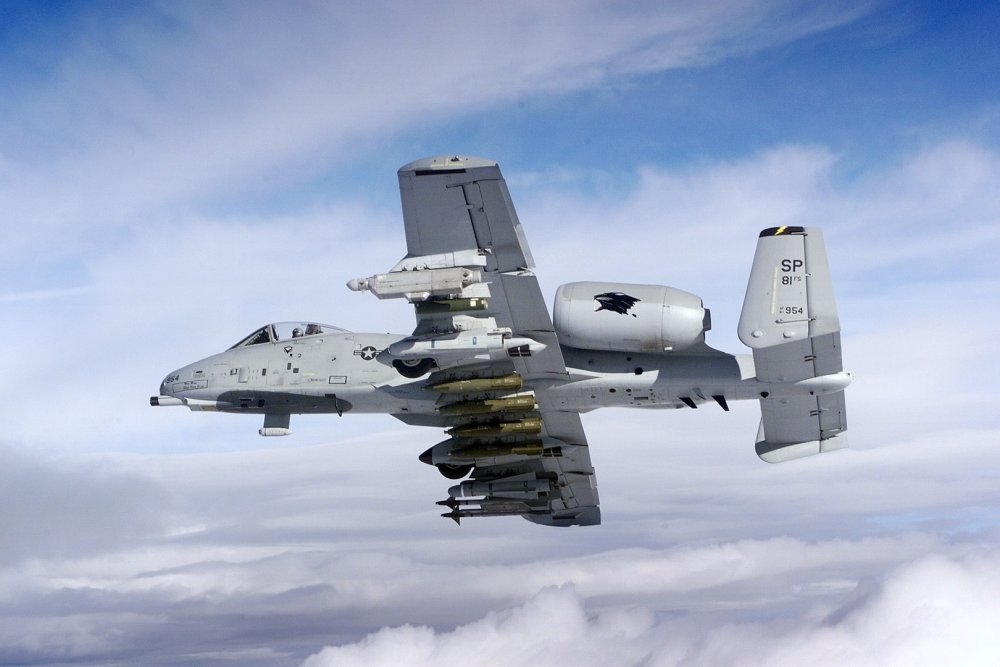
The A-10 Warthog Is America's Phoenix: It Won't Die, It Just Gets Reborn Stronger

Congress blocked the Air Force's latest effort to retire the A-10.

The U.S. Air Force has all but given up on retiring the A-10 Warthog close-air-support jet. Instead, the flying branch is upgrading the tough ground-attackers so they can fight and survive in high-intensity combat.

The Air Force had hoped to begin retiring its 281 A-10s starting in 2015. But Congress blocked the effort. Now the A-10 is safe even as the Air Force considers retiring other plane types.

“Acting Air Force Secretary Matt Donovan stoked speculation that the service will retire the A-10 after announcing that its FY21 budget request will include ‘controversial changes’ such as the divestment of legacy aircraft,” Valerie Insinna reported at Defense News.

But speaking at the conference later that day, Lt. Gen. Timothy Fay, deputy chief of staff for strategy, integration and requirements, confirmed that the A-10 is not one of the aircraft under consideration for divestment and will stay in service until the 2030s.

“Short answer: No,” Fay said, when asked whether the Warthog is on the cutting block. "I will tell you, I wish the response had been that the Air Force is actually bold enough to get after the threats that we’re facing.”

The Air Force acquired the subsonic, twin-engine planes in the 1970s and 1980s in order to destroy Soviet tanks. The stubby Warthog with its powerful 30-millimeter cannon proved effective as a close-air-support aircraft in Iraq and Afghanistan.

Despite its popularity with ground troops, the Air Force wanted to retire the A-10 early in order to free up around $5 billion for other investments. Now that retirement is off the table, the service is moving ahead with a wide range of upgrades meant to keep the Warthog relevant into the 2030s...

...“The new upgrades come after the completion, at the end of July 2019, of a first re-winging program that saw the installation of new wings, built by Boeing, on 173 A-10s,” Stefano D’Urso reported at The Aviationist...

...According to the Air Force Materiel Command, the upgraded wings should last for up to 10,000 flight hours without requiring a depot inspection. One month later, the U.S. Air Force awarded Boeing a second contract, worth up to [$999 million], that will provide up to 112 new wing assemblies, completing the re-winging of all 281 A-10s currently in inventory.

The A-10s also are getting new weapons, avionics and sensors, D’Urso explained.

The Air Force, in fact, has recently started fielding a new improved version of the Thales Visionix Scorpion Helmet Mounted Display System, used by A-10 pilots following the Helmet Mounted Integrated Targeting program in 2012. The main modification is the replacement of the original magnetic tracking sensor with a new sensor known as HObIT (Hybrid Optical-based Inertial Tracker), which should track pilot head movements more accurately. ...

A second major upgrade is the integration of the GBU-39 Small Diameter Bomb in the A-10’s arsenal. Until now the A-10 was limited to carry only a single weapon on each pylon; by using the BRU-61/A rack, the A-10 will be able to carry four SDBs on each weapon pylon, becoming a “bomb truck” that can release these stand-off weapons to neutralize threats as far as 50 miles in the target area before starting to provide close air support to ground troops.

Warthogs finally are getting Link 16 datalinks, too,” D’Urso explained. “With the integration of Link 16, the A-10 will be able to communicate and exchange data with all other legacy air assets, namely tactical jets, electronic warfare aircraft, bombers and AWACS, as well as the F-35.”

Finally, there’s a new radar -- a first for the type. “The last known upgrade is the integration of a synthetic aperture radar pod to supplement the existing targeting capabilities provided by the Sniper and Litening targeting pods. While not officially confirmed, the pod in question could be the AN/ASQ-236 “Dragon’s Eye” active electronically scanned array radar pod, already operational on the F-15E Strike Eagle...”

Back when I was in Korea, we had an Air Force captain with our headquarter, the Fighter Liaison Officer. We were discussing the A-10, and he mentioned to some of the armor officers there he had video of what Warthogs do to tanks. My buddy Mike Lemond said, "No, I don't want to watch them. Makes me a bit uneasy..." :)

Here to another few decades of the Warthog on the battlefield.

Wednesday, December 27, 2017

The Boeing 787

A few years ago I read how the Air Force is looking at a replacement for Air Force One, as the current two Boeing 747s have been in use since 1989. I know that because I was temporarily at Andrews Air Force Base and when I went for a run, I passed by the hangers. And there were the two 747s, brand news (at the time) and looking awesome.

Well, the Air Force has an issue because the replacement for the 747, the 787, has only two engines. And the USAF is concerned about transporting the president without four engines.

I don't know how the AF will handle this, but I've looked at the new Boeing 787 and it is incredible. And take a look at that take off:


Here are some more pics of Boeing's new top end bird. Enjoy.

Saturday, September 30, 2017

Prop plane reboot!

The US Air Force has a love-hate relationship with the A-10 Warthog. No question, it's the best close air support aircraft ever made. The GAU-8 30 mm Gatling gun will cut through tanks like a razor on single sheet paper. War story, when I was in Korea, 1989, we had an air liaison officer at our operations center. He was an Air Force captain who would coordinate close air support missions for the brigade. He mentioned to our battle captain, an armor officer, "I've got video of them shooting up tanks. Want to see it?"

Mike's answer, "No. I don't like watching that, it makes me a little nervous."

Now the Air Force has tried to kill off the A-10 for ages because it's not sexy, they hate the CAS mission, and the USAF likes jack of all trade birds, not master of one. But even they have had to have reality interfere with their hopes.

The Air Force Is Sending Its Light Attack Plane Competition to War

Two of the aircraft involved in the service's OA-X light attack plane competition are headed to a war zone.

The U.S. Air Force is sending two of the four aircraft involved in its OA-X light attack aircraft competition to the battlefield. The move, likely unprecedented, will allow the service to evaluate both airplanes in combat missions before a final purchase decision is made.

Aviation Week & Space Technology reports that the Air Force is sending the Embraer/Sierra Nevada A-29 Super Tucano and the Textron AT-6 Wolverine to a yet-to-be-determined war zone. Under a program nicknamed Combat Sent III, the Air Force will stand up an experimental squadron and send two A-29s and two AT-6s, along with seventy pilots and maintainers, to test the aircraft under combat conditions.

A-29 Super Tucano


The goal of OA-X program, which stands for observer-attack experimental, is to pick a light attack aircraft for low-end missions against enemy ground forces with little in the way of air defenses. OA-X is meant to be a relatively small ground attack aircraft capable of loitering over the battlefield and delivering bombs, rockets, and missiles on enemy targets with precision. The aircraft is also expected to do reconnaissance and observation missions.

Another key requirement: The OA-X is supposed to be cheap to fly. The retirement of the A-10, whether in two years or twenty, is inevitable. The F-35A Joint Strike Fighter will likely take over close air support duties flying against countries with advanced air defense systems—think Russia or China. But in smaller wars against less technologically advanced enemies, there's little reason to use a plane as advanced (and, at $35,000 an hour, as expensive to fly) as the F-35. OA-X will be a low-cost solution for wars where the F-35A would be overkill.

The Air Force hasn't yet decided where to send Combat Sent III, but the war against the Islamic State in Iraq and Syria would be an obvious choice. The Islamic State conflict is exactly the type of fight the OA-X was tailored for, and ISIS has nearly non-existent air defense capabilities, so there is little to no likelihood that a careful pilot could be shot down by enemy fire...

I would hope they would keep the A-10s going for at least as long as the B-52s. Could it use some upgrades, yes, but again, the design is perfect for, if you will, "high end" close air support. But it's good to see the Air Force will use low cost propeller planes to supplement their CAS assets.

I hope to read soon on how this worked out.

Wednesday, February 8, 2017

China and intelligent weapons...

Last year I read a sobering novel called Ghost Fleet, the story of a near future (next 20 years) war between the United States and China. It reminded me of the techno-thrillers of Tom Clancy, not quite as fast but very detailed. And disturbing.

We have become dependent on technology to a great degree. I bemoan the fact a lot of my rookie officers cannot use a map well, but they do know how to use the map app on their smart phone. When I was a trainer I would occasionally take control of the car computer and direct my trainee to use his radio and a notebook only. Welcome to the analog world man, and rely on one fact. Technology will fail.

Now we have one of our two great adversaries making significant leaps on technology, but both civilian and military applications. It may mean serious changes to how we view power projection, especially with our carrier operations.
China’s Intelligent Weaponry Gets Smarter

Robert O. Work, the veteran defense official retained as deputy secretary by President Trump, calls them his “A.I. dudes.” The breezy moniker belies their serious task: The dudes have been a kitchen cabinet of sorts, and have advised Mr. Work as he has sought to reshape warfare by bringing artificial intelligence to the battlefield.

Last spring, he asked, “O.K., you guys are the smartest guys in A.I., right?”

No, the dudes told him, “the smartest guys are at Facebook and Google,” Mr. Work recalled in an interview.

Now, increasingly, they’re also in China. The United States no longer has a strategic monopoly on the technology, which is widely seen as the key factor in the next generation of warfare.

The Pentagon’s plan to bring A.I. to the military is taking shape as Chinese researchers assert themselves in the nascent technology field. And that shift is reflected in surprising commercial advances in artificial intelligence among Chinese companies.

Last year, for example, Microsoft researchers proclaimed that the company had created software capable of matching human skills in understanding speech.

Although they boasted that they had outperformed their United States competitors, a well-known A.I. researcher who leads a Silicon Valley laboratory for the Chinese web services company Baidu gently taunted Microsoft, noting that Baidu had achieved similar accuracy with the Chinese language two years earlier.

That, in a nutshell, is the challenge the United States faces as it embarks on a new military strategy founded on the assumption of its continued superiority in technologies such as robotics and artificial intelligence...

..But the global technology balance of power is shifting. From the 1950s through the 1980s, the United States carefully guarded its advantage. It led the world in computer and material science technology, and it jealously hoarded its leadership with military secrecy and export controls.

In the late 1980s, the emergence of the inexpensive and universally available microchip upended the Pentagon’s ability to control technological progress. Now, rather than trickling down from military and advanced corporate laboratories, today’s new technologies increasingly come from consumer electronics firms. Put simply, the companies that make the fastest computers are the same ones that put things under our Christmas trees.

As consumer electronics manufacturing has moved to Asia, both Chinese companies and the nation’s government laboratories are making major investments in artificial intelligence.

The advance of the Chinese was underscored last month when Qi Lu, a veteran Microsoft artificial intelligence specialist, left the company to become chief operating officer at Baidu, where he will oversee the company’s ambitious plan to become a global leader in A.I.

And last year, Tencent, developer of the mobile app WeChat, a Facebook competitor, created an artificial intelligence research laboratory and began investing in United States-based A.I. companies.

Rapid Chinese progress has touched off a debate in the United States between military strategists and technologists over whether the Chinese are merely imitating advances or are engaged in independent innovation that will soon overtake the United States in the field.

“The Chinese leadership is increasingly thinking about how to ensure they are competitive in the next wave of technologies,” said Adam Segal, a specialist in emerging technologies and national security at the Council on Foreign Relations.

In August, the state-run China Daily reported that the country had embarked on the development of a cruise missile system with a “high level” of artificial intelligence. The new system appears to be a response to a missile the United States Navy is expected to deploy in 2018 to counter growing Chinese military influence in the Pacific.

Known as the Long Range Anti-Ship Missile, or L.R.A.S.M., it is described as a “semiautonomous” weapon. According to the Pentagon, this means that though targets are chosen by human soldiers, the missile uses artificial intelligence technology to avoid defenses and make final targeting decisions.

The new Chinese weapon typifies a strategy known as “remote warfare,” said John Arquilla, a military strategist at the Naval Post Graduate School in Monterey, Calif. The idea is to build large fleets of small ships that deploy missiles, to attack an enemy with larger ships, like aircraft carriers.

“They are making their machines more creative,” he said. “A little bit of automation gives the machines a tremendous boost.”

Whether or not the Chinese will quickly catch the United States in artificial intelligence and robotics technologies is a matter of intense discussion and disagreement in the United States.

Andrew Ng, chief scientist at Baidu, said the United States may be too myopic and self-confident to understand the speed of the Chinese competition.

“There are many occasions of something being simultaneously invented in China and elsewhere, or being invented first in China and then later making it overseas,” he said. “But then U.S. media reports only on the U.S. version. This leads to a misperception of those ideas having been first invented in the U.S.”

A key example of Chinese progress that goes largely unreported in the United States is Iflytek, an artificial intelligence company that has focused on speech recognition and understanding natural language. The company has won international competitions both in speech synthesis and in translation between Chinese- and English-language texts...

Sunday, December 18, 2016

China air power....

Some interesting looks at China's power projection assets. I wrote my master's thesis on the rise of China and her threat to the West. They are investing a fortune in bringing power projection up to American standards and here are two example, a new fighter and space operations.


The Mighty Dragon: A Symbol of China's Maturing Air Force

Forecast

China's new stealth fighter, the J-20A Mighty Dragon, showcases the Chinese air force's remarkable progress over the past two decades.

Nevertheless, significant deficits in equipment and training will continue to hamper further advances.

China will focus its efforts on resolving bottlenecks, including lags in engine development and insufficient combined-arms drills, as it seeks to build up its air force in the coming years.
Analysis

Two sleek Chinese stealth fighters streaked across the skies over Zhuhai on Nov. 1, marking the official debut of Beijing's brand new J-20 Mighty Dragon jet. One of the only fifth-generation stealth fighters ever built, the aircraft's unveiling is a symbol of the impressive progress China's air force has made over the past two decades. The stealth fighter's design, however, also contains several important weaknesses, a reminder of the limitations in military aviation China is still struggling to overcome…

Better, but Imperfect

Just 20 years ago, the bulk of the Chinese air force consisted of vintage aircraft from the 1950s and 1960s. Now, China is on track to become the second country in the world to field a fifth-generation stealth fighter, a rather remarkable feat. As it is currently designed, the J-20 is a large fighter jet that boasts a considerable payload and fuel capacity, making it well-suited for operations requiring travel over long distances. Moreover, the aircraft is equipped with cutting-edge stealth technology, KLJ-5 Active Electronically Scanned Array radar, and infrared search and tracking systems.

…But the Mighty Dragon is not without its flaws. Chief among them is the fact that it is underpowered: Chinese engineers expect the jet to someday run on the powerful WS-15 engine, but since it is still in development, initial batches of J-20 aircraft will likely be forced to make do with a modified version of the weaker Russian AL-31F engine. Because these engines cannot adequately support a heavy fighter like the J-20, they will reduce its ability to maneuver in combat. Furthermore, the Mighty Dragon is not as clandestine as other fifth-generation stealth fighters, such as the American F-22. (The latter is what is known as an all-aspect stealth fighter, boasting low detectability from all angles, while the J-20 has low detectability only from the front.)

A Work in Progress

The Mighty Dragon's strengths and weaknesses are emblematic of the Chinese air force's modernization at large. On one hand, Beijing has much to be proud of when it comes to its air capabilities. China is putting ever more capable fighter jets into production, including significantly upgraded versions of older models such as the J-10B, J-16 and J-11D. Meanwhile, it is also overhauling its bomber force, and new aircraft such as the H-6K are already being mass-produced. China is in the process of expanding its air-launched missile stockpile as well, and U.S. Gen. Herbert Carlisle has cited Beijing's development of variants such as the PL-15 beyond-visual-range missile as a compelling motive for Washington to improve its own air-to-air missiles. Finally, China is increasing its strategic and tactical transport capabilities.

Nevertheless, the Chinese air force still has a long way to go in a number of areas. Delays in engine development are slowing the evolution of transport and bomber aircraft as well as fighter jets. China is also well behind other major powers, such as the United States and Russia, in building a comprehensive aerial refueling force. (Currently, it has too few aerial refueling tankers to service its large fleet.) Moreover, Beijing continues to rely on imports of foreign warplanes as it hashes out the final details of its own domestically made machines. In fact, it bought 24 Su-35 fighter aircraft from Russia just last year.

…Elevating the skills of air and ground crews will take time and effort, and China still has many deep-seated structural issues to resolve. Historically, flight squadrons and ground-based anti-aircraft units in China have trained separately. It has been only within the past few years that the air force has started to incorporate large, multiservice air exercises into its curriculum…


A Test of China's True Intentions in Space

Summary

Beijing is in the process of modernizing and enhancing its space launch capabilities. During the week of June 27, China carried out the inaugural launch of its Long March 7 system, part of a new generation of rocket systems that include the Long March 5 and Long March 6. The Long March 7, using the most powerful rocket ever built in China, will be the workhorse of the nation's future space missions, eventually carrying taikonauts and supplies into orbit for its planned space station. Though the launch was a notable achievement, the secondary payload it carried — the Aolong-1 or "Roaming Dragon," a small satellite designed to collect space debris with a robotic arm — has stirred up familiar speculation about the true nature of China's space program.

Analysis

Like the United States and Russia, China recognizes the importance of space to modern military warfare. In the nearly 10 years since it conducted its first successful anti-satellite weapons (ASAT) test, Beijing's interest in cultivating an array of ASAT capabilities has been well known. Now, some observers speculate that the Roaming Dragon may be another step in that direction.

Hidden Intentions?

As an ASAT, the Roaming Dragon's design marks a significant departure for Beijing. China's previous ASAT tests involved kinetic kill vehicles, which destroyed satellites on impact and spread potentially destructive debris into orbit. By contrast, the Roaming Dragon's robotic arm would avoid creating debris by grabbing an adversary's satellite….

…China's Roaming Dragon highlights the dual nature of most space technologies. A space debris collector is programmed to capture any object of a certain size. In addition to the debris it is designed to pick up, the satellite would also gather other objects of comparable size. So, though perhaps not as efficient as a dedicated ASAT system, the Roaming Dragon could fill a covert anti-satellite function, while ostensibly operating as a benign debris collector. At the same time, however, China may be more interested in the Roaming Dragon as a means to grab uncooperative, unresponsive or dead satellites.

Scrutiny in Space

Whatever the satellite's intended purpose, China is far from the only country testing systems with such applications. Japan launched the Space Tethered Autonomous Robotic Satellite-2 (STARS-2) in February 2014 to test a space tether of sorts planned for a future system that will use a giant net to collect space debris. NASA, meanwhile, is backing early research and development for space debris removal concepts, and it has been suggested that the U.S. X-37B space plane, whose activities are classified, may also collect space debris or satellites. These space programs are also implementing strategies for tracking and monitoring space debris.

…Regardless of Beijing's intentions for the Roaming Dragon, China's space policy, like that of the United States, is multifaceted, encompassing anti-missile systems and exploratory space missions alike. Consequently, China's space program — like all space programs — will always feature a tinge of ambiguity...

Tuesday, November 8, 2016

Why Russia Harasses U.S. Aircraft, April 20, 2016


Why Russia Harasses U.S. Aircraft
A Russian Su-24 jet makes a close-range and low-altitude pass near the USS Donald Cook in the Baltic Sea on April 12. Russia sometimes uses close interceptions to deter U.S. craft without sparking outright combat. (U.S. Navy)

Summary

Since Russia annexed Crimea in 2014, tension with the West has been high, affecting eastern Ukraine, Syria and hot spots across the former Soviet sphere. Less overtly, Moscow has been working to protect areas vital to Russian interests by raising the stakes of U.S. operations there. This has manifested in numerous aggressive interceptions of U.S. military aircraft in flight, especially over the Black and Baltic seas. The interceptions, which are reportedly occurring more frequently, aim to dissuade Washington from operating in that airspace.

Analysis

On April 14, a Russian Su-27 fighter jet performed a barrel roll maneuver over a U.S. Air Force RC-135 spy plane flying in international airspace over the Baltic Sea. Just three days earlier, two Russian Su-24 bombers flew dangerously and repeatedly close to a U.S. destroyer, also in the Baltic Sea. The most recent intercept came less than a week before the NATO-Russia Council is set to convene for the first time since 2014. Along with the fighting in Ukraine and Afghanistan, military transparency and risk reduction — timely and relevant topics given the interception incidents — will be up for discussion at the meeting.

Not all interceptions are aggressive. In fact, the tactic is standard practice among militaries, both in the air and at sea. Around the world, aircraft and ships from a multitude of countries routinely intercept, visually inspect and escort other aircraft and maritime vessels passing through sensitive airspace or waters. Air forces, navies and coast guards worldwide regularly perform intercepts of this kind to enforce an air defense identification zone such as that in the East China Sea, to police operations such as NATO's Baltic Air Policing mission or, as necessary, to conduct ad hoc tactics. In these capacities, interceptions are almost invariably non-threatening; they are simply a means by which nations enhance their situational awareness and protect against contingencies.

But some interceptions deviate from the norm. In a deliberate ploy to deter a nation's forces from transiting a specific space, aircraft or ships may display aggressive maneuvers, harassing and intimidating targets. These interceptions resemble a high-stakes game of chicken, daring the foreign craft to continue on its route, despite the increased risk of collision, or back down.

Though the tactic carries a risk of damage to both sides, the initiator holds the advantage. Usually in aerial interceptions, a sleek, fast fighter jet targets a lumbering bomber or reconnaissance plane. The initiator of the encounter is often far less valuable — in monetary cost and in the number of flight crew aboard — than the intercepted target, raising the stakes for leaders (and crew) as they decide how to respond. As a fighter jet carries out dangerous maneuvers around it, the target is left to wonder about the interceptor's intentions and skill.

For Russia, close interceptions offer a means to deter U.S. craft without sparking outright combat. The tactic has worked for Moscow already: In July 2014, a Russian jet's aggressive flight so alarmed the crew of a U.S. RC-135 over the Baltic Sea that it accidentally fled into Swedish airspace to evade the interceptor.

But close intercepts do not always go as planned. In the April 2001 Hainan Island incident, for example, a collision during a close intercept left a Chinese pilot dead, his J-8II interceptor destroyed and a U.S. EP-3E signals intelligence aircraft seriously damaged. A number of Cold War-era close intercepts also caused collisions, particularly between ships. This led to the 1972 U.S.-Soviet Incidents at Sea Agreement, which sought to reduce the chances of collision and manage escalation when collisions did occur. Further efforts to limit the risk of escalation produced the 2014 Code for Unplanned Encounters at Sea, which included Russia and China, as well as a 2014 agreement between the United States and China to regulate incidents between the two.

But the past few years have demonstrated that the agreements are not enough to stop such dangerous close encounters, at least not between the United States and Russia. And given the substantial tension between the two countries, a midair or at-sea collision resulting from a close interception could trigger retaliatory measures, leading to an escalation that neither side wants. Even so, as long as tension persists between Russia and the United States, the interceptions are likely to continue.

Why Russia Harasses U.S. Aircraft is republished with permission of Stratfor.