Police Work, Politics and World Affairs, Football and the ongoing search for great Scotch Whiskey!

Showing posts with label Foreign Policy/Relations. Show all posts

Monday, September 29, 2025

Mrs. Bill Clinton and her private email server.

I've been a writer for the American Free News Network since its founding in 2022. One of my fellow authors has an excellent piece on Mrs. Bill Clinton and her use of a private email server for official business. 

I've known countless people who had multiple phones during their daily lives. Usually, it's a private phone and your office phone. Also, multiple email address. When I was deployed overseas in Kuwait, I had three official unclassified addresses. plus two collateral (Secret and below) addresses, and two above that. Not counting my personal email, and I had no issue with handling all of them. But we are supposed to believe the smartest women ever, the most qualified person to be nominated for the presidency could not handle two email address. 

Also, being an Army officer for decades, I know at that level you need both classified and unclassified email addresses for your work. The woman fourth in line for the presidency does not have a classified email account? I find that very hard to believe. No, I know that's a lie. John F. Di Leo has an excellent article on this matter, and why she needs to be prosecuted for her crimes. 

Hillary Clinton and the Needle in a Haystack

For over a decade, the press has been minimizing its coverage of the Hillary Clinton email server issue, as Congress and the conservative media have been trying to get to the truth of the matter.

The facts, as shared, are simple enough:  As Secretary of State during Barack Obama’s first term in the White House, Hillary Clinton chose to violate the law and route all of her email traffic, both personal and work-related, through a private email server in her home in Chappaqua, New York. This kept the emails out of the security and record retention protocols of the federal government, and potentially added an additionally severe crime if any of those emails were classified.

It is generally assumed that, logically, the only reason for her to use a private server at the time was to hide communications that included her criminal activity, but without such evidence, she couldn’t be prosecuted for that.  What she could, and should, be prosecuted for, however, was for removing the necessary government security around her job-related communications, which simply had to include at least some classified material.

As the Clinton gang has parsed, and dissembled, and – oh, the heck with it – outright lied, they have tried to give the impression that there was no classified material on the email traffic that the Secretary of State had for four years.  When some emails were finally found that were marked, in the subject line, as classified, the Clinton gang spun it to say that shouldn’t count because those were incoming emails, not outgoing, and therefore not her fault (as if anyone on earth shouldn’t be able to assume that the email address of a Secretary of State would obviously be a secure line).

But even so, they all miss the point. On both sides of the debate, in fact, people are missing the point, perhaps because many don’t fully realize what the role of the Secretary of State is.

It’s conceivable – not likely, but conceivable – that a Secretary of Education, or Energy, or maybe even Veterans Affairs, could go four years without having any classified emails.  It’s possible.  But she was a Secretary of State.  And what does a Secretary of State do, in his or her daily life?

Passports

The State Department issues passports to US citizens, and authorizes and monitors international travel of American passport holders.  While this is rarely particularly secret, if there’s a challenge that needs to go to the Secretary, it would be.

During her four year term, she had to encounter occasions when the department needed her approval to grant a passport to someone of unproven citizenship, or a felon or suspected-felon on a no-travel order, or a person in a witness protection program, or agents with security clearances, etc.  Such issues would have needed her sign-off, and most such discussions would have been classified, some at the highest level.

Visas

The State Department manages inbound visas for foreigners.  If they wind up wanting to stay here, the responsibility is transferred to Homeland Security.  But the question of granting visas – work visas, tourist visas, political sanctuary visas, etc. – is a matter for State.   Again, these are normally not classified, and would not require escalation to a Cabinet Secretary.

But what of the ones that do?  If a visa question goes to the Secretary – politically oppressed people in Russia or China or the middle east, for example, whether dissidents or just victims of homicidal rebellions like ISIS – then such discussions would be secret; the people’s lives would be in jeopardy if it were known at home that they were trying to escape to the United States.  Any communications about such questions that reach the Secretary would have to be classified.

The Embassy Archipelago

There are United States Embassies and Consulates all over the world, located in friendly nations, unfriendly nations, and everything in between.  State manages and staffs these locations, appointing ambassadors and other employees of the foreign service.

While most embassies and consulates include a commercial side (such as an office of the Department of Commerce for import/export outreach and support), the sites are still operated by State.  There are often military and security aspects to these locations as well – a few marines, a few security personnel from other agencies, either publicly acknowledged or clandestine.

Normal staffing matters – “we’re transferring a clerk from the embassy in London to the embassy in Paris” – might not have to be classified, but then, they wouldn’t be escalated to the Secretary anyway.

What about the less normal staffing matters?  What about questions regarding interdepartmental cooperation, like when the CIA asks to put someone in an embassy for a while, or when an ambassador is meeting with a political opposition group or minority, and needs guidance on what American policy supports or opposes?  What about when a prisoner release or exchange is being negotiated, and the Ambassador needs to know what he can or can’t trade?

These are the questions that would make it to the Secretary… and these are the ones that would be classified.

Arms Control

The Export Controls regime of the United States is primarily split between two departments – State and Commerce.  While Commerce handles most controls on dual-use items (such as products that have a legitimate civilian purpose, but could also be abused for chemical or biological weapon proliferation), the State Department handles everything covered by the International Traffic in Arms Regulations (ITAR), in association with the United States Munitions List (USML).

Weapons, weapon parts, and almost anything customized for military use – plus the plans and blueprints, technical specs, molds and dies for manufacturing such things – are therefore controlled by the State Department.

If a defense contractor – say, Northrup Grummon, Honeywell, Ball, General Dynamics, and hundreds of others – is considering outsourcing one of the parts to one of their foreign plants, or is considering selling the parts to one of our allies, they must apply for an export license from State.

Everything about these export license applications – particularly the technology, is confidential.  When a question arises that needs the Secretary’s decision, that email traffic has to be secure.  Our enemies are always trying to get their hands on our defense technology; emails discussing who makes what and how, and who they can share information with and where, are of course classified, or our entire U.S. export control regime is utterly porous.

Treaty Negotiations

One of the key Constitutional responsibilities of the Executive branch is the negotiation of treaties with foreign governments.  The Secretary of State negotiates with the President’s guidance, and then the President submits it to the Senate for their approval or rejection (and, contrary to the practices of the current administration, that’s the only legal way they can be managed).

Some such treaties could, conceivably, be managed without some degree of confidentiality, but not often.  Normally, such treaties – especially since, nowadays, they concern arms control and nuclear non-proliferation efforts – are negotiated based on our own top secret information about what the enemy really has, and what we are really willing to consider giving up.

Such information, of necessity, is obviously confidential.  We cannot allow the enemy – or a third party – to obtain our plans, our internal discussions, our behind-the-scenes evaluations as such treaty negotiations are going on… or for that matter, for many years afterward!

During Hillary Clinton’s tenure at State, there was saber-rattling and more from North Korea and Red China, the virtual evacuation of Iraq and Afghanistan, and a string of revolutions across North Africa and the Middle East.

Under the normal rules governing federal government communications, it is inconceivable that the vast majority of emails that reached the level of Secretary involvement wouldn’t have been classified.

Human Rights

As long as the United States of America have served as a City on the Hill for the rest of the world to emulate, our nation has been a beacon of freedom, seeking out information about foreign prostitution rings, human trafficking organizations, foreign crime gangs, and every other violation of basic human rights that we see on the international news from across the globe.

The State Department applies pressure to foreign governments to stand up to such organizations, attempting to encourage third world governments to bear down on the often politically-connected criminals within their own borders, sometimes organizations that own  a few magistrates or legislators themselves.

Such pressure is a delicate matter, often based on secret discussions by our clandestine agents, local whistle-blowers, or relatives of relatives in-country.  Such documentation naturally must be secret to protect the individuals reporting the matter.

And when they reach the desk of the Secretary, it is again inconceivable that the vast majority of such communications wouldn’t be classified.

Lunch and Dinner

These are only the most obviously serious of the many matters that the State Department handles.  There are countless more, as the leviathan has grown – and each cabinet department with it – in over two centuries of expansion.

But the secrecy of a Secretary’s email is not limited to the obviously classified.  We must remember that a Secretary of State is fourth in line to the Presidency, and therefore has security concerns that you and I don’t have to worry about.

If Hillary Clinton was flying through Chicago to attend her high school reunion, she might have planned a lunch with an old friend… if she flew through Los Angeles on her way to the Far East, she might have planned a shopping trip on Rodeo Drive… if she flew through London on her way to a summit in Europe, she might plan a secret meeting while in town with the British Foreign Minister, or perhaps with some foreign exile who’s hiding in London due to a fatwa.

While the latter would likely be designed with top security, the former might make security challenging.  A famous restaurant in Chicago or shop in L.A. can be secured on the spot, but not if an enemy has a week to prepare.

So it is that even the lunch plans and dinner plans of a U.S. Secretary of State are – and must be – confidential matters. Outside of publicly announced events, such as press conferences, summits, and speaking engagements,  a Secretary of State’s schedule must be tightly controlled, with as much of it as possible kept unknown to any but the participants.

A Secretary of State is no longer an individual private citizen; he or she is a negotiator with foreign countries, many of whom want us – or our allies – to be evaporated, and would stop at nothing to gain the advantage in their effort.  And again, that Secretary is fourth in line to the Presidency.  Particularly in a post-9/11 world, we must take such issues seriously.

It Strains Credulity

And yet, in light of everything we know about the office of Secretary of State, Hillary Clinton expects us to believe that in four years, she never had an email that was classified… or if one came in that was, she shouldn’t be blamed because it was just inbound, not outbound, as if anyone communicating with a United States Secretary of State shouldn’t be able to safely assume that her communications are secure!

In point of fact… virtually HER ENTIRE JOB was classified. For four years, almost everything she did, almost everything that crossed her desk, had to be recognized as some degree of secrecy, anywhere from a low-level confidentiality to a top secret status.

As we have seen, the State Department may indeed do many things that don’t require confidentiality, but none of them would have often reached the desk of the Secretary.  Of those things that did, about the only ones that weren’t classified might have been her attendance at the occasional foreign funeral. Other than that, practically everything she touched had to be sensitive.

In all this time, the spin has been that nothing she did was classified, so to search for an email that was indeed classified was bound to be a matter of looking for a needle in a haystack.

Ridiculous.  In all likelihood, many thousands of the emails were classified – or should have been, and would have been in any sane and competent administration – and that’s why they scrubbed the server so hard.

It’s virtually impossible for it to be otherwise, unless she slept through her entire tenure in the job.

And whatever she did, to the detriment of the United States and the world, we know that she most certainly did not do that.

Copyright 2015-25 John F. Di Leo

This column was originally published in Illinois Review, here.

John F. Di Leo is a Chicagoland-based international transportation and trade compliance trainer and consultant.  President of the Ethnic American Council in the 1980s and Chairman of the Milwaukee County Republican Party in the 1990s, his book on vote fraud (The Tales of Little Pavel), his political satires on the Biden-Harris administration (Evening Soup with Basement Joe, Volumes IIIand III), and his first nonfiction book, “Current Events and the Issues of Our Age,” are all available in either eBook or paperback, only on Amazon.   

Tuesday, September 27, 2022

Multiple nations are paying for Obama's "Worst Mistake"

One of the many disastrous foreign policy efforts of the Obama presidency was overthrowing nations in the Middle East. For a candidate who ran on a “no war” promise, he seemed to have no issue with interfering with an unstable hostile state (Syria), making it worse; an allied nation (Egypt), almost giving it to the Muslim Brotherhood, and; and a stable non-hostile state, Libya, turning it into a disaster.  

The Legacy of Obama’s ‘Worst Mistake’

There’s a problem with the American way of war.


By Dominic Tierney April 15, 2016

In a Fox News interview last Sunday, Obama was asked about his “worst mistake.” It’s a classic gotcha question, but he had an answer ready. “Probably failing to plan for the day after, what I think was the right thing to do, in intervening in Libya.” This was yet another act of presidential contrition for the NATO operation in 2011 that helped to overthrow Muammar Qaddafi but left the country deeply unstable. In 2014, Obama said: “[W]e [and] our European partners underestimated the need to come in full force if you’re going to do this. Then it’s the day after Qaddafi is gone, when everybody is feeling good and everybody is holding up posters saying, ‘Thank you, America.’ At that moment, there has to be a much more aggressive effort to rebuild societies that didn’t have any civic traditions.” In recent interviews with The Atlantic’s Jeffrey Goldberg on the “Obama Doctrine,” the president bluntly said the mission in Libya “didn’t work.” Behind closed doors, according to Goldberg, he calls the situation there a “s*&^ show...”

Mr. Obama, maybe you should have thought (snicker) about that before you decided to overthrow one of the successes of the Iraq War. Qaddafi, no angel, in the aftermath of Saddam Hussein’s ouster, gave up his WMD program, settled the civil actions arising from the Lockerbie Scotland airline bombing, and was cooperating with us on intelligence matters. In case you never understood this, we don’t necessary need friends, or allies in other nations. A non-hostile but stable nation is also good to have. We had that in Libya, until you and your Secretary of State, Hillary Clinton,  turned stability to a “s*&^ show.”


Perhaps you and Mrs. Clinton should read something other than Rules for Radicals, like a biography of one of your predecessors, Dwight Eisenhower. He was famous for many things, including thinking things through. He had been planning major operations for decades, and he always asked, “And what next?” You plan for what will come after you execute your grand plan.


The results of your great plan in Libya? Well, from the CATO institute:

The Obama Administration Wrecked Libya for a Generation

Such is the cost of America’s promiscuous war‐​making

Libya’s ongoing destruction belongs to Hillary Clinton more than anyone else. It was she who pushed President Barack Obama to launch his splendid little war, backing the overthrow of Moammar Gaddafi in the name of protecting Libya’s civilians. When later asked about Gaddafi’s death, she cackled and exclaimed: “We came, we saw, he died.”

The arrogance, hubris and incompetence of Mrs. Bill Clinton never ceases to amaze me. 

Alas, his was not the last death in that conflict, which has flared anew, turning Libya into a real‐​life Game of Thrones. An artificial country already suffering from deep regional divisions, Libya has been further torn apart by political and religious differences. One commander fighting on behalf of the Government of National Accord (GNA), Salem Bin Ismail, told the BBC: “We have had chaos since 2011.”

… in 2011, the Arab Spring engulfed Libya, as people rose against Gaddafi’s rule. He responded with force to reestablish control. However, Western advocates of regime change warned that genocide was possible and pushed for intervention under United Nations auspices. In explaining his decision to intervene, Obama stated: “We knew that if we waited one more day, Benghazi…could suffer a massacre that would have reverberated across the region and stained the conscience of the world.” Russia and China went along with a resolution authorizing “all necessary measures to prevent the killing of civilians.”

In fact, the fears were fraudulent. Gaddafi was no angel, but he hadn’t targeted civilians, and his florid rhetoric, cited by critics, only attacked those who had taken up arms. He even promised amnesty to those who abandoned their weapons. With no civilians to protect, NATO, led by the U.S., bombed Libyan government forces and installations and backed the insurgents’ offensive. It was not a humanitarian intervention, but a lengthy, costly, low‐​tech, regime‐​change war, mostly at Libyan expense. Obama claimed: “We had a unique ability to stop the violence.” Instead his administration ensured that the initial civil war would drag on for months—and the larger struggle ultimately for years…

And thanks to Mrs. Clinton and Mr. Obama’s foolishness, they turned a stable nation in an unstable region into an example of disaster. Critically, Libya’s inventory of 20,000 Man Portable Air Defense Systems (MANPADS) was lost, and the US and Israel had only recovered 5,000 of them as of 2013. 

Amazingly, ten years since Mrs. Clinton and Mr. Obama “worse mistake,” other nations are having to deal with this disaster of foreign policy. The Italians have elected a new prime minister, Giorgia Meloni. One of her promises is to “secure the border” (Sound familiar?). 

From the Washington Post:

… (Giorgia) Meloni has also called, repeatedly, for a “naval blockade” of the Mediterranean. A spokesman for Meloni said Monday that such a move could only be led by Europe, and in cooperation with North African countries.


In her interview with The Post, Meloni said “migrant flows need to be managed,” because “nations only exist if there are borders, and if those are defended.” She said that Italy had been giving immigrants few legal pathways, while instead letting migration be dominated by “smugglers” and “slave drivers.”

But there is no question thanks to the chaos of Libya, established by the Obama’s interference in their nation, Europe is having to deal with millions of refugees. Italy is having to deal with over a million refugees from the Libyan civil war. Did the US start the civil war, no. But interference by the US and NATO was a disaster, causing a strain on the nations of Europe and Africa. 

I can recommend another book to Mr. Obama and Mrs. Clinton, Once an Eagle. Towards the end, the protagonist, Sam Damon, is speaking with an officer of the fictional nation of Khotiane (obviously an allegory of Vietnam). The officer reviews with Damon how Great Britain almost entered on the side of the south during the American Civil War. He makes the point just as Britain had no business being in that conflict, the Americans have no business in Khotiane’s fight. “It is our civil war.” 

Unfortunately Mr. Obama and Mrs. Clinton didn’t learn that lesson. And Europe, as well are other nations, are paying the price for it.

Saturday, April 3, 2021

More books, more books!

My wife Beth is always on me about buying books, and I have to say it, she has a point. My "To Read" bookshelf have over 100 books on it. But my retort is, "There are worse habits to have." And I've discovered buying used books for a lot of what I'm reading now. I just picked up a four volume biography of General Marshall, hardcover, used and in good condition, for less than fifty dollars.

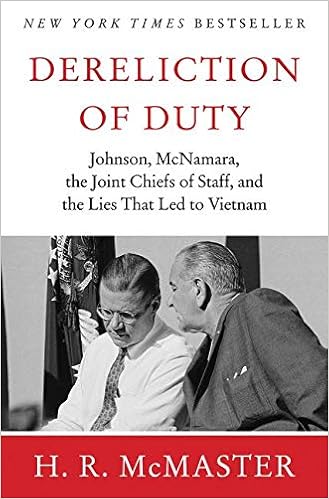
I am currently re-reading The Leader's Bookshelf by retired US Navy Admiral James Stavridis, and R. Manning Ancell, which is a review of fifty books on leadership. I read the summary of Dereliction of Duty by retired Army Lieutenant General H. R. McMaster, and yes, I immediately got on Amazon and ordered a slightly used copy. I promise Beth, I will get to it. 


But while I was reviewing this, I found this article by General McMaster, and found it fascinating. I agree with the general that Ronald Reagan did the proper thing in challenging the Soviet Union. In the Gipper's immortal words, Reagan,  “Here’s my strategy on the Cold War: We win; they lose.” Rawhide was always to the point. 

Now with China rising as our new major advisor (Although Putin is trying to make Russia the Soviet Union 2.0), I find this article very insightful.
Among the best remembered summits of the 20th century are those of Ronald Reagan and Mikhail Gorbachev. Reagan’s commitment to dialogue with America’s primary adversary and what then-Secretary of State George P. Shultz called his “personal chemistry” with his Soviet counterpart were hallmarks of his presidency. But even more important was the fact that Reagan had a clear strategy for victory in the global contest with the Soviet Union.

Reagan’s approach — applying intensive economic and military pressure to a superpower adversary — became foundational to American strategic thinking. It hastened the end of Soviet power and promoted a peaceful conclusion to the multi-decade Cold War. 

Now it is useful to ask if a similar approach would be equally successful in America’s contest with an even more formidable rival, the People’s Republic of China, a challenger with whom the free world’s economies are intertwined and increasingly interdependent.

In 1983, Reagan approved National Security Decision Directive 75, which set the course for an assertive, competitive approach to the Soviets, in contrast to the “live and let live” aspirations of détente... 

...Working from (George F.) Kennan’s original intuitions (on containment), the operational approach that Directive 75 emphasized was “external resistance to Soviet imperialism” and “internal pressure on the USSR to weaken the sources of Soviet imperialism.” Rather than trying to reduce friction with the Soviets as prior administrations had done, Directive 75’s aim was “competing effectively on a sustained basis with the Soviet Union in all international arenas.” Within nine years, the Soviet Union collapsed, worn out by economic pressure, an arms race it could not win and internal political contradictions.

The goal of a competitive strategy versus Chinese Communist Party aggression should be different. The United States and like-minded liberal democracies must defend against the expansion of the party’s influence, thwart its ambitions to dominate the 21st century global economy, and convince Chinese leaders that they can fulfill enough of their aspirations without doing so at the expense of their own people’s rights or the sovereignty of other nations.

These efforts must apply Reagan’s fundamental insight — to win against a rival of China’s magnitude requires sustained pressure against the true sources of the adversary’s power.

China is an economic juggernaut. Through its engagement with the United States and other major markets, it has made itself central to global supply chains, moved to dominate strategic industries and emerging technologies, and built up a military designed to win a war with the U.S. and its allies. Numerous multinational corporations and global financial institutions pump capital, technology and know-how into China. This transfer of capability and competitive advantage can be used against the free world to devastating effect. As the CCP puts it, China is poised to “regain its might and re-ascend to the top of the world.” 
To foil China’s plans for preeminence, the United States and its partners should restrict investment into Chinese companies and industries that support the CCP’s strategic goals and human rights abuses. The U.S. should work to block China’s access to Western technology in areas that contribute to military advantage and to construct a new global trade and supply chain system that reduces dependency on China. With India, Australia and Japan, the U.S. must also maintain preponderant military power in the Indo-Pacific to convince Chinese leaders that they cannot accomplish their objectives through threats or the use of force....

H.R. McMaster, a senior fellow at the Hoover Institution, was national security advisor from 2017 to 2018. He is the author of “Battlegrounds: The Fight to Defend the Free World.” Jonathan D.T. Ward is the author of “China’s Vision of Victory” and the founder of Atlas Organization.

Friday, January 31, 2020

Containment? Or the other Cold War?

Ages ago I was in a college geography class, during the Cold War era, 1986 or 87. The professor, as liberal as you could get, was rather critical on the views of Ronald Reagan. I can hear her now, "The Soviet Union is not something that is going away, it is there, it will continue to be there, we can't defeat (emphasis hers) it, we must live and deal with it..."

The Soviet Union was rotting from inside and collapsed in less than five years.

I've posted the STRATFOR article on Ronald Reagan's passing countless times on this blog, and I'll post the critical passage now:
...We can debate Reagan's role in the fall of the Soviet Union forever. What cannot be disputed is this: He believed the Soviet Union was going to collapse, and he believed it would happen within his lifetime. He believed this at a time when almost no one else believed it. He was ridiculed for his simplistic thinking, silly generalizations and lack of sophistication by serious thinkers and policy makers all over the world. But the fact is that the cowboy was absolutely right in his reading of history — and the world-renowned scholars were wrong. We know of no major Soviet expert in or out of government who was prepared to argue in 1980 that the Soviet Union would not survive the century. Reagan did argue that. He was laughed at. He was right...

One of the truisms I've learned over 55 years, don't confuse intelligence and education.

One of the distinction's of the Cold War was focus on one primary enemy, the Soviet Union. Now we have multiple "smaller" enemies (Russia, China), often non-national (International terrorism, non-governmental cyber warfare), that require different focus. But of all the nations in the Middle East, Iran is our greatest threat, in both areas of operations, conventional and unconventional. And they are intermingling with Russia and China, for example, holding naval exercises together to keep the US and Israel off balance. No question, Iran is a threat to the stability of the Middle East, and multiple other counties that rely on Persian Gulf oil. Now we have other serious thinkers and policy makers all over the world telling us we can't take the mullahs out in Tehran, we must learn to live with them. And we will just give them 150 billion to show we're nice guys, in spite of them continuing to develop nuclear weapons, and the means to deliver them. A question never asked of, or answered by, the Obama regime, "If Iran doesn't want nukes, why are they developing ICBMs?"

From this mornings's Foreign Policy, the latest wisdom of the appeasers:

The Only Sensible Iran Strategy Is Containment
The most effective plan against the Islamic Republic has always been the most obvious—and the one nobody in Washington seems willing to try.

BY STEVEN A. COOK

I trace my interest in the Middle East back to the Iranian hostage crisis—those 444 days of yellow ribbons...

The subject hasn’t gotten any less confusing since. In the past 40 years, U.S. policymakers have endlessly debated a central issue in U.S.-Middle East policy: What should the United States do about Iran? The answer has often proved to be elusive in large part because of domestic politics. The traumas of the late 1970s and early 1980s have rendered parts of the U.S. policy community needlessly bellicose, others credulously dovish, and the remaining wary of both in search of a “just right” strategy to modify Iran’s behavior.

But the central question has now taken on a new urgency. U.S. President Donald Trump’s decision to kill Iranian military commander Qassem Suleimani in a drone strike on Jan. 3 has raised fears of violent escalation—even war—between the United States and Iran. It’s time to directly address the question of what exactly the United States can do about Iran—and fortunately, there’s a good answer available, even if it’s not satisfying for anyone in Washington.

What’s already clear is that the current U.S. approach needs improvement. Despite his hit on Suleimani, it is not at all clear what the president wants to achieve regarding Iran. He has combined hawkish rhetoric with periodic offers to negotiate with Tehran while pursuing a “maximum pressure” policy that until recently did not employ military force. Depending on whom one asks or who is doing the asking, the administration is seeking either full-scale regime change or simply a more robust nuclear deal than the Joint Comprehensive Plan of Action (JCPOA)—the agreement negotiated by the Obama administration, which set limits on Iran’s nuclear program...

Actually it empowered the Iranian nuclear development program. After giving Tehran 150 billion, did they use it to relive the suffering of the Iranian people? No. But they are putting in large arms purchases to Russia and China. And yes, I think it's fair to say, Trump wants regime change in Tehran, like other sane people.
...Yet just because the Trump administration and the politics of U.S.-Iran relations have imposed a binary choice on policymakers—regime change or the existing nuclear agreement—does not mean that there are no other possibilities. The U.S. government could pursue, for example, a “grand bargain” with Iran that would settle all the outstanding issues—notably, the nuclear program, Iran’s use of proxies to meddle in the region, and the release of Americans held in Tehran—between the two countries. Yet the most rational option under the present circumstances is another strategy that no longer goes mentioned in Washington: containment.

Consider the other potential strategies in turn. Regime change has, for obvious reasons, become a scary term and a policy one would think officials and analysts would want to avoid given the U.S. experience in Iraq, but it remains an option if only because influential people continue to advocate for it. It would not necessarily require a march on Tehran, but it would be costly, requiring the United States to provide far more military, political, and financial resources to Iran’s opponents around the region than current policy. This seems an unlikely scenario for two important reasons: 1) The potential for further regional chaos is high, and 2) the American people and Congress would likely be reluctant to support policies that would undoubtedly include augmenting the already sizable deployment of almost 45,000 American soldiers, sailors, and airmen in the Persian Gulf.

Not necessarily. You start with open support to the protesters in Tehran and elsewhere. Then you use lethal (e.g. small arms, explosives) and non-lethal (money, intelligence, communications) assistance to aid their efforts. Of particular need is video communications of the protest. Tehran has blocked its citizens from accessing the Internet in the past, and if threatened, it will do so again. Video of Iranian troops shooting protesters will show the world what they are dealing with in the mullahs. And why it needs to be changed.
Returning to the JCPOA or negotiating a new nuclear deal that addresses some of the defects in the original agreement—for example, the failure to set limits on Iran’s ballistic missile program—is the flip side of Washington’s Iran debate. Reviving the JCPOA would mean acceptance of Iran’s alleged right to develop nuclear technology, sanctions relief, and the normalization of Tehran’s commercial ties with the world. It would also require implicit acceptance of Iran’s role in the region, especially its influential positions in Lebanon and Syria.

The problems with returning to the JCPOA or an enhanced agreement that addresses Iran’s missile program, for example, are similar to the one’s the Obama administration encountered, including opposition from regional allies and hawks in Washington determined to scuttle a deal, with one additional, notable challenge: Iran’s leaders would likely be reluctant to enter an agreement with the United States after the Trump administration breached the JCPOA in May 2018. The Iranians would also resist limits on their ballistic missiles given their reliance on those weapons for regional deterrence. There are also constraints on the U.S. side: In order for the Trump administration to make a new agreement work, it would need to convince its regional allies of its wisdom...

Legitimately, the Iranians have reason to fear the US intent. After Muammar Gaddafi gave up his WMD program, and started to assist us with intelligence, we (should I specifically say, Obama and Mrs Bill Clinton), did what? Overthrew his government, got him killed, and threw his nation into chaos. The Obama regime initiated another disaster in Egypt, almost giving an ally and stable nation over to the Muslim Brotherhood. Not to mention, if the Trump administration developed Iran Nuke Deal II, the Democrats in the Senate will suddenly rediscover the Treaty Claude in the Constitution, and demand to have it approved by 2/3 of the members present.

But it doesn't matter, the mullahs want a nuclear force, and have vowed to wipe Israel off the face of the earth. And back to the issue of "containment," during the Cold War, it was a plausible policy. The Soviets were concerned with only one issue, regime survival. But they were not insane. They had a well developed nuclear force, but they would not attack Alaska or Great Britain to simply "wipe them off the map." The same cannot be said of the leaders in Iran. They have as stated government policy the elimination of Israel, which will only lead to their own destruction, if they attempt it. It's an open secret that Israel has had nuclear weapons since the early 70s, and they have the means to deliver them to every nation in the Middle East. And, in spite of multiple attacks on their soil, they have not used them. If the mullahs had a similar force, does anyone believe it would not be used?

Sorry, containment is not a plausible policy with Iran. We must use the indirect means at hand to weaken, then collapse the regime. Over half the population in Iran is less than 40 years old, they have no memory of the Shah, but they know they are living in 3rd World conditions while the rest of the world is light years ahead of them. While the Obama regime had no issue with destroying friendly (Egypt) or non-hostile (Libya) governments, the one nation in the Middle East it would not interfere with was Iran. You can speculate why, but hopefully, a new administration will encourage this movement, filled with people risking their lives. Not to mention, the end of the Iranian regime will help stabilize a very critical, but unstable, area of the world.

Monday, November 18, 2019

The only question of the Iran nuke deal, was this cluster f%^& on purpose or because of the incompetence of the Obama foreign policy?

In 2009, the Iranian regime was dealing with a very angry population, protest and other issues. And the nation was primed for assistance from us to the people. And Barrack Obama, with his Secretary of State Mrs. Bill Clinton, sent their call for help to voice mail. He wanted a "deal," not regime change.

Fast forward six years, he got the "deal," and the mullahs got 150 billion dollars in cash. I've often argued with Obamaites who scream "This money belongs to the Iranians!" Yes, you are right, it belongs to the Iranian people. That is not who that incompetent moron gave it to, but the mullahs who seized the nation in 1979. And they did not use it to upgrade the lives of the Iranians, but to fund insurgency throughout the Middle East, and work on their WMD program (You really didn't think the Iran nuke deal would slow that down).

Well, the mullahs are showing how well they can handle the economy. Hopefully this again revs up the insurgency, and unlike 2009, we have a president that actually is interested in ending the terrorist Iranian regime.
Uprisings Against the Mullahs
Short on cash, the regime faces protests at home and in Iraq.

The latest anti-regime protests in Iran look like a major political event, and judging by its vigorous and violent response the regime agrees. Now is a moment for the political left and right in the U.S. and Europe to unite in support of the Iranian people.

The protests erupted in several cities across the country in response to government increases of 50% in fuel prices. The increase raises the price of a liter of gasoline to only about 35 cents, or 50 cents a gallon. But the reaction to the increase reveals the desperation and anger of Iranians as the economy falters under the pressure of U.S. sanctions.

With parliamentary elections scheduled for February, the regime would only have reduced its fuel subsidies if it felt it had no choice. The mullahs must be short on cash as their oil sales abroad have been sharply reduced by Trump Administration sanctions. Oil sales are the regime’s main source of revenue.

Supreme Leader Ayatollah Ali Khameini publicly supported the price increases on Sunday and called protesters “thugs.” The government shut down internet access across most of the country, which makes it difficult to assess the extent of the protests. But the reports and videos that have emerged show clashes that sometimes turned violent. Mr. Khameini also blamed loyalists of the former Shah, who was deposed 40 years ago.

The truth is that this turmoil is made in Tehran by the mullahs themselves. They could have used the financial windfall they received from the 2015 nuclear deal to invest in their own country. Instead they used those resources to spread revolution throughout the Middle East. They’ve continued to plow cash into developing ballistic missiles and arming Houthis in Yemen, Hezbollah in Syria, and Shiite militias in nearby Iraq.

Iran’s heavy-handed meddling has also inspired a backlash in Iraq. Protesters have chanted anti-Persian slogans and demonstrated against Shiite sites in Karbala and other holy cities. Most Iraqis are Shiites but they are also nationalists and resent Iran’s political interference that includes direction to militias by Qasem Soleimani, head of the Quds Force that is Iran’s vanguard abroad.


...Above all, the world should speak up in support of Iranian aspirations to become a normal country, instead of a theocracy that spreads revolution and terror. Barack Obama made an historic blunder when he stayed mute amid the Iranian regime’s bloody crackdown on democratic protests in 2009. President Trump should not make the same mistake.

I have no doubt President Trump is directing his national security staff to help this Green Revolution. He can remember the wisdom of Ronald Reagan and his view of handing the Cold War, "We win, they lose."

Tuesday, January 29, 2019

Springtime for Hitler!!! and Germany!

Anyone who like Mel Brooks will remember that tune from The Producers, a 1967 comedy classic. Gene Wilder and Zero Mostel plan a massive fraud on investors, getting them to put thousands into a play they know will flop on the first night. After that, the two producers can legally keep all the extra cash. They are horrified when their play is the hit of the season!

With that as background, I found this article interesting. From Foreign Policy, a definitely left of center publication. Mr. Kagan is concercered of the expansion of the world's authoritarian regimes around the world.
Springtime for Strongmen
The world’s authoritarians are on the march—and the West helped pave the way.
BY ROBERT KAGAN

The year 2018 was springtime for strongmen everywhere. It was the year Xi Jinping put an end to collective leadership in China, made himself president for life, and put a final nail in the coffin of U.S. Sinologists’ credibility as predictors of Chinese behavior. (They’ve been prophesying liberalization for decades.)

Elsewhere in Asia, North Korea’s Kim Jong Un won the admiration of U.S. President Donald Trump because of the high quality of his dictatorial control. Poland’s dubiously democratic government became a favorite of Trump’s, as did Hungary’s proudly illiberal prime minister, Viktor Orban. Orban even got a hero’s welcome in Israel, where the prime minister’s son Yair Netanyahu called him the “best leader in Europe.” In Nicaragua, Daniel Ortega solidified his position as the new Anastasio Somoza, whom he overthrew in the name of the people four decades ago.

In Venezuela, Nicolás Maduro managed to hang on, despite being the only dictator in the world the Trump administration seemed not to like. And in the Middle East, the year’s best drama came when one autocrat, Turkey’s Recep Tayyip Erdogan, exposed another, Saudi Crown Prince Mohammed bin Salman, for apparently ordering an assassination worthy of Goodfellas.

Mohammed bin Salman will probably be just fine—the easily distracted U.S. media is already forgetting about the grisly killing of Jamal Khashoggi and so will Congress, just as it overlooked for years Saudi brutality in Yemen. U.S. newspapers and television scarcely even cover the equally murderous Egyptian military dictator Abdel Fattah al-Sisi, who gets the red-carpet treatment whenever he visits the United States. The Trump administration, like the Obama administration before it, sees Middle Eastern dictators as essential bulwarks at a time when both administrations sought to reduce the United States’ involvement in the Middle East as much as possible.

Autocracy flourished in 2018 because when Washington pursues a so-called realist policy of global retrenchment, it looks for dictators it thinks it can rely on. Autocracy flourished in 2018 because when Washington pursues a so-called realist policy of global retrenchment, it looks for dictators it thinks it can rely on. This was Richard Nixon and Henry Kissinger’s strategy in the late 1960s and early 1970s. The famous Nixon doctrine, which aimed at reducing U.S. commitments overseas, put all of Washington’s chips on the Shah of Iran and the Saudi monarchy. One produced the Iranian revolution that still bedevils the region today; the other produced rampant Wahhabism and 15 of the 19 hijackers who attacked the United States on 9/11.

Today, academics who urge retrenchment in U.S. foreign policy argue that Washington should accommodate “diversity” in the world—perhaps a nice mix of tyrants and would-be tyrants to go along with the dwindling number of democracies. As Harvard University’s Graham Allison puts it, America needs to adapt “to the reality that other countries have contrary views about governance and seek to establish their own international orders governed by their own rules.” Don’t worry. It has.

Autocracy is making a comeback because too many in the West act like late 19th-century racial imperialists; they think Arabs and others lacking so-called Judeo-Christian traditions can’t handle democracy. For decades, of course, Americans did not believe Catholics were fit for democracy either, because they supposedly obeyed the authoritarian dictates of Rome; then it was Asians with their Asian values; now it is Muslims, who can’t be allowed to choose their own leaders because Americans don’t like their choices. So Washington prefers that they be ruled by strongmen. Order first, liberty later—as Samuel P. Huntington and Jeane Kirkpatrick argued back in the 1960s and 1970s.

Mr. Kagan, yes, we need order first, because without order, out nation will not have allies. You may recall the first half of the Obama regime, when he and his completely incompetent Secretary of State, Mrs Bill Clinton, decided to go after allied nations they didn't seem to like. They were icky, if you will, and they didn't want to deal with them. Mubarak in Egypt, Gaddafi in Libya, Assad in Syria. And they overthrew an ally in Egypt, giving a reliable partner (and non-threat to the only democracy in the Middle East, Israel) to the Muslim Brotherhood. Thankfully the military overthrew the government they put in and the radicals are out. Gaddafi is no humanitarian, but he has given up his WMD program after the Iraq war, plus he was able to keep the over 140 tribes in Libya under control. Stable, if you will. Barrack and Mrs Bill Clinton thought they could improve on that. Syria...enough said.
Authoritarianism is also on the rise because dictatorships have money to throw around. And unlike democratic leaders, they don’t have to tell anyone where the money is going. So even poor African nations, such as Zimbabwe and Egypt, can spend millions of dollars to hire top Washington lobbyists to make their cases and fend off pesky congressional pressures. The oil-rich Persian Gulf potentates, meanwhile, already practically own Washington, feting the powerful in their palaces and effortlessly landing top-level meetings. Rumors abound about what benefits senior Trump officials may have received from the Saudi crown prince. After all, the cash of Russian and Ukrainian oligarchs that flowed into the accounts of the now convicted Paul Manafort and his associates, as well as to top law firms lending a hand to the cause of Ukraine’s corrupt former strongman, has now been mostly revealed. Imagine what has not been disclosed.

The Chinese dictatorship has had the best run of all. It barely had to spend a dime on lobbying; corporate America did the heavy lifting. Desperate to gain access to the Chinese market, U.S. corporations lobbied hard to grant China “most favored nation” status and entry into the World Trade Organization. They hired former cabinet officials; they endowed chairs at universities and think tanks across the United States; they convinced local chambers of commerce to approach members of Congress—all in the hope of convincing Washington and the public to view Beijing as a peaceful liberalizing partner. And they’ve succeeded so completely that it may soon be too late to do anything about the militarizing totalitarian power that emerged instead.

Finally, autocrats are on the march because even Americans are not so sure how they feel about democracy. Autocrats are on the march because even Americans are not so sure how they feel about democracy. U.S. politics are polarized. Congress is stalemated. Bureaucrats are incompetent. While the rest of the world has been taking the United States to the cleaners, Americans are starting to notice: Look how efficient the Chinese are! Look what a strong leader Vladimir Putin is! Maybe what the world needs, maybe what America needs, is a strongman who can cut through all the nonsense and just get things done. This widespread sentiment was among the factors that led to the rise of Adolf Hitler in Germany, made Benito Mussolini popular in Italy and abroad, and is now being revived around the world as faith in democracy recedes...
I find his distaste for China's leadership a bit strange. I know Mr. Kagan, you have heard of the propagandist Thomas Friedman, from the Manhattan tabloid The New York Times. He would like Obama to be Xi for a day:
Well, David, it's been decimated. It's been decimated by everything from the gerrymandering of political districts to cable television to an Internet where I can create a digital lynch mob against you from the left or right if I don't like where you're going, to the fact that money and politics is so out of control—really our Congress is a forum for legalized bribery. You know, that's really what, what it's come down to. So I don't—I, I—I'm worried about this, it's why I have fantasized—don't get me wrong—but that what if we could just be China for a day? I mean, just, just, just one day. You know, I mean, where we could actually, you know, authorize the right solutions, and I do think there is a sense of that, on, on everything from the economy to environment. I don't want to be China for a second, OK, I want my democracy to work with the same authority, focus and stick-to-itiveness. But right now we have a system that can only produce suboptimal solutions.

Mr. Kagan, life in the offices of Foreign Policy may seem simple, but life in the real world is not. Sometimes you must make deals with people you don't like. The classic example was FDR and Churchill alying themselves with Stalin. Uncle Joe had murdered seven million of his countrymen just before the beginning of Second World War, and conspired with Hitler to take over Europe. But he and his manpower were needed to defeat the NAZIs by 1941:
When John Colville, Churchill’s private secretary, told the prime minister on the morning of Sunday, June 22,1941, that Germany had invaded the Soviet Union, Colville saw him respond with a “smile of satisfaction.” In a special radio address to the nation that evening, Churchill said, “No one has been a more consistent opponent of Communism for the last twenty-five years. I will unsay no word I have spoken about it. But all this fades away before the spectacle which is now unfolding. The past, with its crimes, its follies, its tragedies, flashes away.… The Russian danger is therefore our danger, and the danger of the United States, just as the cause of any Russian fighting for hearth and house is the cause of free men and free peoples in every quarter of the globe.” Churchill then said that Britain would provide all possible military aid to the Soviet Union in its battle against Germany. It was a testament to the desperate situation confronting both nations that Churchill, a champion of democracy, would agree to an alliance with a tyrannical regime at least as bad as that of Nazi Germany.

So yes Mr. Kagan, life is a bit complicated. Hopefully you will figure that out before you publish another piece of ivory tower propaganda like this.

Monday, March 6, 2017

STRATFOR: Ukraine gauges US support, February 22, 2017


Stratfor Senior Eurasia Analyst Eugene Chausovsky examines the uptick in fighting in eastern Ukraine as Kiev measures Washington's support.

Tuesday, December 27, 2016

Obama and the "Dignity" of Terror

In the last year I've become a Facebook friend with Steven Mason and he's pinned a great small column here.

On his way out the door, the rampant Anti-Semitism of the Obama regime is shown in full bloom. Again, he stabs the only democracy in the Middle East in the back by allowing the UN to condemn Israel for settlements. As he wants America destroyed (excuse, fundamentally transformed), he will like to see Israel pushed off the map. His State Department wants Israel set back to pre-1967 borders...where the country at one point is six miles wide.

One of the points I (and many others) have made is the fact American Jews give the Dems 70% of the vote, while the Democratic Party is the worse enemy Israeli has. To borrow a phrase from Leonard Nimoy, "Not logical." In repose to me making that point, his response was, "And perhaps this will take that number down to 60%. Baby steps."

Let's hope so. Otherwise, enjoy this.
Obama and the "Dignity" of Terror

After eight long years, the wait is over. Now freed of any political necessary to engage in the taqiyya he so richly practices, he has chosen to reveal his malefactor's soul, denuded of the raiments with which he had clothed his true intentions: the utter deracination of Israel, the full embrace of anti-Semitism.

And now that he has delivered by directing leftist U.N. Ambassador to vote the equivalent of "present," a choice he embraced during his mercifully short time as a Senator, he has done us all multiple favors, the value of which far exceeds the damage done to Israel:

First, except for possibly the J Street crowd (the Jews who hate themselves so much that if their thoughts were physical matter, they would spontaneously combust) the rest of the Jews as well as many Democrats, those who falsely believed Obama cared about Israel, now see Obama and his agenda for what it is: baldly anti-Semitic, pro-radical Islam and pro-terror. For what if nothing else but terrorists are the Palestinians, they who send nail bombs, suicide bombers and stabbers across the border to foment terror, to kill civilians, women, children, babies, everyone; they who school their children with maps that do not have Israel on it; they who treat their own citizens as offal while launching jihad after jihad against Israel? Now, as Obama's legacy, he has removed all doubt: the man who stated that "the future is not for those who would slander the prophet of Islam" has gone all-in. And the Democrats will lose support and votes because of it, not a tsunami, but a gradual, yet inexorable decay, just as he lost the red states.

Second, he has exposed himself as the petty man and malignant narcissist that he is. Even beyond his open embrace of terror is the desire to "get back" at Netanyahu, the man who would not bow to His Majesty. And for the sin of lese majeste, a sin against Obama's anointment as the wisest, greatest President of all time, Netanyahu had to pay. And so he did. But Obama will pay, too, not among the BDS-embracing, leftist elite, but among left-liberals who sought any reason to embrace the First Black President. Now their cognitive dissonance in trying to square the circle will overwhelm many, their worldview of Obama The Great, Obama The Protector, Obama the pro-Israeli President against Trump, that vicious anti-Semite whose most trusted child is a convert to Judaism, who appointed the most pro-Israeli ambassador ever and who got El-Sisi to withdraw his resolution -- but, alas, it was too late. Not all will accept the truth, but some will. And that is enough. Now some would argue that Obama must have been able to anticipate this, but that is because they ignore his malignant narcissism, that of the man who, in his own words, knew more than any of his appointees, more than his campaign managers, more than essentially anyone. Such people will not conclude that Obama is a malignant narcissist, however; rather, they will conclude that he really did and does and for ever shall hate Israel and the Jews.

Third, the action is a sign not of power, but of desperation, of his signature "achievements" being vitiated by Trump. He had to get one last lick in, that last series of kicks between the legs of the Jews and all those who value Western Civilization. All because he is so small a man, so small a President, that schoolyard revenge, Chicago-style, was the primary motive force behind his action, seconded only by his need for adulation by the ever more-deranged left, an adulation without which his life would mean nothing. And if history is written by the victors, and we do indeed eliminate the cancer of radical Islam, that is precisely how he will be remembered: as nothing but a quisling to freedom, liberty and justice for all.

Thursday, December 15, 2016

STRATFOR: Where Intelligence and Foreign Policy Intersect, December 14, 2016

Where Intelligence and Foreign Policy Intersect
Stratfor Vice President of Tactical Analysis Scott Stewart discusses the role intelligence agencies play in the foreign policy process.
Where Intelligence and Foreign Policy Intersect is republished with permission of Stratfor.

Thursday, November 10, 2016

STRATFOR: Conversation: Trump's Foreign Policy Priorities, November 10, 2016

I for one am still stunned from the results of the election. I've said more than once, I didn't vote "for" him but "against" her. Hell, if the Republicans nominated a crack whore passed on out the street they would get my vote. Yes, Mrs. Bill Clinton is that bad.

With Mrs. Clinton is office, Obamacare is in for good, our foreign policy is a joke, taxes are up trillions of dollars (on the positive note, I'm now rich), law enforcement will be federalized, like education, banking, student loans and medicine. We all see how great those have worked out.

With that as a backdrop, here is STRATFOR's initial look at what Trump's foreign policy. I've heard Trump is looking at Gingrich as Secretary of State, and I can handle that. Now one of the analysts says the nuke deal has prevented Iran from getting a nuke. May I remind these people the words of Joe Stalin, "Treaties are like pie crust. Made to be broken." The Iran deal has not done anything to stop Iranian nuclear development.

This is going to be interesting.
Stratfor Vice President of Global Analysis Reva Goujon and East Asia Analyst John Minnich discuss the critical foreign policy issues facing President-elect Donald Trump.

Conversation: Trump's Foreign Policy Priorities is republished with permission of Stratfor.

Friday, July 22, 2016

Iran: Secret Document Reveals New Nuclear Deal Details

Posted with one comment:
Iran: Secret Document Reveals New Nuclear Deal Details

A secret document connected to last year's Iran nuclear deal and made public on July 18 revealed that restrictions on Iran's nuclear program will begin to ease four years before the official agreement expires, AP reported. The document, described as a separate from but closely related to the 15-year nuclear accord, shows that Iran will be able to begin replacing centrifuges with thousands of advanced machines starting in 2027, just 11 years after the deal was first implemented. The document was never released to the public and came to light on July 18, when a diplomat passed it to the press. However, U.S. officials say it was made known to members of Congress earlier.

The document lays out important terms of the nuclear agreement that were absent in the public record. Along with the shorter timeline, it imposes a significant constraint on the number of centrifuges Iran will be allowed to replace. Iran currently has 5,060 centrifuges, and the number of replacements would be limited to between 2,500 and 3,500, depending on their efficiency levels. Those replacement centrifuges could be up to five times as powerful as the older models. The document seems to suggest that Iran actually requires less than 12 months — the number put forward by the U.S. government — to make enough weapons-grade uranium for a nuclear weapon. In fact, Iran's breakout time could be closer to six months. However, because of the time it takes to build and integrate that many centrifuges, the country would not be able to turn them all on at once, an assessment echoed by U.S. officials familiar with the document. Notably, the document does not specify enrichment restrictions after year 13. International concerns about Iran's nuclear program remain.

B Hussein Obama, RINOs, Bob Corker...Thanks! :<(

Sunday, May 1, 2016

Trump

From a recent STRATFOR post. I'm no fan of The Donald, I firmly believe his nomination will insure the election of the Democratic nominee, the loss of the Senate and seats lost in the House. Yes, I'm a conservative-libertarian while Trump is at best a fraud and more likely a radical leftist.

This article reviews Trump's foreign policy views. If he becomes president....God Help Us All.
A Thoughtful Response to Trump?


Editor's Note: The Global Affairs column is curated by Stratfor's editorial board, a diverse group of thinkers whose expertise inspires rigorous and innovative thought in our analyses. Though their opinions are their own, they inform and sometimes even challenge our beliefs. We welcome that challenge, and we hope our readers do too.

By Ian Morris

No one, it seems, has a nice word to say about Donald Trump's foreign policy thinking.

Nearly every pundit on the planet has taken a swing at his confused and alarming pronouncements. More measured than most, The New York Times began cautiously suggesting that Trump's views "reflect little consideration for potential consequences," but soon hardened its line to denounce Trump's "completely unhinged view of international engagement" as "contradictory and shockingly ignorant." The Atlantic magazine agreed that Trump had "no understanding of the post-war international order," and The Washington Post joined the chorus, concluding that "Donald Trump's ignorance of government policy, both foreign and domestic, is breathtaking." NBC called Trump "completely uneducated about any part of the world," while CNN described him as "wholly unqualified to handle the real issues facing America." Newsweek magazine neatly summed up the consensus: "When it comes to foreign policy, Donald Trump, he's just saying stuff."

At least, this is the kind of thing the foreign policy crowd was saying until recently, but one consequence of this unusual unanimity among the talking heads was that it quickly became difficult for a journalist to get noticed merely by thinking up new ways to denigrate the Donald. Instead, a new attention-grabbing strategy emerged this month: Columnists began pretending to think they had found a method in Trump's madness. In her recent column in beer Foreign Policy, for instance, Rosa Brooks — while hardly pouring praise on Trump — suggested that beneath the surface bluster, "Trump is, to a great extent, nonetheless articulating a coherent vision of international relations and America's role in the world." CNN, flip-flopping on its earlier criticisms, has gone further, saying that "his opinions also reflect basic common sense."

Trump's rationalizers claim he is simply a foreign policy realist. Back in 1848, British Foreign Secretary Lord Palmerston famously said, "We have no eternal allies and we have no perpetual friends … [only] our interests are eternal and perpetual." Similarly, the neo-Trumpians argue, the billionaire businessman is just taking a cold, hard look at the geopolitical facts — much as Stratfor tries to do — and consistently putting American interests first.

Of all the stuff Trump is just saying, the revisionists seem most impressed by his views on America's system of overseas alliances. "To Trump," Brooks concludes, "U.S. alliances, like potential business partners in a real-estate transaction, should always be asked: 'What have you done for me lately?'" If an old ally such as Saudi Arabia has no satisfactory answer, Trump proposes, the United States should stop buying its oil. Or if Japan will not pay more toward the costs of American forces in the Western Pacific, those forces should withdraw.

"The old cliches roll easily off the tongue: U.S. alliances and partnerships are vital … And so on," says Brooks; "But this is pure intellectual and ideological laziness." Brooks does not, however, join Fox News in concluding that "Donald Trump is 100 percent correct to insist that our allies should share the burden of collective defense." (They do, of course, already share the burden; Fox News presumably means they should pick up more of the burden.) Nor does she follow CNN's new line that "Washington should stop defending its prosperous, populous allies." Rather, she more thoughtfully observes, "Trump's vision of the world demands a serious, thoughtful and nondefensive response."

The Cost of Abandoning Allies

I want to try my hand at such a response. To my mind, Trump looks less like a realist than like a caricature of a realist, claiming to offer completely transactional international relations, stripped of conventional policymakers' wooly thinking. Realism, though, is not simply a matter of being unsentimental. It is about knowing when an appeal to tradition, values and loyalty will advance a nation's interests and when it will not.

In an earlier Global Affairs column, I mused that "Even the most Kissingerian of geopoliticians tend to recognize that values have a place in strategy (a good subject for a future column, perhaps) and that it is usually a mistake to sell out allies or walk away from deeply held beliefs to win a small advantage." These may be obvious points to make, but the friendships that the United States has built in the 70 years since the end of World War II are worth much more than their weight in gold, and few things will undermine American security quite so quickly as throwing them over for the sake of short-term gains.

Signaling to former allies that past favors, shared values or common struggles no longer count for anything, and that every interaction will now be weighed on the "What have you done for me lately?" scale, is a surefire method for raising the cost of doing business (something a businessman such as Trump presumably wants to avoid). Perhaps Washington can bully Saudi Arabia into doing more against the self-styled Islamic State; but will the gains from that deal offset the costs if the Saudis conclude they can no longer trust America to take the lead against rivals such as Iran?

There is a saying in Chicago that an honest politician is one who, when you buy him, stays bought. A new president who walks away from America's "friends" — however slippery and self-serving she or he might think that some of them are — will run the risk of relearning another old Chicago lesson: that the costs of being seen as a dishonest politician can be fatal.

Appealing to values is certainly not an alternative to cold geopolitical calculation. In what is probably the clearest case of a struggle between right and wrong, Britain and the United States consistently took the moral high ground against Germany and Japan in World War II. Both Western allies were liberal democracies, and neither ever attacked a neutral country (although Britain did consider invading Norway in 1940), herded prisoners of war and members of what they considered lesser races into death camps (although the United States did intern Japanese-Americans), or committed genocide (although the English-speaking Allies did collaborate in killing more than a million German and Japanese civilians in air raids). Germany and Japan (and, of course, the Soviet Union) were totalitarian dictatorships and did all these bad things; and yet despite the stark contrasts, few countries voluntarily joined the Western Allies before 1945, by which time it was clear that Germany and Japan were going to lose.

The truth of the matter is that values and calculation are not alternative approaches to foreign policy; they are always inextricably mixed.

A Balanced Strategy

This simple fact has been hardwired into us by evolution, because people whose genes predispose them to combine ethics and cold calculation in just the right way are more likely to pass their genes on to the next generation than those whose genes predispose them to act differently. Across the seven or eight million years since the evolutionary branch that led toward humans split off from that which led toward the other great apes, people have developed what biologists call an evolutionarily stable strategy — or equilibrium — balancing morality and self-interest.

Even before seven million years ago, however, the last common ancestor shared by all five species of African great apes (eastern and western gorillas, chimpanzees and bonobos, and humans) already had its own stable strategies, and modern humans' nearest genetic kin — chimpanzees and bonobos — see diplomacy in ways that are similar to, just less sophisticated than, our own.

In 1975, the primatologist Frans de Waal began a six-year study of politics among the chimpanzees of the Netherlands' Arnhem zoo, and since the 1980s numerous scientists have confirmed his findings among wild populations in Africa. Chimpanzees and bonobos both have steep dominance hierarchies in which a handful of alpha individuals (mostly males among chimps, mostly females among bonobos) lead a larger community; and in both species, alliances do more than use brute force to determine power. Primates have evolved to be extremely good at recognizing one another, remembering favors and insults, and calculating whom they can rely on when the chips are down. In fact, one of the most influential theories in physical anthropology holds that the whole reason primate brains more than tripled in size across the three million years separating Australopithecines from us was that apes that kept track of their allies were more likely to pass their genes on to the next generation than those that didn't.

De Waal documented in meticulous detail just how deadly serious this game is. In 1980, two of the Arnhem chimpanzees, Yeroen and Nikkie, manipulated friendships and rivalries to isolate the alpha male, Luit. Only then, when Luit was quite without allies, did Yeroen and Nikkie turn to hard power to dethrone him. In a vicious nighttime attack, they slashed Luit to pieces, biting off his fingers and toes and tearing out his testicles. He bled to death. Within days a new alliance system had formed, in which Nikkie was the top ape and Yeroen was the power behind the throne.

Biology seems to show that you should never turn your back on a friend — unless the gains from doing so clearly outweigh the reputational costs of being known as a dishonest politician. The secret of success lies in being able to judge the costs and benefits accurately.

On the whole, American leaders since 1945 have done a good job at balancing values and calculation. It is probably no coincidence that in addition to having the greatest military and economic dominance in history since 1989, the United States has also led the greatest network of allies in history. The only country that could possibly compare, mid-19th-century Britain, in fact did not even come close to American levels of dominance on either count.

At the end of the day, the brouhaha over Trump's incoherent policy pronouncements is no more than a colorful illustration of a small part of a larger debate over the place of values in international relations. The real argument is not between Trumpian transactionalism and establishment sentimentality, because even self-conscious realists always have to factor idealism into their calculations. (Historian Niall Ferguson was quite right to subtitle the first volume of his recent biography of Henry Kissinger "the Idealist.") What matters is the most old-fashioned virtue of all — good judgment — something that neither candidate Trump nor those who claim to see coherence in his statements have so far displayed. There's no need for us to sink to just saying stuff.

"A Thoughtful Response to Trump? is republished with permission of Stratfor."