Police Work, Politics and World Affairs, Football and the ongoing search for great Scotch Whiskey!

Thursday, May 6, 2010

Good commentary on the new Arizona law

This was a couple from the Houston Astros-Arizona Diamondback game…where LULAC had all of 25 people out there to protest!


The New York Puke, err Times

The New York Times shows again why it’s not even worth of being on the bottom of a bird cage.

On May 6, 2010 it was very supportive of "Free Expression", saying California cannot regulate video games.

But video games are a form of free expression. Many have elaborate plots and characters, often drawn from fiction or history. The California law is a content-based restriction, something that is presumed invalid under the First Amendment. The Supreme Court has made it clear that minors have First Amendment rights....California lawmakers may have been right when they decided that video games in which players kill and maim are not the most socially beneficial form of expression. The Constitution, however, does not require speech to be ideal for it to be protected

But where was the idea of “The Constitution, however, does not require speech to be ideal for it to be protected” in January

With a single, disastrous 5-to-4 ruling, the Supreme Court has thrust politics back to the robber-baron era of the 19th century. Disingenuously waving the flag of the First Amendment, the court’s conservative majority has paved the way for corporations to use their vast treasuries to overwhelm elections and intimidate elected officials into doing their bidding.

Congress must act immediately to limit the damage of this radical decision, which strikes at the heart of democracy.

As a result of Thursday’s ruling, corporations have been unleashed from the longstanding ban against their spending directly on political campaigns and will be free to spend as much money as they want to elect and defeat candidates. If a member of Congress tries to stand up to a wealthy special interest, its lobbyists can credibly threaten: We’ll spend whatever it takes to defeat you.


Gee, are the leftist of the NY Times showing typical liberal hypocrisy…free speech for people and groups I like, not for others. They seem to have issues with regulation of commerce inside of the state (something that is in a legislature’s authority) but none with abusing political speech, the thing the First Amendment was designed to protect.

Wednesday, May 5, 2010

Jihadists in Iraq

Another good look on things in Iraq from STRATFOR


Jihadists in Iraq: Down For The Count?
April 29, 2010

By Scott Stewart

On April 25, The Islamic State of Iraq (ISI) posted a statement on the Internet confirming that two of its top leaders, Abu Omar al-Baghdadi and Abu Ayub al-Masri, had been killed April 18 in a joint U.S.-Iraqi operation in Salahuddin province. Al-Baghdadi (an Iraqi also known as Hamid Dawud Muhammad Khalil al-Zawi), was the head of the ISI, an al Qaeda-led jihadist alliance in Iraq, and went by the title “Leader of the Faithful.” Al-Masri (an Egyptian national also known as Abu Hamzah al-Muhajir), was the military leader of the ISI and head of the group’s military wing, al Qaeda in Iraq (AQI).

Al-Masri replaced Abu Musab al-Zarqawi, who was killed in a U.S. airstrike in June 2006. Al-Zarqawi had alienated many Iraqi Sunnis with his ruthlessness, and al-Baghdadi is thought to have been appointed the emir of the ISI in an effort to put an Iraqi face on jihadist efforts in Iraq and to help ease the alienation between the foreign jihadists and the local Sunni population. Al-Masri, the leader of al Qaeda in Iraq and the military leader of the ISI, was considered the real operational leader of ISI/AQI efforts in Iraq.

STRATFOR viewed the initial announcement by Iraqi authorities of the deaths of the two leaders with a healthy degree of skepticism. After all, they had been declared dead before, only to later release statements on the Internet mocking the Iraqi government for making false claims. But the details provided in the April 19 press conference by Iraqi Prime Minister Nouri al-Maliki (complete with photos of the deceased) and the confirmation by the U.S. military helped allay those initial doubts. The recent admission by the ISI, which made a similar statement following the death of al-Zarqawi, has all but erased our doubts about the deaths.

But the ISI’s statement has raised some other questions. It claimed that the deaths of the two leaders would not affect the group’s operations in Iraq because new members had recently joined it. But when viewed in the context of other recent developments in Iraq, it appears that the operational capability of the ISI will indeed be affected — at least in the near future.

Recent Activity

The operation that resulted in the deaths of al-Baghdadi and al-Masri did not occur in a vacuum. Rather, it was a part of a series of operations targeting the ISI in recent months. The raids have come as a result of a renewed effort to counter the ISI following a resurgence in the group’s operations that included high-profile multiple-vehicle bombings directed against targets in central Baghdad on Aug. 19, 2009, Oct. 25, 2009, Dec. 8, 2009, and Jan. 25, 2010.

The raids that resulted in the deaths of the ISI leaders on April 18 were part of a chain of events that stretches back for months, and appear to be the result of the effective exploitation of intelligence gained in one raid used to conduct the next. For example, Iraqi Maj. Gen. Qasim Ata, the spokesman for the Baghdad Operations Command, told Al-Iraqiya TV on April 20 that the intelligence that led to the location of al-Baghdadi and al-Masri was obtained during the March 11, 2010, arrest of Manaf Abdul Raheem al-Rawi, the AQI commander in Baghdad. Iraqi government sources claim al-Rawi is the man responsible for planning the multiple-vehicle bombings in Baghdad. If so, he is another effective operational leader who has been taken out of the ISI/AQI gene pool.

Then, following the April 18 raid, Ahmad al-Ubaydi — aka Abu-Suhaib, whom Iraqi officials identify as the AQI military commander for the northern Iraqi provinces of Ninevah, Salahuddin and Kirkuk provinces — was killed April 20. The next day, Iraqi authorities located an improvised explosive device (IED) factory in western Anbar province and seized two vehicle bombs and some smaller IEDs. On April 22, the U.S. Army announced the arrest of a bombmaker in Anbar province. On April 23, Iraqi police arrested another AQI military leader in Anbar, Mahmoud Suleiman, who was reportedly found with several IEDs in his home. Also on April 23, an Iraqi police SWAT team reportedly killed two AQI leaders during a raid in eastern Mosul. They claimed that one of the AQI leaders, Yousef Mohammad Ali, was also a bombmaker. In recent days, dozens of other alleged AQI members have either surrendered or been arrested in Diyala, Mosul, Salahuddin and Basra.

There have even been unconfirmed reports that Izzat al-Douri was captured April 25. Al-Douri, the “king of clubs” in the U.S. military’s 2003 deck of most-wanted Iraqis and who has a $10 million bounty on his head, was a vice president of Iraq under Saddam Hussein and an important insurgent leader.

In late March, progress was also made against AQI in Mosul. Several suspects were arrested or killed, and among the latter were major AQI figures Khalid Muhammad Hasan Shallub al-Juburi, Abu Ahmad al-Afri and Bashar Khalaf Husayn Ali al-Jaburi.
This type of rapid, sequential activity against jihadists by U.S. and Iraqi forces is not a coincidence. It is the result of some significant operational changes that were made in 2007 in the wake of the American surge in Iraq. The then-commander of the Joint Special Operations Command (JSOC), Gen. Stanley McChrystal, was instrumental in flattening hierarchies and reducing bureaucratic inefficiencies in both intelligence and special operations forces activities inside Iraq in order to create a highly integrated and streamlined organization. The result was the capability to rapidly plan and execute special operations forces raids based on actionable intelligence with a limited shelf life — and then to rapidly interrogate any captives, quickly analyze any material of intelligence value seized and rapidly re-task forces in a series of follow-on operations. The resulting high tempo of operations was considered enormously successful and a key factor in the success of the surge, and recent developments in Iraq appear to be a continuation of this type of rapid and aggressive activity.

Such operations not only can produce rapid gains in terms of capturing and killing key targets, they also serve to disrupt and disorient the enemy. According to Iraqi Maj. Gen. Qasim Ata, AQI is currently in disarray and panic, and he believes that the organization is also facing money problems, since it reportedly has been in contact with al Qaeda prime in an attempt to secure financial assistance. This stands in stark contrast to the 2005 letter in which al Qaeda No. 2 Ayman al-Zawahiri asked AQI leader al-Zarqawi for funding. At that time there was a large flow of men and money into Iraq, but it now appears that AQI is facing some financial difficulties. Following the recent raids in which senior operational commanders and bombmakers have been captured or killed, it also appears that the group may also be facing some leadership and operational-expertise difficulties.

Leadership

As STRATFOR has previously noted, leadership is a critical factor in the operational success of a militant group. Without skilled leadership, militant groups lose their ability to conduct effective attacks, particularly ones of a sophisticated nature. Leadership, skill and professionalism are the factors that make the difference between a militant group wanting to attack something — i.e., its intent — and the group’s ability to successfully carry out its intended attack — i.e., its capability. The bottom line is that new recruits simply cannot replace seasoned operational commanders, as the ISI suggested in its statement.

Although it might seem like a simple task to find a leader for a militant group, effective militant leaders are hard to come by. Unlike most modern militaries, militant groups rarely invest much time and energy in leadership development training. To compound the problem, the leader of a militant group needs to develop a skill set that is quite a bit broader than most military leaders. In addition to personal attributes such as ruthlessness, aggressiveness and fearlessness, militant leaders also must be charismatic, intuitive, clever and inspiring. This last attribute is especially important in an organization that seeks to recruit operatives to conduct suicide attacks. Additionally, an effective militant leader must be able to recruit and train operatives, enforce operational security, raise funds, plan operations and then methodically execute a plan while avoiding the security forces constantly hunting the militants down.

Of course, not every leadership change is disastrous to a militant group. Sometimes a new leader breathes new life and energy into an organization (like Nasir al-Wahayshi in Yemen), or the group has competent lieutenants able to continue to operate effectively after the death of the leader (like AQI after the death of al-Zarqawi). But the current environment in Iraq, where numerous individuals have been rapidly and sequentially killed or captured, makes this sort of orderly leadership replacement more difficult.

Therefore, it will be important to watch the ISI carefully to see who is appointed as the group’s new emir and military commander. (In practical terms, the emir may be easier to replace than the military commander, especially if the former is just a figurehead and not a true operational commander.) The group may have had a clear chain of command and competent, designated successors who have survived the recent operations. But if not, the leadership vacuum at the top could result in infighting over control, or result in an ineffective leader assuming control. The jury is still out, but with the recent successes against the ISI, there is a very good chance that it may take some time for the group to regain its footing. This, of course, is the objective of the up-tempo operations recently seen in Iraq. Effective counterterrorism programs seek to keep the militants (and especially their leaders) off balance by killing or capturing them while also rolling up the lower levels of the group. Militants scrambling for their lives seldom have the opportunity to plan effective attacks, and sustained pressure makes it difficult for them to regain the offensive.

Like operational leaders, competent bombmakers are not easy to replace. They also need to possess a broad set of skills and require a great deal of training and practical experience to hone their skills. A master bombmaker is a rare and precious commodity in the militant world. Therefore, the bombmakers recently arrested in Iraq
could prove to be almost as big a loss to AQI as the operational leaders.

When we discussed the resurgence of the ISI/AQI back in October, we noted that at that time they had retained a great deal of their capability and that they were able to gather intelligence, plan attacks, acquire ordnance, build reliable IEDs and execute spectacular attacks in the center of Baghdad against government ministry buildings. We also discussed how the polarization surrounding the election in Iraq was providing them an opportunity to exploit. That polarization has continued in the wake of the elections as the factions jockey for position in the new government, but the extent of the damage done to the jihadists through the loss of so many commanders and operatives may not allow the successors of al-Masri and al-Baghdadi to take advantage of the situation before their window of opportunity closes.

We will be watching the jihadists in Iraq carefully in the coming months to see if they can regroup and retain their operational capability. The big question is: Will the recent operations against the ISI/AQI merely serve as another temporary setback like the killing of al-Zarqawi, or do they portend something more long-term for the future of the organization? The ISI/AQI has proved to be resilient and resourceful in the past, but we are not sure they have the ability to bounce back this time.


This report is republished with permission of STRATFOR

MSMBC shows more intelligence

OK, you want to be taken seriously but then you stay stupidity like this...

MSNBC host Contessa Brewer appeared on the liberal Stephanie Miller radio show on Tuesday and lamented the fact that the person arrested for the attempted Times Square bombing is a Pakistani American. ...

CONTESSA BREWER: "I mean the thing is that- and I get frustrated and there was part of me that was hoping this was not going to be anybody with ties to any kind of Islamic country because there are a lot of people who want to use terrorist intent to justify writing off people who believe in a certain way or come from certain countries or whose skin color is a certain way. I mean they use it as justification for really outdated bigotry. And so there was part of me was really hoping this would not be the case that here would be somebody who is not the defined. I mean he’s accused, he’s arrested you know I don’t want to convict him before it’s time to do so. He’s the guy authorities say is involved. But that being said, I mean, we know even in recent history you have the Hutaree militia from Michigan who have plans to, let’s face it, create terror. That’s what they were planning to do and they were doing so from far different backgrounds then what this guy is coming from. So, the threat is not just coming from people who decide that America is the place to be and you know come here and want to become citizens. And obviously this guy did."

09:11

BREWER: "What’s interesting is you know we’re seeing within the boundaries of the United States it’s the people that they’re arresting seem to be you know- these loners, in some ways. I mean, the underwear bomber had obviously been sent. There was a network behind him. But, they’re guys who are, I don’t know, isolated some ways from their families. It will be interesting when we hear what is the background of Faisal Shahzad as we are, you know, of course our NBC crews are on that and looking onto more background there. We’ll find out more. Were there failed family ties? Did he have a strong community network here in the United States? Did he feel isolated?"


I really find two parts of this interesting:

"I mean they use it as justification for really outdated bigotry."

You mean like judging groups of people on your preconceived notion, not on what the individuals are or what they did. I don't see people like Limbaugh or Hannity saying all American's of Pakistani decent are terrorist. But I do see idiots like HIZONORDAMAER of New York immediately say the suspect was probably “Home-grown, maybe a mentally deranged person or somebody with a political agenda that doesn't like the health care bill or something.” Of course Katy Curic challenged him…right?
Reminds me of when Phil Donahue said on his short lived show that the DC sniper “You’re not going to like to hear this, but this is a white guy,”

“…interesting when we hear what is the background of Faisal Shahzad as we are, you know, of course our NBC crews are on that and looking onto more background there. We’ll find out more. Were there failed family ties? Did he have a strong community network here in the United States? Did he feel isolated?"

Who cares….he wanted to murder people whose only crime was just conducting their lives in New York City….

Dirty Bombs

I didn't have much access to my computer over the last ten days, but this is a very timely article...

Dirty Bombs Revisited: Combating the Hype
April 22, 2010

By Scott Stewart

As STRATFOR has noted for several years now, media coverage of the threat posed by dirty bombs runs in a perceptible cycle with distinct spikes and lulls. We are currently in one of the periods of heightened awareness and media coverage. A number of factors appear to have sparked the current interest, including the recently concluded Nuclear Security Summit hosted by U.S. President Barack Obama. Other factors include the resurfacing rumors that al Qaeda militant Adnan El Shukrijumah may have returned to the United States and is planning to conduct an attack, as well as recent statements by members of the Obama administration regarding the threat of jihadist militants using weapons of mass destruction (WMD). A recent incident in India in which a number of people were sickened by radioactive metal at a scrap yard in a New Delhi slum also has received a great deal of media coverage.

In spite of the fact that dirty bombs have been discussed widely in the press for many years now — especially since the highly publicized arrest of Jose Padilla in May 2002 — much misinformation and disinformation continues to circulate regarding dirty bombs. The misinformation stems from long-held misconceptions and ignorance, while the disinformation comes from scaremongers hyping the threat for financial or political reasons. Frankly, many people have made a lot of money by promoting fear since 9/11.

Just last week, we read a newspaper article in which a purported expert interviewed by the reporter discussed how a dirty bomb would “immediately cause hundreds or even thousands of deaths.” This is simply not true. A number of radiological accidents have demonstrated that a dirty bomb will not cause this type of death toll. Indeed, the panic generated by a dirty bomb attack could very well result in more immediate deaths than the detonation of the device itself. Unfortunately, media stories hyping the threat of these devices may foster such panic, thus increasing the death toll. To counter this irrational fear, we feel it is time once again to discuss dirty bombs in detail and provide our readers with a realistic assessment of the threat they pose.

Dirty Bombs Defined

A dirty bomb is a type of radiological dispersal device (RDD), and RDDs are, as the name implies, devices that disperse a radiological isotope. Depending on the motives of those planning the attack, an RDD could be a low-key weapon that surreptitiously releases aerosolized radioactive material, dumps out a finely powdered radioactive material or dissolves a radioactive material in water. Such surreptitious dispersal methods would be intended to slowly expose as many people as possible to the radiation and to prolong their exposure. Unless large amounts of a very strong radioactive material are used, however, the effects of such an exposure will be limited. People are commonly exposed to heightened levels of radiation during activities such as air travel and mountain climbing. To cause adverse effects, radiation exposure must occur either in a very high dose over a short period or in smaller doses sustained over a longer period. This is not to say that radiation is not dangerous, but rather the idea that the slightest amount of exposure to radiation causes measurable harm is not accurate.

By its very nature, the RDD is contradictory. Maximizing the harmful effects of radiation involves maximizing the exposure of the victims to the highest possible concentration of a radioisotope. When dispersing the radioisotope, by definition and design the RDD dilutes the concentration of the radiation source, spreading smaller amounts of radiation over a larger area. Additionally, the use of an explosion to disperse the radioisotope alerts the intended victims, who can then evacuate the affected area and be decontaminated. These factors make it very difficult for an attacker to administer a deadly dose of radiation via a dirty bomb.

It is important to note that a dirty bomb is not a nuclear device, and no nuclear reaction occurs. A dirty bomb will not produce an effect like the nuclear devices dropped on Hiroshima or Nagasaki. A dirty bomb is quite simply an RDD that uses explosives as the means to disperse a radioactive isotope, and the only blast effect will be from the explosives used to disperse the radioisotope. In a dirty bomb attack, radioactive material not only is dispersed, but the dispersal is accomplished in an obvious manner, and the explosion immediately alerts the victims and authorities that an attack has taken place. The attackers hope that notice of their attack will cause mass panic — in other words, the RDD is a weapon of fear and terror.

The radioisotopes that can be used to construct an RDD are fairly common. Even those materials considered by many to be the most likely to be used in an RDD, such as cobalt-60 and cesium-137, have legitimate medical, commercial and industrial uses. Organizations such as the International Atomic Energy Agency warn that such radioisotopes are readily available to virtually any country in the world, and they are almost certainly not beyond the reach of even moderately capable non-state actors. Indeed, given the ease of obtaining radiological isotopes and the ease with which a dirty bomb can be constructed, we are surprised that we have not seen one successfully used in a terror attack. We continue to believe that it is only a matter of time before a dirty bomb is effectively employed somewhere. Because of this, let’s examine what effectively employing a dirty bomb means.

Dirty Bomb Effectiveness

Like a nonexplosive RDD, unless a dirty bomb contains a large amount of very strong radioactive material, the effects of the device are not likely to be immediate and dramatic. In fact, the explosive effect of the RDD is likely to kill more people than the device’s radiological effect. This need for a large quantity of a radioisotope not only creates the challenge of obtaining that much radioactive material, it also means that such a device would be large and unwieldy — and therefore difficult to smuggle into a target such as a subway or stadium.

In practical terms, a dirty bomb can produce a wide range of effects depending on the size of the improvised explosive device (IED) and the amount and type of radioactive material involved. (Powdered radioisotopes are easier to disperse than materials in solid form.) Environmental factors such as terrain, weather conditions and population density would also play an important role in determining the effects of such a device.

Significantly, while the radiological effects of a dirty bomb may not be instantly lethal, the radiological impact of an RDD will in all likelihood affect an area larger than the killing radius of the IED itself, and will persist for far longer. The explosion from a conventional IED is over in an instant, but radiation released by a RDD can persist for decades unless the area is decontaminated. While the radiation level may not be strong enough to affect people exposed briefly in the initial explosion, the radiation will persist in the contaminated area, and the cumulative effects of such radiation could prove very hazardous. (Here again, the area contaminated and the ease of decontamination will depend on the type and quantity of the radioactive material used. Materials in a fine powdered form are easier to disperse and harder to clean up than solid blocks of material.) In either case, it will be necessary to evacuate people from the contaminated area, and people will need to stay out of the area until it can be decontaminated, a process that could prove lengthy and expensive.

Therefore, while a dirty bomb is not truly a WMD like a nuclear device, we frequently refer to them as “weapons of mass disruption” or “weapons of mass dislocation” because they may temporarily render contaminated areas uninhabitable. The expense of decontaminating a large, densely populated area, such as a section of London or Washington, is potentially quite high. This cost would also make a dirty bomb a type of economic weapon.

Historical Precedents

The world has not yet witnessed a successful dirty bomb attack by a terrorist or militant group. That does not necessarily mean that militant groups have not been interested in radiological weapons, however. Chechen militants have perhaps been the most active in the realm of radioactive materials. In November 1995, Chechen militants under the command of Shamil Basayev placed a small quantity of cesium-137 in Moscow’s Izmailovsky Park. Rather than disperse the material, however, the Chechens used the material as a psychological weapon by directing a TV news crew to the location and thus creating a media storm and fostering public fear. The material in this incident was thought to have been obtained from a nuclear waste or isotope storage facility in the Chechen capital of Grozny.

In December 1998, the pro-Russian Chechen Security Service announced it had found a dirty bomb consisting of a land mine combined with radioactive materials next to a railway line frequently used to transport Russian troops. It is believed that Chechen militants planted the device. In September 1999, two Chechen militants who attempted to steal highly radioactive materials from a chemical plant in Grozny were incapacitated after carrying the container for only a few minutes each; one reportedly died. This highlights another difficulty with producing a really effective dirty bomb: The strongest radioactive material is dangerous to handle, and even a suicide operative might not be able to move and employ it before being overtaken by its effects.

Still, none of these Chechen incidents really provided a very good example of what a dirty bomb detonation would actually look like. To do this, we need to look at incidents where radiological isotopes were dispersed by accident. In 1987, in Goiania, Brazil, a tiny radiotherapy capsule of cesium chloride salt was accidentally broken open after being salvaged from a radiation therapy machine left at an abandoned health care facility. Over the course of 15 days, the capsule containing the radioisotope was handled by a number of people who were fascinated by the faint blue glow it gave off. Some victims reportedly even smeared the substance on their bodies. The radiation was then dispersed by these people to various parts of the surrounding neighborhood, and some of it was even taken to nearby towns. In all, more than 1,000 people were contaminated during the incident and some 244 were found to have significant radioactive material in or on their bodies. Still, only four people died from the incident, and most of those who died had sustained exposure to the contamination. In addition to the human toll, the cleanup operation in Goiania cost more than $100 million, as many houses had to be razed and substantial quantities of contaminated soil had to be removed from the area.

In a more recent case involving a scrap dealer, this time in a slum outside New Delhi, India, eight people were admitted to the hospital because of radiation exposure after a scrap dealer dismantled an object containing cobalt-60. The material apparently arrived at a scrap shop March 12, and the owner of the shop was admitted to the hospital April 4 suffering from radiation-poisoning symptoms (again another case involving prolonged exposure to a radiation source). The radiation source was found at the scrap yard April 5 and identified as cobalt-60. Indian authorities hauled away eight piles of contaminated scrap. The cleanup operation was easier in the Indian incident, since the radioactive material was in metallic form and found in larger pieces rather than in powdered form seen in the cesium in Goiania. Intriguingly, a nearby scrap shop also was found to be contaminated April 16, but it appears from initial reports that the second site was contaminated by a second radioactive source that contained a weaker form of cobalt-60. Though we are watching for additional details on this case, so far, despite the long-term exposure to a potent radioactive source, no deaths have been reported.

At the other end of the spectrum from the Goiania and New Delhi accidents is the 1986 Chernobyl nuclear disaster in northern Ukraine, when a 1-gigawatt power reactor exploded. It is estimated that more than one hundred times the radiation of the Hiroshima bomb was released during the accident — the equivalent of 50 million to 250 million grams of radium. More than 40 different radioisotopes were released, and there was a measurable rise in cesium-137 levels across the entire European continent. No RDD could ever aspire to anything close to such an effect.
Chernobyl wrought untold suffering, and estimates suggest that it may ultimately contribute to the deaths of 9,000 people. But many of those affected by the radiation are still alive more than 20 years after the accident. While STRATFOR by no means seeks to downplay the tragic human or environmental consequences of this disaster, the incident is instructive when contemplating the potential effects of a dirty bomb attack. In spite of the incredible amounts of radioactive material released at Chernobyl, only 31 people died in the explosion and immediate aftermath.
Today, 5.5 million people live in the contaminated zone — many within or near the specified EU dosage limits for people living near operational nuclear power plants.
It is this type of historical example that causes us to be so skeptical regarding claims that a small dirty bomb will cause hundreds or even thousands of deaths. Instead, the most strategic consequences of this sort of destruction are economic. By some estimates, the Chernobyl disaster will ultimately cost well in excess of $100billion. Again, in our opinion, a dirty bomb should be considered a weapon of disruption — one that will cause economic loss, but would not cause mass casualties or any real mass destruction.

Fighting Panic

Analytically, based upon the ease of manufacture and the historical interest by militants in dirty bombs — which ironically may in part be due to the way the RDD threat has been hyped — it is only a matter of time before militants successfully employ one. Since the contamination created by such a device can be long-lasting, more rational international actors probably would prefer to detonate such a device against a target outside their own country. In other words, they would lean toward attacking a target within the United States or United Kingdom rather than the U.S. or British embassies in their home country.

And since it is not likely to produce mass casualties, a dirty bomb attack would likely be directed against a highly symbolic target — such as one representing the economy or government — and designed to cause the maximum amount of disruption at the target site. Therefore, it is not out of the question to imagine such an attack aimed at a target such as Wall Street or the Pentagon. The device would not destroy these sites, but would limit access to them for as long as it took to decontaminate them.

As noted above, we believe it is possible that the panic caused by a dirty bomb attack could well kill more people than the device itself. People who understand the capabilities and limitations of dirty bombs are less likely to panic than those who do not, which is the reason for this analysis. Another important way to help avoid panic is to carefully think about such an incident in advance and to put in place a carefully crafted contingency plan for your family and business. Contingency plans are especially important for those who work in proximity to a potential dirty bomb target. But they are useful in any disaster, whether natural or man-made, and something that should be practiced by all families and businesses. Such knowledge and planning provide people with the ability to conduct an orderly and methodical evacuation of the affected area. This allows them to minimize their exposure to radioactivity while also minimizing their risk of injury or death due to mass hysteria. For while a dirty bomb attack could well be messy and disruptive, it does not have to be deadly.


This report is republished with permission of STRATFOR

Tuesday, May 4, 2010

Crying Lone Wolf by Mark Steyn

Mark Steyn is a great columist for National Review and again he hits it out the park...

Whenever something goofy happens — bomb in Times Square, mass shootings at a US military base, etc. — there seem to be two kinds of reactions:

a) Some people go, "Hmm. I wonder if this involves some guy with a name like Mohammed who has e-mails from Yemen."

b) Other people go, "Don't worry, there's no connection to terrorism, and anyway, even if there is, it's all very amateurish, and besides he's most likely an isolated extremist or lone wolf."

Unfortunately, everyone in category (b) seems to work for the government.

To the traditional who-ya-gonna-believe-me-or-your-lyin'-eyes cliches, Mayor Bloomberg has now added the inspired line that the amateurish loner with no connection to terrorism "didn't like the health care bill". I do hope they ask Faisal Shahzad his views on the individual mandate.

Any moment now, Janet Napolitano will announce that effective immediately it will be illegal to remove your sweat shirt in a public place.

By the way, there are so many of these isolated extremists and lone wolves, they surely belong to the United Amalgamated Union of Lone Wolves and Isolated Extremists. So their cadillac health care plan probably has an Obamacare opt-out anyway. Very odd.

Why do public officials so reflexively dissemble and misdirect every time? In the end, all they're doing is undermining confidence in the integrity of their own institutions. That doesn't seem a smart move.

Monday, May 3, 2010

Officer Down


Sergeant Joseph Bergeron, Maplewood MN Police Department was shot and killed at approximately 7:00 am 5/1/10 while attempting to question two men in connection with an earlier carjacking incident.

He located the men near the intersection of English Street and Arlington Avenue, in St. Paul, approximately 10 minutes after responding to reports of the carjacking. As he exited his patrol car one of the men approached him and immediately opened fire, fatally wounding him.

A passerby who heard the shots and witnessed the shooter running from the scene immediately went to Sergeant Bergeron's aide and used his radio to call for assistance. He was transported to Regions Hospital where he was pronounced dead.

Approximately four hours after his shooting an officer assigned to the crime scene's perimeter noticed one of the suspects walking out of nearby woods near Ivy Avenue and Prosperity Avenue. The officer confronted the suspect, who then struck him in the face with the toolbox, breaking his nose and fracturing his eye sockets. The officer was able to fatally shoot the suspect during the ensuing struggle over control of the officer's weapon.

The second suspect surrendered to officers two hours later without further incident.

Sergeant Bergeron had served with the Maplewood Police Department for 26 years. He is survived by his wife and twin daughters.


Rest in Peace Bro…We’ll Continue The Watch

Day is done, gone the sun,
From the lake, from the hills,
From the sky.
All is well, safely rest,
God is nigh.

This really had to annoy the Kennedy's

I was searching through my kitchen cabinet last night and found a coffee mug I bought in 1989 when I went to the Smithsonian Air and Space Museum. It had images from the Apollo 11 landing from July 1969. And it just occurred to me this must have annoyed a lot of the Kennedy kiddies to see whose signature was on the bottom of the plaque on the landing module arm.

So if the Vulcans visit in the next few thousand years and find a piece of machinery in Tranquility Bay, they will see the great leader of 1969.

RICHARD NIXON, PRESIDENT, UNITED STATES OF AMERICA


The one from Apollo 17, the last moon landing also has his signature


Somewhere, down there, I hope Teddy Kennedy is even more pissed off!

Sunday, May 2, 2010

Vacation Day 9

OK, finally home, a few dents, hardly any scratches and a couple of sore asses, but were back. Nine days, two states, three cities and 1402 miles and it’s great to be at the house, not a hotel.

A few last pictures….hope you had a great week!


The Route


The Grade


The End!

Are Reporters this Stupid!

OK, you gotta be kidding…can you believe that MSNBC is this stupid.

I guess the answer is yes.

During the Monday 12PM ET hour of live coverage on MSNBC, anchor Contessa Brewer described the "firestorm" over a newly passed immigration law in Arizona and fretted: "does this lead to a situation where neighbors are turning in neighbors or families turning against families?" Later in the segment, a headline on screen read: "Law Makes it a Crime to be Illegal Immigrant."

Brewer discussed the issue with Democratic Congresswoman Loretta Sanchez and wondered: "Is this an effective way to deal with the problem?" In response, Sanchez declared: "to stop people and say, 'I think you look like an illegal immigrant' and then drag them off to jail is not the way to deal with this issue."

Brewer followed up by quoting current Homeland Security Secretary and former Arizona Governor Janet Napolitano: "she would veto these kinds of bills because she said – she thought it was important for police to be doing actual police work, that they are not immigration enforcement officers." As Brewer made that argument, the headline "Law Makes it a Crime to be Illegal Immigrant" flashed on screen.


OK what next is a crime…murder?...robbery?

Great Car Photo's

While Beth and I were at the hotel, we noticed several classic cars parked there. Apparently there was a convention of some type....these are beautiful.


Saturday, May 1, 2010

Got to meet a canidate this morning

On the way to Little Rock Beth and I stopped at a McDonald's for lunch and there was this parked in the front.

The surprise was as we were looking at the ambulance Senator Holt and his family were looking at the Harley.

Spent a few plesant minutes with the next senator from Arkansas. Have to pass this on!


Beth with Mr and Mrs Holt

Unintended Consequences


Too good not to pass on!

Vacation Day 8

Well, got packed and we're at McD's having our final coffee and free WiFi. Gotta get the bike from the police station, drop off the car and then we are out of here. Stopping by Toad Suck Harley Davidson for a few t-shirts and a picture by the sign!

It's been a great week and hopefully we will be home around 6pm.

UPDATE: BLUF we're stoppin in Marshall TX. It was ok when we left but raining after an hour, delayed us by over three hours. We were just dead after 300 miles. Will start around 700 Sunday.

UPDATE 2:

Had to stup at Tode Suck Harley Davidson. They just opened and it's great. Got a few gifts from them.


Backview from our cabin:


Friday, April 30, 2010

Vacation Day 7

Woke up a little before 6 and went to Sunrise Point to see the sunrise…oh well, so close yet so far. The clouds came in early. At least got a few good pictures from the edge.

Spoke with the police department on Thursday and they agreed to let me park the Harley in their station garage. It will probably be raining, or at least the roads will be wet when we leave Saturday morning and I am just getting used to it. Well, got up on Friday and the storms that we due for the later afternoon came in a bit early. To play it safe we parked the bike a few hours earlier than planned. We will spend a lot of time today getting ready for the ride home on Saturday. We both need some clean cloths!
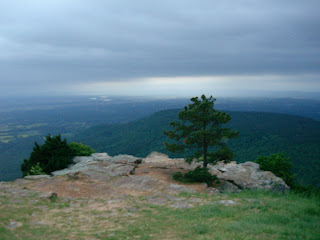


Sunrise Point
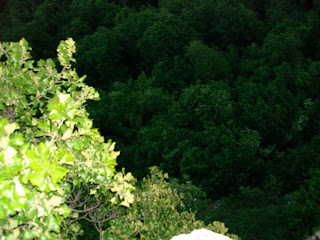


The view down from the edge of Sunrise Point!


The front of the cabin.

Update:

Got the bike to the police station early in the morning. It was less scary going down this morning. But the rain was just starting to drizzle and I wanted to get the thing down before the rain really stated.

Found a great place near Arkansas Tech University named Whatta Burger. No, it’s not part of the national chain, a local place with some great burgers. Some pictures to follow.





AR Tech
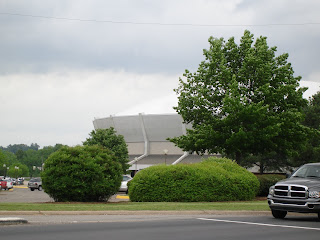

A Minidome!



Gotta love a street named "O"!
Beth and I got our souvenirs and other stuffed shipped and they are en route home! Hope to get out of here Saturday morning but the weather may not cooperate.
More pictures to follow. Gotta go pick up the KFC.

Thursday, April 29, 2010

Vacation Day 6

Started a little late...we planned to wake up before 6 and watch the sunrise that went over like a soup sandwich.

Took a tour around middle Arkansas and it's been great...went to Mount Magazine State Park and got some awesome pictures. It's the highest point between teh Applicians and the Rockies.


Scene from the first senic overwatch.


Beth at the scene overwatch


Big Bear at the Vistior Center


Cougar at Visitor Center


A view from the rear of the Visitor Center

Next was visting Atlus AR visiting the Post winery...tasting and lunch at Kilts Pup...awesome local beer.


Kilts


Beth and I having lunch


Man I would have loved to have a bottle of that!


The City Hall of Atlus TX...gotta love a city hall that used to be a bank!
More to come....