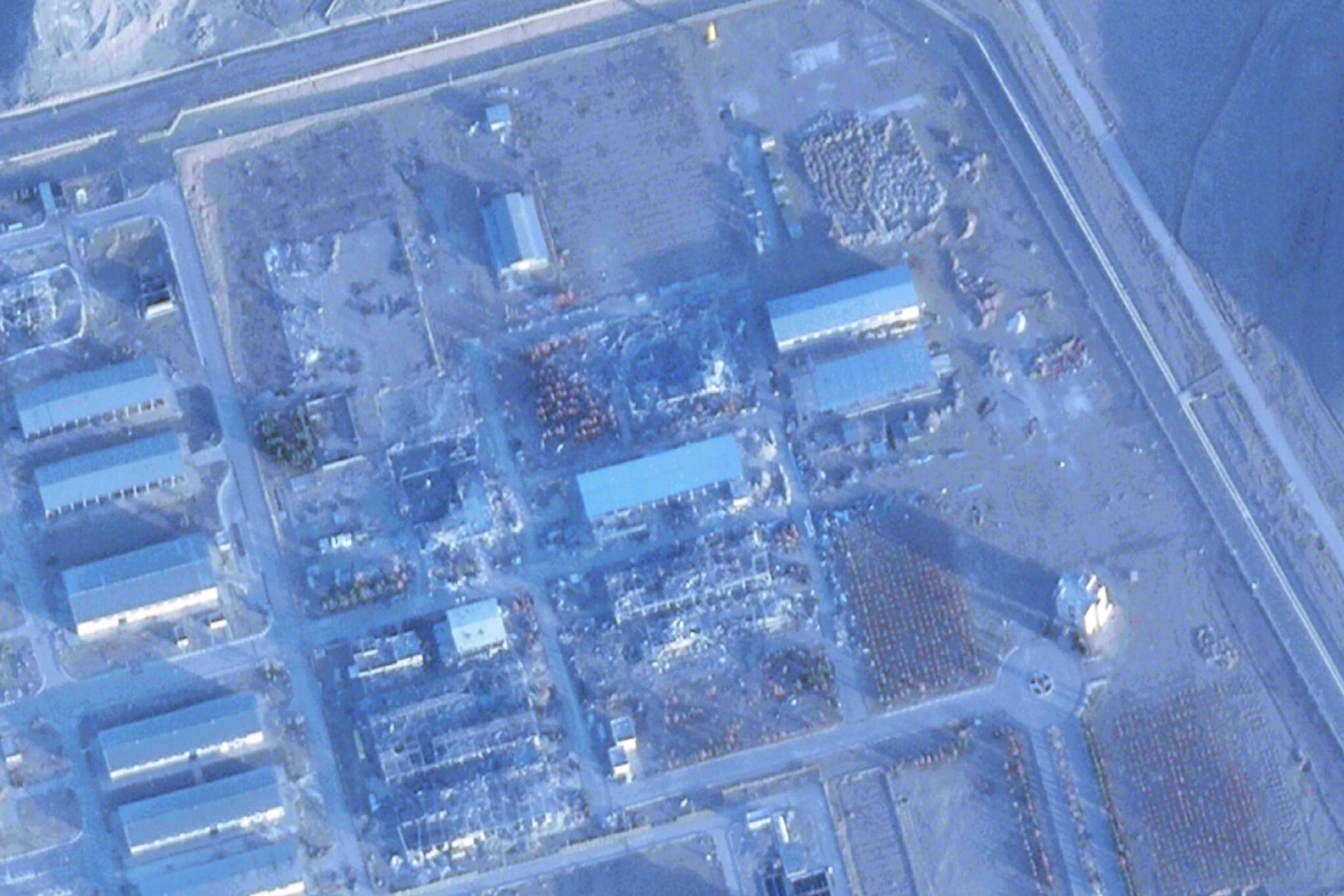
In the immediate aftermath of Operation Midnight Hammer and Israel’s Operation Rising Lion, several news sources went straight to work. Citing anonymous sources, within two days they said the attack caused practically no damage to the Iranian nuclear program.
In the immortal words of Dr. Evil, Riiiiiight. An initial (i.e., before the smoke clears) battle damage assessment (BDS) will be at best an educated guess. This work takes looking at the damage from multiple sources, analyzing what the enemy is doing in response, etc. And seeing the media sources putting out this propaganda, it’s wise to take what they say with a brick of salt.
Fast forward several months, and more reliable sources, we have a better look at what we did in June 2025. And analysising what the Iranians are doing indicates we did some serious damage to their program. From the Times of Israel:
Satellite images indicate Iran working to salvage nuclear materials from damaged sites
Experts say new roofs at Isfahan, Natanz likely part of effort ‘to assess whether key assets, such as limited stocks of highly enriched uranium, survived the strikes’ by Israel and US
As tensions soar over Iran’s bloody crackdown on nationwide protests, satellite images show activity at two Iranian nuclear sites bombed last year by Israel and the United States that may be a sign of Tehran trying to obscure efforts to salvage any materials remaining there.
This satellite image from Planet Labs PBC shows a roof built over rubble Iran’s Isfahan Nuclear Technology Center outside of Isfahan, Iran, on Wednesday, Jan. 28, 2026. (Planet Labs PBC via AP)
The images from Planet Labs PBC show that roofs have been built over two damaged buildings at the Isfahan and Natanz facilities, the first major activity noticeable by satellite at any of the country’s stricken nuclear sites since Israel’s 12-day war with Iran in June.
Those coverings block satellites from seeing what’s happening on the ground, which is the only way for inspectors from the International Atomic Energy Agency to monitor the sites right now, as Iran has prevented access…
The new roofs do not appear to be a sign of reconstruction starting at the heavily damaged facilities, experts who examined the sites said. Instead, they are likely part of Iran’s efforts “to assess whether key assets — such as limited stocks of highly enriched uranium — survived the strikes,” said Andrea Stricker, who studies Iran for the Washington-based Foundation for Defense of Democracies, which has been sanctioned by Tehran.
“They want to be able to get at any recovered assets they can get to without Israel or the United States seeing what survived,” she said.
Isfahan and Natanz are 2 key Iran sites
The Natanz site, some 220 kilometers (135 miles) south of the capital, is a mix of above- and below-ground laboratories that did the majority of Iran’s uranium enrichment.
Before the war, the IAEA said Iran used advanced centrifuges there to enrich uranium up to 60 percent, a short, technical step from weapons-grade levels of 90%. Some of the material is presumed to have been onsite for when the entire complex was attacked.
The facility outside the city of Isfahan was mainly known for producing the uranium gas that is fed into centrifuges to be spun and purified.
A third site, Fordo, some 95 kilometers (60 miles) southwest of the capital, housed a hardened enrichment site under a mountain…
…Iran has not allowed IAEA inspectors to visit the sites since the attacks.
The main above-ground enrichment building at Natanz was known as the Pilot Fuel Enrichment Plant. Israel hit the building on June 13, leaving it “functionally destroyed,” and “seriously damaging” underground halls holding cascades of centrifuges, the IAEA’s director-general, Rafael Mariano Grossi, said at the time. A US follow-up attack on June 22 hit Natanz’s underground facilities with bunker-busting bombs, likely decimating what remained. Planet Labs PBC images show Iran began building a roof over the damaged plant in December. It completed the roof by the end of the month. Iran has not provided any public acknowledgment of that work. Natanz’s electrical system appears to still be destroyed…
…At Isfahan, Iran began building a similar roof over a structure near the facility’s northeast corner, finishing the work in early January. The exact function of that building is not publicly known, although the Israeli military at the time said its strikes at Isfahan targeted sites there associated with centrifuge manufacturing. The Israeli military did not respond to requests for comment over the construction.
Meanwhile, imagery shows that two tunnels into a mountain near the Isfahan facility have been packed with dirt, a measure against missile strikes that Iran also did just before the June war. A third tunnel appears to have been cleared of dirt, with a new set of walls built near the entrance as an apparent security measure.
Sarah Burkhard, a senior research associate for the Washington-based Institute for Science and International Security, which long has watched Iran’s nuclear sites, said the roofs appear to be part of an operation to “recover any sort of remaining assets or rubble without letting us know what they are getting out of there.”
Sean O’Connor, an expert at the open-source intelligence firm Janes, concurred that the aim was likely “to obscure activity rather than to, say, repair or rebuild a structure for use.”
Again, at best an initial assessment is a guess. It takes time to see the facts in full. In a Facebook discussion with a friend of mine, he was convinced the bombing did nothing. The man trusted The New York Times (mistake). I pointed out if there was no damage, the Iranians could easily show the failure of the American attack. I also explained, multiple times, a complete assessment would take time. As we have looked at, and analyzed the information, it’s accurate to say we devastated the Iranian nuclear program.
Completely destroyed, no. But between cutting off their funding, obliterating billions in high tech assets, killing their scientist (thank you Mossad), and putting the regime in fear for their life (literally, the mullahs are looking at real estate in Moscow), their nuclear program is on the ropes. Hopefully, between the Trump White House, Bebe in Israel, and the people of Iran rising up, we can finally wipe this threat to world peace (not an exaggeration) off the face of the earth.
SUMMARY: Our aim is to have friends or allies. But barring that, America’s interest is in having stable and non-hostile powers on the world stage.
In the immediate aftermath of the invasion of Venezuela, many liberal friends of mine were adamant this for one reason, oil. No, that’s not the case. Oil is areason we have an interest in that country, as well as narcotics and other issues. I’ll cover those later in this article.
First we need to take a big picture at what is in the interest of America. What does the United States need in the world? We need access to resources and markets, we need to keep our adversaries at bay, and as such we need other nations assistance. That is, we need friends and allies.
A friend is another nation who’s aligned geo-politically, economically and culturally to us (e.g., the United Kingdom, Israel). Also we have multiple allies in the world, such as Saudi Arabia. While we may have different types of societies or government but our critical political and economic interests align. The greatest example of this was the Allies allying with the Soviet Union during World War II against the Axis powers.
What if we don’t have friends or allies in a certain region? We need, to coin a phrase, Stable Non-Hostile Nations. Their interest may not fully align with ours, but they are not opposing ours. They also are stable enough they don’t interfere with American interests in the region.
A current example would be Indonesia. While not a formal ally of the West, we have similar interest against Chinese aggression and free trade. Or Cameroon, with a stable enough government to keep disruptions from overflowing to nearby countries. Another recent example is Israel and Egypt. Very different nations, but as a result of the Camp David accords, both were not hostile to each other.
A example of a Stable Non-hostile Nation is Libya. In the aftermath of the 2003 overthrow of Saddam Hussein, Muammar Qaddafi had an epiphany. It’s better to not be in the cross hairs of the United States. Qaddafi gave up his WMD programs, settled multiple lawsuits over the Pan Am 103 bombing, and stopped supporting terrorist groups in the Middle East and Europe. He also shared intelligence with western nations.
In exchange we agreed to let him live. We would stop our efforts to force regime change as long as he kept his country secure and caused no other trouble. Easy, accomplished multiple goals of the US, and cheap. Of course we can’t leave well enough alone.
In one of the greatest disasters of the Obama years, in 2011 the administration attacked Libyan targets, destabilizing the Qaddafi regime. Qaddafi’s convoy was attacked by US forces, and he was killed by rebel forces.
Qaddafi was not an ally of the west, but he had changed from being an advisory to a non-hostile regime. Looking at the totality of the circumstances, that was the best we can hope for. We didn’t need to act against Qaddafi, just keep an eye on him. Trust, but verify.
Again, Qaddafi was not a nice person. We’re not interested in “nice,” we’re interested in America’s national concerns. When we can’t have allied nations, we’ll work with nations that are not working against our interests, and stable so we don’t worry about them affecting other countries in the region.
With that as context, let’s look at South America again. Venezuela is definitely in America’s area of interest, like every other country in the western hemisphere. We do not want nations aligning with our adversaries. In the case of Caracas, the Maduro government was very aligned with four of our greatest competitors: Russia, China, Iran and Cuba.
It’s in our national interest to weaken these nations? Absolutely. The weaker they are, the less likely they will engage or compete with us. How do we do that? Isolation, from allies and resources.
Russia has sold multiple weapons system to the Venezuelan government, including many air defense systems. A steady income for the Putin regime, generating cash for his adventures in places like the Ukraine. The Kremlin just lost a reliable paycheck.
China is expanding and hungry, and Venezuela has resources. Prior to last week, China imported 470,000 BPD from Venezuela, approximately 4.5 percent of its seaborn crude. But oil is not Beijing’s only interest.
Worst off is Iran. After four years of crippling sanctions and trade cut offs in Trump I, Iran was on its knees. Within days of becoming president, Joe O’Biden relieved Tehran of these sanctions and unfroze billions in Iranian assets. Tehran was selling Venezuela weapons systems (e.g., drones and short-range missiles systems), generating cash for the mullahs. Since January 2025, Iran has been put under sanctions and has the greatest open rebellion against the mullahs since 1979.
With the disposing of the Maduro regime, what can be expected. To be honest, we cannot expect Caracas to be (at least initially) friendly to us, nor an ally of the United States. However, with a less corrupt government, a functioning oil industry and the supporting industries, Venezuela will be stable. A stable nation where millions do not rush to America’s borders or disrupt near by countries with refugees. A stable government not allowing our greatest adversaries access to critical resources, perhaps allowing western companies to handle their extraction. In other words, a Stable Non-Hostile Nation in what was arguably the most unstable country in South America.
So has Trump’s incursion into Venezuela been in America’s best interest? Unquestionable so. We have just given the Venezuelan government reason to not allow drug shipments through its ports so easily. Four of our greatest advisories have been cut off from cash, oil and other minerals. And with any luck, fewer Venezuelan nationals will be heading north, further exacerbating our issues with illegal immigration. It also reaffirms the Monroe Doctrine, we are the preeminent power in the Western Hemisphere. The US must insure no one questions that.
Let’s look at another land issue from the administration. President Trump has been very open about controlling Greenland, as a territory or by treaty.What does that allow us to do?
First, it’s not about the land. Controlling Greenland prevents Russia and China from access to northern water routes and Arctic rare minerals. As one person put it on Facebook, ”Whoever controls Greenland controls the high ground of the next century.” It’s close to the western hemisphere, and multiple allied nations. Securing it would provide the West the closest land platform for exploiting these assets and securing sea routes in the north. Definitely in the interest of the West in general, and the US in particular, if we can secure this as a base.
Cutting off our adversaries from critical resources in the West and not allowing them to use these nearby nations as a base to threaten us. Changing volatile adversaries to Stable Non-Hostile countries so we can obtain resources we need and focus our power on other threats. Looking at Venezuela and Greenland, may I say, Trump might just have a method to his madness.