Police Work, Politics and World Affairs, Football and the ongoing search for great Scotch Whiskey!

Wednesday, March 30, 2016

K9 Down


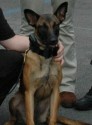
K9 Fritzie
Bath Police Department, West Virginia
End of Watch: Thursday, March 12, 2015
Breed: Belgian Malinois
Age: 1
Gender: F

K9 Fritzie drowned as the result of a crash in which the patrol car she was riding in left the roadway and submerged in Sleepy Creek Channel at approximately 10:00 pm.

Fritzie's handler was returning to Berkeley Springs after assisting the Morgan County Sheriff's Office serve a felony warrant. The patrol car struck a patch of gravel in the travel lane, left the roadway, and entered the channel. Her handler was able to escape the cruiser before it became totally submerged in the water.

Despite repeated efforts by her handler and other responding personnel, K9 Fritzie drowned.

Fritzie had served with the Town of Bath Police Department for one year.
Rest in Peace Fritzie …till our next roll call at the Rainbow Bridge!


In Memory of all Police Dogs

They handled themselves with beauty & grace
And who could ever forget that beautiful face
Whether at work; or at home; whatever the test
They always worked hard; and did their best

They were real champions; at work or at play
But their lives were cut short; suddenly one day
While working on the job with their partner one day
They put themselves out on a limb; out into harms way

They gave the ultimate sacrifice; any dog can give
They gave up their life; so someone could live
The best of their breed; as his partner and anyone would say
Many hearts are now broken; that he had to prove it this way

Now as the trees are blowing in the gentle breeze
The sun is shining; thru the leaves on the trees
The meadows are green; and the grass grows tall
Off in the distance they can see a waterfall

As they look over the falls; down through the creek
The water flows gently; as a rabbit sneaks a peek
Far up above; in the deep blue sky
They see the birds soar high; as they fly by

They see animals playing; at the bridge by a waterfall
Chasing each other; and just having a ball
They play all day; from morning to night
There's no more rain; just warm sunlight

Off in the distance; they hear trumpets blow
Then all the animals look up; and notice a bright glow
The harps would play and the angels would sing
As they know they've come home; they've earned their wings

We remember that they died; in the line of duty
And are now with the Lord; sharing in heaven's beauty
Off to the meadows now; where they can play and roam free
With an occasional rest stop; under a tall oak tree

No more bad guys to chase; or bullets to take
Just a run through the meadow; down to the lake
A quick splash in the water; then back to the shore
Then it's off to the forest; to go play some more

These special dogs are back home; up in heaven above
They're cradled in God's arm's; and covered with His love
We'll light a candle for all of them; in the dark of night
In loving memory of all; these very special knights

By John Quealy

Tuesday, March 29, 2016

Officer Down


Police Officer Gregory Thomas Alia
Forest Acres Police Department, South Carolina
End of Watch: Wednesday, September 30, 2015
Age: 32
Tour: 7 years
Badge # 161

Police Officer Greg Alia was shot and killed when he and two other officers responded to a suspicious person call at the Richland Mall shortly before 8:00 am.

The officers located the subject inside a van in the mall's parking lot. As they spoke to him the man became uncooperative and then fled on foot into the mall. During the ensuing struggle the subject produced a stolen .40 caliber handgun and fatally shot Officer Alia.

The man was apprehended a short time later and charged with murder.

Officer Alia had served with the Forest Acres Police Department for seven years. He is survived by his wife, 6-month-old son, and parents.

Rest in Peace Bro…We Got The Watch

Nemo me impune lacessit

Day is done, Gone the sun, From the lake, From the hills, From the sky. All is well, Safely rest, God is nigh. 

Monday, March 28, 2016

Finally a double feature for the wife and I

I've complained in many blog posts (and Facebook postings, and other ways) why I don't go to movies much anymore. First, because they suck. And the experience is just not worth it anymore. When the wife and I have to spend $32.00 for a matinee for two (tickets, two drinks and one popcorn) that's ridiculous. And we other choices (Amazon Prime, HuLu, etc) I can find some decent entertainment (Amazon has just completed season two of Bosch, highly recommended). But over the last two days, we've both had two great films.

Bridge of Spies is an account (forgive me I don't call it "the story of") of the exchange of Soviet agent Rudolf Abel for American pilot Gary Powers. The script was excellent, I won't go as far as saying Hanks should have gotten another Oscar but it was superb, and the Hollywood's "moral relativism" that seems to creep into any movie wasn't overbearing.


Well I returned Bridge of Spies this morning and unfortunately Beth had to drive to Galveston tonight, I got to watch Steve Jobs by myself. I've often posted on the Steve Jobs bio by Walter Isaacson and how Jobs is a complicated and difficult man, without question a force of nature. And Michael Fassbender did a superb job of showing the multiple issues of his life, his complicated relationship with his daughter, his fights with the company he founded and fired him. I saw that knowing someone like Jobs, to do him real justice, would need a miniseries to give him full credit. That being said, watch this movie.

I say I generally go to the movies 2-3 times a year. Both of these flicks I wished I had watched in the theater. Well worth the time and money.

Thursday, March 24, 2016

An updated version of Simon and Garfunkel's signature song

As a rule I'm not a fan of remakes (although I have to say I'm more a fan of the Bangles version of Hazy Shade of Winter than the S&G original), and I still prefer the original here, but this is a great cover.  A bit off the subject for this blog, but gotta lighten it up a bit. Enjoy.


As a rule I'm not a fan of remakes (although I have to say I'm more a fan of the Bangles version of Hazy Shade of Winter than the S&G original), and I still prefer the original here, but this is a great cover.  A bit of the subject for this blog, but gotta lighten it up a bit.  Enjoy.


Simon & Garfunkle's classic "The Sounds of Silence" performed by heavy metal band "Disturbed"
Posted by Mark Watson on Friday, December 18, 2015

Wednesday, March 23, 2016

Geopolitical Weekly: A Picture of Russian Patriotism, March 22, 2016

A Picture of Russian Patriotism


When the first Russian pilots returned to Voronezh air base as part of the recently announced military drawdown from Syria, they were greeted with a hero's welcome. Russian women in folk costumes offered loaves of bread with salt. Robed Orthodox priests gave the pilots icons to kiss. Crowds carrying balloons, flowers and Russian flags hoisted the pilots onto their shoulders and tossed them into the air. It was a picture of patriotism, broadcast live across the nation.

But that picture has changed throughout the years. The sentiment the Kremlin used to shape its interventions in Syria and Ukraine evolved from a kind of nationalism that was often used in the early years of President Vladimir Putin's government. Rabid and inspired, it was based mostly on civic patriotism and duty. Today's nationalism, on the other hand, taps into the deeper identity of the Russian people — their sense of moral virtue, their survival instinct and their belief in Russia as a global power.

In Good Times ...

Nationalism has rallied in tandem with popular support for Putin and his administration. At the beginning of 2016, Putin's approval rating was 81 percent, just shy of the all-time high of 86 percent. Social sentiment in support of the country is also at 82 percent. This comes as Russia remains mired in its second recession in seven years, it is under continuing sanctions by many global powers, and it has failed to prevent former ally Ukraine from shifting toward the West.

Early in his presidency, Putin laid a foundation of national support for himself and his government. He was seen as the savior of Russia, stabilizing the country after the chaos that followed the Soviet Union's collapse. He promised a future of stability and wealth, along with a return to global power. In return, the Russian people offered loyalty and a willingness to disregard the administration's heavy hand.

As the Russian state consolidated most major aspects of the economy — including energy firms, media outlets and the telecommunications industry — the Kremlin vilified the oligarchs who had previously run these industries. The state promoted the idea that it was taking over businesses to make Russia strong again, while the oligarchs were only in it for personal gain. In security matters, Putin blamed the failure of the First Chechen War on his predecessor, and Moscow clamped down on Chechnya, launching a second war. Today Chechnya is fairly stable, and terrorism in Russia is at its lowest level in decades. Moreover, the Chechen leadership is fervently loyal to Moscow, something unimaginable a decade ago.

Over the past 10 years, the Kremlin harnessed religion as an important tool to foster nationalism. Russian Orthodox affiliation under Putin has skyrocketed: At the start of the 1990s, less than a third of Russians considered themselves Russian Orthodox, as opposed to roughly 72 percent today. The Orthodox revival gave Russians an identity after the years of uncertainty that followed the fall of the Soviet Union. The Kremlin has used this to its advantage, so effectively portraying support for Putin's government as a religious duty that the church is now seen as part of the state apparatus.

Realizing that people born after the fall of the Soviet Union were growing up, the Kremlin started pro-government youth organizations in 2005 to instill a sense of nationalism in the new generation. These groups appealed mainly to lower-class ethnic Russians, giving them a sense of community and structure. The most notable group, Nashi ("Ours"), was created by current presidential aide Vladislav Surkov, who also helped design the plan for a stable Chechnya. At its height, Nashi alone boasted some 150,000 members.

These strategies all hinged on the principles that the state was only as strong as its people's support and that, therefore, support for the state was a civic duty. And Putin's system used them to such success in part because Russia benefited from years of economic plenty at a time when a global challenger — the United States — was distracted with two wars. But nationalism can grow stale, particularly in the face of challenges.

... And in Bad

Things began to change in 2008, when Russia was hit hard by the global financial crisis. Going into the crisis, Putin's popularity was high, bolstered as it was by Russia's success in the war in Georgia. But as the government struggled to keep the country financially stable, the Russian people began to feel as though Putin was not holding up his end of the bargain. His support dropped accordingly.

Dissatisfaction culminated in 2011, when the Russian government, concerned over a decline in support, blatantly tampered with parliamentary elections. The Russian people had mostly ignored such interference in more prosperous years. But this time the flagrant manipulation — combined with a weak economy — sparked mass protests across the country. The protests swelled as Putin announced that he would return for a third term as president. Support for the government tumbled from 88 percent to 61 percent between 2011 and 2012, shaking the very ground on which the Kremlin stood.

Nationalism could no longer rely solely on civic patriotism. So in recent years, Moscow has incorporated traditional beliefs about Russia's position in the world and the deeply ingrained love of the motherland. To this end, the Kremlin has promoted the idea of Russia as a unique place misunderstood by the rest of the world. Or, as the 19th-century romantic poet Fyodor Tyutchev put it, Russia's "soul is of a special kind, By faith alone appreciated."

In 2012, Russia began the process to formalize its Eurasian Union. Although the concept had been around for decades, Putin put a new spin on the initiative. He promoted the project to the Russian people as a way to protect Russia from future economic crises and to put the country in its natural place as the land bridge between east and west.

The use of the terms "Eurasian" and "land bridge" evokes 19th- and 20th-century Russian philosophers and historians who believed that Russia was neither eastern nor western. Russia was unique. As the bridge between Europe and Asia, Russia and the Russian people are great unifiers. As a result, they are also naturally more enlightened than those who know only Eastern or Western culture, according to Soviet historian Lev Gumilyov, whom Putin frequently mentions in speeches. And while most outsiders would not catch these brief references, the Russian people understand the significance of this exceptionalist attitude.

Overcoming the Past

But the spark that truly revived Russian nationalism came from Ukraine. At first, the Russian government looked weak, having failed to predict the uprising in Kiev that led to the installation of a pro-Western government. Moscow's failure to galvanize large parts of Ukraine against the new government exacerbated this sentiment. In the end, Russia was left supporting just a sliver of breakaway territory in eastern Ukraine.

However, over the past two years, the Kremlin has turned the narrative on its head. Putin has advanced Russia's duty to protect the Ukrainian people from the lawlessness caused by the new government's unconstitutional takeover in Kiev. To emphasize Russia's obligation, Putin has invoked the two countries' historical connection. In a 2014 speech, he called Ukraine Russia's "heartland" and its capital "the mother of all Russian cities." Russia has also alluded to Western-backed color revolutions, claiming that the latest uprising in Kiev was "foreign sponsored." He even compared Russia's support for eastern Ukraine to the West's support for Kosovo. And the rhetoric seems to be working: Currently, more than two-thirds of Russians favor military support in eastern Ukraine.

Moscow's annexation of Crimea in March 2014 boosted pro-Kremlin sentiment in Russia. In a speech to the Duma in the weeks after annexation, Putin compared the action to the 1990 German reunification. With this reference, like the heartland reference before it, Russia framed the annexation as a fulfillment of its historic imperative to reunify the territories. Some 85 percent of Russians now believe Crimea should be part of Russia. Support for Putin rose 10 percent just after the annexation, reaching a three-year peak at 71 percent.

At the same time, the action invited sanctions by the United States and European Union against Russia, bringing a new decline in the Russian economy. Foreign direct investment fell by 67 percent in 2014 to $22 billion, and then 94 percent to only $1.3 billion in 2015. And when oil prices tumbled in 2014, Russia slid into its second recession in seven years. The Kremlin blamed the West for many of Russia's troubles, referring once again to history. In a speech following the sanctions' imposition, Putin concluded that "the notorious policy of confining Russia, pursued in the 18th, 19th and 20th centuries, continues today." Most Russians feel that the West not only misunderstands them but is also attacking their leader.

Western pressure has fueled Russian nationalism. Russian culture has a generational legacy of survival. Russia's territory is a hostile habitat, with extreme winters and a history of devastating famines and invasions from all sides. And Russians have survived through the direst circumstances, including the Nazis' 900-day blockade of Leningrad during World War II. Russia's current climate of economic recession and isolation from the West has triggered its cultural survival instinct, which has fortified support for the Kremlin.

Russia's operations in Syria have filled the Russian people with even more pride. When Russia initially launched airstrikes in Syria, nearly 85 percent of Russians opposed the intervention. Now, the reverse is true, as Russia has not only made progress in its bombing campaign, but also showcased its modernizing military far away from home. In addition, by getting involved in Syria, Russia stood up against objections from NATO — particularly the United States and Turkey — winning even more approval from the Russian public.

The church's repeated references to Russia's intervention as a "holy war" have encouraged these positive feelings. The reference has rekindled the belief in Moscow as the Third Rome, a term first coined by a Russian monk in 1510. Throughout history, from the 18th century to Stalin's rule, the Kremlin has rallied behind the Third Rome concept, positing Russia as the world's moral and ideological leader, the heir to Constantinople and Rome.

Russia intervened in Syria despite Western and Turkish opposition. And however contentious its claim to a victory there, Russia announced its withdrawal with fanfare — a stark contrast to the quiet and defeated withdrawal of Soviet forces from Afghanistan in the late 1980s. It is as if Russians feel they have overcome their past.

Nationalism can be misleading, however. The Kremlin first fostered nationalist feeling to rebuild its state from collapse and chaos. But now the Putin administration is using it to cover the cracks within Russia and to retain its grip on power. Russia has economic problems with no solutions in sight. It is also experiencing a demographic shift that will one day change the religious and cultural fabric of the state. The generation that remembers the heyday of the Soviet period is fading. In 2018, Putin may run for his fourth term as president. The only solution to unify in spite of all these pressures is to draw on a singular sense of Russian nationalism — one deeply rooted in the past.

Editor's note: Unless otherwise specified, all polling numbers are from independent Russian pollster Levada.
A Picture of Russian Patriotism COPYRIGHT: STRATFOR.COM

Tuesday, March 22, 2016

Carrying a BUG...

Also known as a Back Up Gun. Timing is good, I've just picked up a Ruger LCR 357 as my BUG/Off Duty Weapon. Good look at what you need to do.

Carrying a backup gun: 6 things you need to know

Your duty weapon can malfunction and will run out of ammo, so train and prepare for that moment – your life depends on it

Unless you own a magical gun that never runs out of ammo and never malfunctions, you need to carry a backup gun (BUG). Here are some questions and considerations for these important tools.

1. Is the BUG faster than a reload?

A backup gun — sometimes known as a “New York Reload” — offers you the opportunity to draw a second weapon to continue a gunfight. Practice your draw from your method of concealment and compare it to your times during a standard reload in order decide whether to go this route.

Regardless of whether you’re faster reloading or drawing a second weapon, I can guarantee that one situation in which the second gun will be faster into action than a reload is when you are wounded and need to get back in action one handed.

2. Is the BUG faster than a malfunction drill?

Again, you need to put in the practice to know your capabilities. A ‘tap-rack-bang’ will probably be faster, but it will probably beat your time doing a double feed malfunction one handed.

3. Can you access the BUG for a deadly-force response to a gun takeaway?

A suspect attempting to take your duty weapon — either from your hand or holster — is a deadly threat. Can you reach your weapon with either hand? Consider the possibilities of the body positions you could find yourself in while in a fight for your life.

When one hand is out of commission due to trying to maintain control of your main weapon, can you access your BUG with your free hand?

4. Consider where you carry, what you carry, and how you train to carry your BUG.

The considerations above should help you determine the location you choose to carry your BUG. Here are the common locations.

Ankle: The ankle carry is convenient when you are seated and can be accessed when you find yourself on the ground with a suspect on top of you. Ankle carry means your gun will get dirtier than other locations. Clean and lube your weapon weekly to make sure it functions in that critical moment. Some officers replace the seam of their uniform pants with Velcro to allow faster easier access to that location.

Pant pocket: Access can be hindered by the equipment on your belt. If you can’t get your hand into your pocket you will find it hard to access the weapon. If you wear pants with cargo pockets consider carrying it there. Make sure the gun is in a holster that covers the trigger guard in an otherwise empty pocket. Several officers have shot themselves when objects came into contact with the exposed trigger of their BUG.

Back pocket carry is also an option, but sitting on a gun all shift may be an invitation to sciatica.

Vest: With concealed body armor, you have two options: on the vest strap or in a BUG holster that is attached to the front of your vest. Understand that your ability to unzip or unbutton your shirt quickly under stress in a fight may significantly slow the draw down. Some officers sew their buttons to the top part of the shirt and use Velcro below to keep their shirt “buttoned.” This will speed the draw and allow the use of only one hand versus two to get the shirt open.

On an external vest carrier you have the option of sewing a holster on the inside. Trainer Jeff Chudwin advises officers against it due to concerns of possible injury caused to them by their weapon if they were in an accident and their airbag deployed.

The ability to draw the weapon with either hand when it is under your armpit can be very difficult, this requires practice. Some officers have found that the gun and holster protrude just enough to cut off blood circulation to the arm when seated in a car during patrol.

5. What kind of BUG should you carry and how big should it be?

If possible stick with the same manufacture for consistency in design and function. A Glock 17, with a Glock 26, 42, or 43 backup fit that concept. Most gun makers are making sub compacts to fill that niche.

I don’t suggest anything smaller in caliber than a .380. Semi-autos are much easier to hit with than revolvers when the barrels are short. The size of the weapon will determined by how big you are and where you intend to carry it. Pockets and pant cuffs space limit weapon size.

6. Don’t forget to train with your BUG!

Buy a replica blue gun of your BUG and practice drawing with all your duty gear on to identify any problems.

Shoot the thing! If you can’t hit anything with it, it is just an expensive paper weight in a fight.

Your duty weapon can malfunction and will run out of ammo, so train and prepare for that moment – your life depends on it. A BUG is like a backup plan, always have one.

Monday, March 21, 2016

A remote control drone that can carry 1100 pounds...

The potential for this is great. They are mentioning how you can airlift men from the battlefield. There is also the potential for airlifting injured civilians in distant rural areas to trauma centers at a fraction of the cost of standard helicopters.


Military drone ambulance can carry loads of up to 500kg

The Israeli company Urban Aeronautics created AirMule, a drone capable of carrying loads of up to half a ton. The equipment was developed primarily for military use, to be used in missions in hard to reach places where conventional helicopters can’t access.

“[It could fly to] anyone out in the field who needs water, food, batteries, supplies, medical equipment and so forth,” Rafi Yoeli told the BBC. “Later, it could be used to fetch soldiers that you don’t want to leave behind or are wounded. There are plenty of situations where you cannot send a helicopter – for example, in the middle of fighting where you want to evacuate people from a street or from a narrow roof. Eventually, there could be civilian applications, such as rescue missions in the mountains or flying into disaster areas – for example, nuclear facilities where no person in a helicopter could get in.”

Still in testing phase, AirMule flies completely autonomously: take-off, maneuvers, landing, everything is done by the device’s navigation system and the Israeli aircraft can reach speeds of up to 180 km/h.

Despite the interesting proposal of carrying people in a drone that can be remote-controlled, one must keep in mind some obstacles that involve drones in general. Like the flight distance which is limited to 49 km, while helicopters have no distance limits as long as the fuel lasts. According to the creators, the drone has incredible flight capacity even in turbulent weather, resisting winds of up to 50 knots, a significant improvement over existing helicopters.

Thank you Mike K for the link.

Good news from Detroit

Detroit is a war zone right now and there is not much positive from a law enforcement perspective. However, this is good news, using technology to catch the bad guy, or bad girl, in this case.


At first I was a bit uneasy with the stations identifying the locations, but it makes sense. Generally criminals don't shoot where they know there are being video taped. And the results were excellent, captured in less than two hours and the officers get real time intelligence.

Great word Detroit.

The Russians in Syria....

Good read.
Even As Russians Withdraw, Their Legacy in Syria Remains

Analysis

As the departure of Russian forces from Syria announced March 14 continues, evidence of construction at Russia's main air base in the country demonstrates Moscow’s intention to maintain a military presence there. Imagery dated March 17 acquired by Stratfor of the Bassel al Assad air base in Latakia province and the naval base at Tartus highlights the ongoing Russian drawdown of its forces in Syria that Moscow contends will be largely completed by March 20.

The imagery shows that as of noon local time March 17, more than a quarter of the Russian air group at Bassel al Assad air base had departed Syria. Three Su-34 combat aircraft and a Tu-154 transport plane were the first to leave March 15, followed a day later by all 12 Su-25 ground attack aircraft and a number of Il-76 transport planes. The transport planes carried the mechanics, aircrew and equipment that serviced the combat aircraft. The Russians have indicated that a number of Su-24 aircraft departed March 17, but the imagery indicates that the Su-24 group was still largely in place. It is possible that those Su-24s departed after the imagery was taken.


The imagery not only shows that the Russians are still expanding infrastructure and facilities at the air base, but also that they have deployed additional assets in the past few days there. These prominently include Mi-28 and Ka-52 helicopter gunships that have a variety of uses: In addition to protecting the facilities, they can conduct combat search and rescue operations and provide close air support to ground forces. The Russians have also emphasized that their air defenses will remain in place, as shown in the imagery of the active S-400 battery at Bassel al Assad air base. Furthermore, the Russians have not yet withdrawn their Su-30 and Su-35 air superiority fighters from Syria. Since the troop withdrawal announcement, Russia has continued to launch bombing sorties from that air base in support of Syrian government forces that are fighting the Islamic State near Palmyra.


As can be see from the imagery of the naval base at Tartus, there are currently no significant onloading operations taking place. While military vehicles are staged there and are seemingly ready to depart, heavy artillery and armored fighting vehicles — which the Russians have deployed in Syria — do not appear to be among them. This highlights the possibility that Russia is going to maintain its active ground support of the Syrian government forces as they continue to conduct operations against rebel and Islamic State targets. There is also the potential for the Russians to transfer some of that equipment to loyalist forces, as they have with tanks and artillery over past months. As recent battlefield casualties reveal, Russian special operations forces are continuing their active support of loyalist operations as well.

Even As Russians Withdraw, Their Legacy in Syria Remains is republished with permission of Stratfor.

Sunday, March 20, 2016

Israel's offense as defense...

I don't often put a full STRATFOR article out like this, but this is interesting. Notice how an assertive country deals with terrorism.

Israel's Fear Tactics in Bulgaria

Analysis

By Fred Burton

Editor's Note: The following piece is part of an occasional series in which Fred Burton, Stratfor's vice president of intelligence, reflects on his storied experience as a counterterrorism agent for the U.S. State Department.

Embassies are meant to be safe places. Swathed in the legal protections of the 1961 Vienna Convention on Diplomatic Relations, they are entitled to security provided by the countries that host them. But last month, the niceties of diplomacy gave way to the uncomfortable realities of business as usual when Palestine's diplomatic mission in Sofia, Bulgaria, was the scene of a murder.

For about a month, Naif Hassan Omar Zayed had been hiding out in the embassy. The Palestinian national and member of a Palestinian revolutionary group had been convicted in 1986 of killing an Israeli in Jerusalem. He escaped prison and in 1988 relocated to Bulgaria, where he married and settled down to run a grocery store. In December, Israel formally requested his extradition, and Zayed became a wanted man again. He feared for his safety and sought the protection of the local diplomatic mission. On Feb. 26, he was found dead on the mission's back lawn.

The case should be straightforward. Entrances and exits to diplomatic missions are carefully monitored, not only by the embassy itself but also by the host country. Across the street from the front door, authorities invariably either station watchers or set up some kind of video recording equipment. If I were investigating this case, one of my first moves would be to take a look at that video. Mark the time of death, find out who entered just before and left just after then, and the case is closed. But when it comes to state-sanctioned assassinations, nothing is so simple. And if Israel was involved, it is unlikely anyone will ever be held accountable for Zayed's death.

Israel's Strategy: Offense as Defense

As a tiny nation surrounded by hostile neighbors, Israel learned early in its history that it needed to cultivate a tough reputation. After the assassinations of Israeli athletes at the Munich Olympics in 1972, Israel's security service, Mossad, hunted down the perpetrators as a clear warning to its enemies: Kill Israelis, and you've signed your own death warrant.

More killings followed. Specifically, Zayed's death calls to mind the murder of a much higher-profile figure: Ashraf Marwan, codename "Angel." This now-infamous spy was the son-in-law of Egypt's towering president, Gamal Abdel Nasser. Sometime around the Yom Kippur War, he started spying for Israel — but to this day it is unclear whether he was actually a loyal Egyptian who infiltrated Israeli ranks or whether he truly did betray Egyptian secrets to the Israeli government. Either way, in 2007 someone leaked an official Israeli document with his name on it, and it showed up online. A little more than a week later, Israel's most important spy fell to his death from the balcony of his London flat. Witnesses said they saw two Middle Eastern men on the balcony behind Marwan; the men disappeared into the shadows after his fall.

In the investigation into his death, authorities were woefully short on answers. The coroner confirmed that he died of a ruptured aorta and that there were traces of antidepressants in his blood. But the details at the scene didn't point to suicide. There was no note, for instance. The shoes Marwan was wearing when he fell mysteriously went missing, along with all 600 pages of the memoir he was writing. The Israelis were almost certainly behind it all, but no one ever proved it, and no one ever answered for the crime.

Leads That Go Nowhere

The Marwan case shows how extraordinarily hard it is to get to the bottom of any assassination case, much less hold anyone accountable. In Zayed's death, there are a number of players involved. Although by all indications Israel played some part in the killing, whom exactly they colluded with to get the job done is a mystery. Last week, protesters in the Palestinian territories condemned the Bulgarian police for their suspected involvement, but the fact that the killing took place within the walls of the Palestinian Embassy itself may implicate the Palestinians.

Making things even more complicated are the stovepipes and divisions within security organizations. Take Zayed's case: The police officer assigned to investigate the murder may make a good-faith effort to solve the crime. But if the Bulgarian police had a hand in Zayed's death, the officer's superiors may have orders to put the brakes on the investigation. Not everyone is working with the same information or with the same motives. Part of what led to Marwan's death in 2007 was a public spat between two high-ranking Israeli generals over whether Marwan's loyalties truly lay with Egypt or Israel. The fight became so vicious that the government forced both to agree to arbitration, and it was documents from that mandated arbitration process that leaked and exposed the notorious spy.

At that point, the truth about Marwan's loyalties became immaterial. As soon as those documents went public, all that mattered was that there was suspicion that Marwan had betrayed Israel. For Israel, harsh punishments for even suspected treachery are a powerful deterrent.

Compared with Marwan, Zayed was a low-profile target. But both assassinations illustrate Israel's strategy of inculcating fear in its enemies. Zayed had lived in Bulgaria for two decades, seemingly free of his past and safe from Israeli justice. Then Israel came for him, first through formal channels with a request for extradition, and then with brute force. In all likelihood, the public will never know the true details of the operation — which insiders allowed the killers access to the embassy, whether the Bulgarian police were involved, and so forth. The case may be unsolvable, but the message is clear: Those who target Israeli citizens suffer the consequences.

Production Editor: Margaret Fox

COPYRIGHT: STRATFOR.COM

Saturday, March 19, 2016

Sovereign Citizens....

Haven't had to deal with these idiots yet, and some can be dangerous. Here is a good overview of their stupid "arguments." Be alert guys.
5 Responses to a Sovereign Citizen at a Traffic Stop


The sovereign citizen movement has become the bane of many police officers in the U.S.

These people feel that due to some contrived loopholes in the constitution they can declare themselves free and laws do not apply to them. However, people who get their legal advice from Wikipedia find out these loopholes don’t tend to actually exist.

For many officers, a traffic stop will be a likely way to encounter one of these people. Please do not take them lightly. Most sovereign citizens are basically law-abiding people, albeit highly misinformed about how the law works. However, some sovereigns have proved a willingness and ability to be violent. If you suspect you are dealing with a sovereign citizen as a LEO, please call for backup.

If you read any sovereign literature, they advocate trying to confuse and befuddle the police. Their mantra is to make a cop so confounded the officer just decides to end the contract before he/she becomes more perplexed.

1. “I am not driving, I am traveling.”

Often the sovereign citizens don’t bother to pay for their licenses. They feel the right to free movement means they do not need a license. Travel is a right, which in true.

What the sovereigns fail to grasp is they are free to travel, by foot, by bike, even by horse. A car is a complex machine. To operate a complex machine requires training and some licensure to operate said machine. Heck, here in Wisconsin all our driving laws are worded with “operate a motor vehicle”; none say “drive.”

responses to sovereign citizens, no taxes, no firefightersDon't need taxes? Then you don't need firefighters either. (Chris Dixon via flickr.com)
2. "As a free person, I do not recognize the jurisdiction you have blah blah blah blah…"

At some point, a sovereign citizen will say they are a free person. As a free person, they are not subject to any local laws and are “free of any legal constraints,” including taxes and fines.

What they fail to grasp is that they want all the protection of local government without paying the cost for it. Ask a sovereign what they would do if their child was hurt. Ask if their house was on fire how they plan to put it out? Their response is always to call 911. It is a funny, eye-opening experience to point out that 911 and the fire/EMS service is a local, tax-funded entity. So if they are a free person, well maybe 911 is something they are free to keep away from as well -- as in no ambulance and no fire trucks for them because they are not paying for the service.

3. “Speeding is not a crime; a crime requires an ‘injured party.’”

In their twisted view of the law they feel ordinance violations are not valid because there is no victim. Yet they forget we have different levels of legal violations in this country.

Here in Wisconsin most, traffic and other minor violations are ordinance violations. Not a crime, but a civil forfeiture. Thus, no “injured party” is needed. It is a civil matter, not a criminal matter.

responses to sovereign citizens, national license plateThere's something fishy about this license plate... (via reddit.com)
4. “As a free person, your license plate taxes do not apply to me.”

It seems some sovereign citizens will make their own license plates for their cars. These plates will display terms like “US Constitutional Plate,” “Exempt: Sovereign Neutral Non-Combatant,” “Sovereign Christian Citizen.” or any of some other non-legal terms. They feel they are exempt from the 'illegal' tax on car ownership.

These sovereigns love to use legal terms and talk about contracts. They forget the nice roads they “travel” on have to be paved and, in the winter, plowed. Point out to them that there is a social contract between the people using the roads and the people keeping the roads open for travel. Someone needs to pay for the cost of the roads, so license plate costs are not a tax, they are a user fee.

5. “Am I being detained?”

The sovereign citizens and the CopBlock movement both love this question. People who got their law degrees by reading Facebook comments feel that being detained is the same as an arrest. Yet real lawyers can explain the difference between the two.

Yes, a traffic stop is a short investigative detention. An officer with reasonable suspicion that a violation has taken place may stop someone for a short time to establish facts related to that violation. How brief that short time will be is decided solely by the citizen. If they want to play games, they are the one making the contact last longer.

Conclusion

Remember, sovereign citizens have the propensity for violence. Make sure you have backup. Keep your eyes open for threats. Just because they are dumb enough to get brainwashed into some crazy belief system does not mean they are too stupid to learn tactics to hurt us.

Their tactic is to cause confusion with the officer. Turn the tables on them and confuse them. Make them question what they have learned by watching videos on YouTube. Twice I have used the example of the fire department on a sovereign citizen. Both times they were so flummoxed they forgot all the other rhetoric.

Friday, March 18, 2016

Not exactly an Absolute Genius...

I've often said you don't know stupidity until you direct traffic. And here we go:

A GRAFFITI ARTIST PAINTED A ROAD RUNNER TUNNEL ON A WALL AND SOMEBODY TRIED TO DRIVE THROUGH IT

And he suffered the same fate as Wile E. Coyote did every time he tried to drive through those damn things.

According to Mirror, a man attempting to drive his Fiat through what he was thought was a tunnel instead crashed his car because it turned out to be a painting of a tunnel on a wall.

guy tries driving through painted roadrunner tunnel The accident happened a few months ago despite the fact that the graffiti artist also painted a large depiction of the Looney Tunes Road Runner next to the tunnel.

Even funnier than somebody thinking that was actually a real tunnel? You guessed it: The comments left on Imgur after one "rburn" posted the photos.

"Nice to see that Wile E. Coyote finally got his driver's license," said EvilGenomic.

"This is why we can't have nice things," added CoalCuts.

And of course our favorite: "He's lucky, a train could've come out of there," courtesy of Greub.

Is comment needed? :<)

Monday, February 29, 2016

Good look at consensual encounters compared to detention based on reasonable suspicion or arrest on probably cause

A few weeks ago I was called to a scene by one of my cops where they arrested the driver of a vehicle. The passenger was alarmed we didn't have "probably cause" to stop the vehicle and he "went to UT and knew a lot about the law..." I kept my mouth shut and resisted the smile forming on my face as I recall the wisdom of a quote attributed to Lincoln, "Better to remain silent and though a fool then to open your mouth and remove all doubt."

Reading this month's Police Magazine there is an excellent article on the difference between a Consensual Encounter, Detention or Arrest.
Consensual Encounters

What happens if you make a ped stop, and then develop probable cause to arrest the person, and then find contraband or weapons or other evidence when you search incident to arrest, and then get told by the judge that your detention was not justified by reasonable suspicion? As you're painfully aware, what happens is that all evidence deemed the "fruit" of your unlawful detention gets suppressed, charges may get dismissed, and you may find yourself on the receiving end of administrative discipline and a civil suit. Not good.

Safety permitting, there's a smarter way to initiate contact with people, without risking the possibility of these bad outcomes flowing from an unreasonable detention. The well-trained, self-disciplined, smart law enforcement officer first tries a consensual encounter, before resorting to a detention that may or may not win judicial approval.

Three Levels of Interaction

The U.S. Supreme Court has identified three distinct categories of Fourth Amendment police-citizen interaction:

(1) Arrests, which are typically made by taking physical custody of a person and taking him to the station or the jail for booking, and which require "probable cause" as justification;

(2) Detentions, including ped stops and vehicle stops, which are justifiable by the lower standard of "reasonable suspicion;" and

(3) Consensual encounters, in which police use no commands, force, red or blue lights or sirens, but simply approach a person and engage him in conversation and make plain-view observations without any official restraints, and for which no level of justification is needed, because unlike arrests and detentions, the consensual encounter is not a Fourth Amendment "seizure" of the person.

If you believe you have PC for an arrest but the judge disagrees, you've made an unconstitutional arrest. If the judge finds your reasons for making a detention don't add up to reasonable suspicion, you've made an unconstitutional detention. But because consensual encounters do not require any showing of suspicion whatsoever, there's no opportunity for a court to find that you've made an unconstitutional consensual encounter. For Fourth Amendment purposes, the consensual encounter is risk-free; a detention is not. Therefore, which of these choices should be your preferred method of attempting contact with a suspect?

Distinguishing a Consensual Encounter From a Detention

The essential test of a detention is to look at all of the surrounding circumstances and ask whether, in view of what officers have said and done, a reasonable, innocent person in this situation would have felt that he no longer had a choice about coming or going as he pleased, but was compelled by official authority to submit to the interaction with police.

What kinds of actions could convert a consensual encounter into a detention, requiring reasonable suspicion? "Examples of circumstances that might indicate a seizure, even where the person did not attempt to leave, would be the threatening presence of several officers, the display of a weapon by an officer, some physical touching of the person, or the use of language or tone of voice indicating that compliance with the officer's request might be compelled." (U.S. v. Mendenhall) In a series of cases, the Supreme Court has expressed the distinction as follows:

"A person has been 'seized' only when, by means of physical force or a show of authority, his freedom of movement is restrained. As long as the person to whom questions are put remains free to disregard the questions and walk away, there has been no intrusion on that person's liberty or privacy as would under the Constitution require some particularized and objective justification." (U.S. v. Mendenhall)

"Our cases make it clear that a seizure does not occur simply because a police officer approaches an individual and asks a few questions. So long as a reasonable person would feel free to disregard the police and go about his business, the encounter is consensual and no reasonable suspicion is required." (Florida v. Bostick)

"The initial contact between the officers and defendant, where they simply asked if he would step aside and talk to them, was clearly the sort of consensual encounter that implicates no Fourth Amendment interest." (Florida v. Rodriguez)

"Law enforcement officers do not violate the Fourth Amendment by merely approaching an individual in a public place and putting questions to him. If there is no detention—no seizure within the meaning of the Fourth Amendment—then no constitutional rights have been infringed." (Florida v. Royer)

Scope of Investigative Activity

To attempt a consensual encounter, you could simply approach a person in a public place and ask a non-threatening, engaging question: "Hey, how you doing? Man, can you believe this weather?" The person doesn't have to remain or respond, but if he does, there are a number of things you can do:

Observe his demeanor for signs of intoxication, drug use, nervousness, or other suspicious behavior. (U.S. v. Crews)
Request ID. Although a demand for ID would convert the encounter into a detention, a request for ID does not. (INS v. Delgado) Without retaining the person's ID, you can quickly copy information, promptly return the ID, and run records checks.
Ask questions about the person's activities. (Florida v. Royer)
Request consent to search. (Florida v. Bostick)
Seize evidence discovered in plain view, or discovered under a consent search. (U.S. v. Drayton)
If in the course of these permissible activities you establish reasonable suspicion to detain and then probable cause to arrest, resulting evidence cannot be suppressed on grounds that it flowed from an unjustified detention, because it flowed instead from a consensual encounter, which requires no justification.

Limitations on Activity

Unless you have reasonable suspicion that the person is involved in criminal activity, do not turn your consensual encounter into an unlawful detention by doing any of these things:

Giving any orders or commands.
Displaying or pointing a weapon.
Surrounding the person with multiple officers or K-9.
Frisking or touching the person without consent.
Holding onto license or ID after a quick consensual examination.
Caging, cuffing, restricting, or moving the person without consent.
Overcoming Common Arguments

Although defense attorneys sometimes argue that a consensual encounter was really a detention because no reasonable person holding drugs (guns, stolen property, etc.) would feel free to ignore a police request, "This argument cannot prevail because the 'reasonable person test' presupposes an innocent person." (Florida v. Bostick)

Another common argument is that no reasonable person would feel at liberty to refuse to talk to an armed, uniformed officer. "Those factors should have little weight in the analysis. Officers are often required to wear uniforms, and in many circumstances, this is cause for assurance, not discomfort. Much of the same can be said for the wearing of sidearms. That most law enforcement officers are armed is a fact well known to the public. The presence of a holstered firearm thus is unlikely to contribute to the coerciveness of the encounter, absent active brandishing of the weapon." (U.S. v. Drayton)

The Dividends

Initiating contact with a suspect through a consensual encounter (safety permitting) can reduce citizen complaints, administrative discipline, suppression of evidence, and civil liability. These are substantial reasons not to jump the gun with a premature detention, when a consensual encounter could have done the trick.


Devallis Rutledge is a former police officer and veteran prosecutor who currently serves as special counsel to the Los Angeles County district attorney.

Saturday, February 27, 2016

I'll say it about the persecutor of the cops in Baltimore....

Couldn't have happened to a nicer bitch!

Ms Mosby was so ready to indict these officers for jaywalking and jumped at anything. She had visions of being next best legal thing, perhaps a position in the Obama Just-Us department. Oh well, I doubt it's meant to be.

Freddie Gray Autopsy Report Deals Blow to Murder Charges

Baltimore prosecutor Marilyn Mosby has withheld the autopsy report on Freddie Gray from defense counsel and the public for nearly two months. It is the report on which she relied to file murder and other charges against six police officers, even though the investigation into Mr. Gray’s death was not close to being complete.

Now, just two days before Friday’s court deadline for the state to disclose the report to the defense, it has been leaked to the Baltimore Sun.

The Sun’s story makes it easier to understand why Ms. Mosby wanted the autopsy kept under wraps. It raises additional disturbing questions about her case — a case in which she has already had to dismiss false-imprisonment charges, the untenable nature of which I explained when Mosby filed them.

It turns out that Mr. Gray “tested positive for opiates and cannabinoid.” Moreover, he carried on wildly when initially placed in the police van. It had previously been widely reported that he was not belted into his seat, a violation of recently adopted Baltimore police policy that Mosby dubiously makes the plinth of her case. The Sun’s latest dispatch, however, indicates that Gray was making matters difficult for the police: “yelling and banging, ‘causing the van to rock,’ the autopsy noted.”

The van made several stops during its 45-minute ride. At the second one, six minutes after the arrest, Gray was reportedly “still yelling and shaking the van.” Police thus removed him and placed him in leg restraints — ankle cuffs, to go along with the handcuffs that had already been applied. Gray was “then slid onto the floor of the van, belly down and head first,” according to the autopsy report, which gingerly adds that he was, at that point, “still verbally and physically active.”

It’s now easier to understand why Mosby wanted the autopsy kept under wraps: It raises additional disturbing questions about her case.
It was after this, the medical examiner concluded, that Gray suffered a severe spinal injury (which led to his death, a week later). At some undetermined point during the van’s journey, he was catapulted by the force of its deceleration and crashed into the interior. The injury is likened to a “shallow-water diving accident.”

Significantly, however, the medical examiner, Carol H. Allan, surmised that Gray probably could not have sustained his severe injuries if he’d remained in the prone position the police had put him in.

The Sun report elaborates:

While it’s possible Gray was hurt while lying on the floor and moving back and forth, Allan determined that his body likely couldn’t have moved in that position with enough force to cause his injuries. Allan surmised that Gray could have gotten to his feet using the bench and opposite wall. With his hands and ankles restrained, and unable to see out of the van and anticipate turns, she said, he was at a high risk for an unsupported fall.

Thus, the most likely scenario is that Gray, under the influence of narcotics and in the course of making his transport difficult for the arresting officers, elected on his own to get to his feet despite the difficulty of doing so. Under circumstances where his arms and legs were restrained, Gray’s decision to change the position the police had put him in rendered him vulnerable to the “high-energy” injury he sustained...


Ms Mosby, before you jumped the gun perhaps you should have actually read all the pertinent facts and then made a decision to proceed? You had visions of being the next legal behemoth. Now if things play out, can you see yourself as the next Mike Nifong?

You think you can prosecute a case successfully and not present to the defense all evidence? Woman, there is a document you should read called the Constitution of the United States. You are probably ignorant of the fact that you are required to turn over everything and as the prosecutor you cannot surprise the defense. Idiot.

As your cases disintegrates and your legal reputations is left in tatters, I would be worried about your future. The cops will never back you, the Black Live Matter crowd will end up hating your guts because you failed them and Obama will not come to save your ass. We haven't started to think about the civil suits coming out of this soon enough. You choose these men and women as scapegoats and I think in the future you will make them millionaires. So please, make a bigger ass out of yourself. I for one will enjoy seeing you self destruct.

A good way to start this up again

I've been off the net for a bit, a few crazy weeks and it's gonna get crazier, finishing up my thesis. But I can't think of a better thing to post to get started again. The only time all Four Stooges were seen together.


A true classic clip! The only time FOUR Stooges appeared together.
Posted by Michael Boynton on Tuesday, September 22, 2015
Ironic that at first they though Curley was too handsome to be part of the trio, then they cut his hair and the greatest Stooge of all time was born. In the off season he would let his hair grow out and he was a ruggedly handsome dude.


RIP to all Six Stooges. God knows they have given me a laugh and a lift when needed.

Have a great weekend.

Tuesday, February 16, 2016

Officer Down


Deputy Sheriff Rosemary Vela
Madison County Sheriff's Office, Tennessee
End of Watch: Monday, September 28, 2015
Age: 24
Tour: 2 years, 6 months
Badge # 7809

Deputy Sheriff Rosemary Vela was killed in a single vehicle crash while responding to backup another deputy.

She was traveling on Highway 70 West, near Huntersville, when her patrol car left the roadway during a period of heavy rain. The vehicle struck a tree and then came to rest in a creek.

Deputy Vela had served with the Madison County Sheriff's Office for five months and had previously served with the Alamo Police Department and the Crockett County Sheriff's Office. She is survived by her 5-year-old son.
Rest in Peace Sis…We Got The Watch

Nemo me impune lacessit

Day is done, Gone the sun, From the lake, From the hills, From the sky. All is well, Safely rest, God is nigh. 

Monday, February 15, 2016

Officer Down


Deputy Sheriff William J. Myers
Okaloosa County Sheriff's Office, Florida
End of Watch: Tuesday, September 22, 2015
Age: 64
Tour: 26 years
Badge # 336

Deputy Sheriff Bill Myers was shot and killed while serving a domestic violence injunction at a local attorney's office on Plew Avenue, in Shalimar, at approximately 8:20 am.

He had served the papers on the subject and was leaving the office when the man opened fire from behind, striking him multiple times in the back and the back of the head.

The man fled to a local hotel where he barricaded himself in a room for approximately 90 minutes. He was shot and killed by members of the agency's Special Response Team after exiting the room displaying a firearm.

Deputy Myers had served with the Okaloosa County Sheriff's Office for a total of 26 years. He had retired from the agency after serving 25 years and then returned as a part-time deputy in January 2015 to assist with serving civil papers.
Rest in Peace Bro…We Got The Watch

Nemo me impune lacessit

Day is done, Gone the sun, From the lake, From the hills, From the sky. All is well, Safely rest, God is nigh. 

Security Weekly: Can Libya Be Reassembled?, January 28, 2016

By Scott Stewart

Many indicators suggest that European and regional powers along with the United States are once again gearing up for an intervention in Libya. These signs include increased surveillance activity over the North African country, reports of U.S., British and French soldiers already on the ground, and leaks that countries in the region are being approached to provide assistance.

Libya is mired in a period of protracted chaos. Jihadists aligned with al Qaeda and the Islamic State now control substantial portions of the country. Thanks to their connections with other militant groups in the region, there is a network that provides training and weapons reaching from the Sinai Peninsula to West Africa.

It is understandable that the United States and its allies feel compelled to intervene in Libya to degrade the power of these jihadist groups. However, given the divisive and fractious nature of Libya, putting together a viable and sustainable political system after the military intervention will remain the greatest challenge.

Unshackling the Jihadists

In February 2011, a month before the NATO-led international coalition intervened in the Libyan civil war, I wrote that overthrowing Gadhafi could plunge Libya into chaos that would allow jihadists to flourish. I based this assessment on the continued involvement of Libyans in global jihadist activities from the 1980s in Afghanistan through Chechnya, Bosnia and Iraq. This was exacerbated by Moammar Gadhafi's policy of keeping his security and military forces weak, fractured and dependent on him. Throughout its own history, al Qaeda has had a disproportionate number of Libyan leaders, considering the population of Libya compared to the rest of the Muslim world. Senior al Qaeda figures hailing from Libya have included Abu Yahya al-Libi, Anas al-Libi, Abu Faraj al-Libi and Abu Laith al-Libi.

The degree of Libyan involvement in Iraq was perhaps best documented in a batch of personnel files captured by U.S. troops from an al Qaeda safe house in the northern Iraqi city of Sinjar in 2007. These documents, often referred to as "the Sinjar files," contained the details of 595 jihadists who had traveled to Iraq to fight. Of these 595, 112 were Libyans. The number of Libyans in this sample was smaller than the 244 Saudis, but when compared against the populations of their respective countries, the Libyans had a higher per capita participation rate than the Saudis. The Libyans also appeared to be more radical than the Saudis: 85 percent of the Libyans asked to be suicide bombers complied, compared to only 50 percent of the Saudis.

Of the Libyan jihadists represented in the Sinjar files, 60 percent of them had listed their home city as Darnah and around 24 percent had come from Benghazi. Gadhafi's security apparatus kept a close eye on returning jihadists and used a strong carrot-and-stick approach to keep them under control prior to the outbreak of the civil war in early 2011. On reflection, the pro-jihadist sentiment in Libya's east helps explain why those cities were hotbeds of anti-Gadhafi revolutionary sentiment and why jihadists remain a powerful force in Darnah and Benghazi today.

I believed back in 2011 that this strong jihadist current, combined with literally tons of loose weapons, was a potentially deadly combination for Western interests in Libya, writing that:

This bodes ill for foreign interests in Libya, where they have not had the same security concerns in recent years that they have had in Algeria or Yemen. If the Libyans truly buy into the concept of targeting the far enemy that supports the state, it would not be out of the realm of possibility for them to begin to attack multinational oil companies, foreign diplomatic facilities and even foreign companies and hotels.

This forecast was proved tragically correct on Sept. 11, 2012, when the U.S. diplomatic facility in Benghazi was attacked. U.S. Ambassador J. Christopher Stevens and State Department communicator Sean Smith were killed, along with two CIA contractors later that night when a CIA annex was attacked. Since then, jihadists have continued to attack hotels and kill or kidnap foreigners.

Other Fractures

But the jihadist ideology is not the only divisive factor in Libya. Indeed, there are a number of significant ethnic, tribal and regional fault lines inside Libya. I was referencing these divisions in August 2011 (two months before the death of Gadhafi) when I wrote the following:

As the experiences of recent years in Iraq and Afghanistan have vividly illustrated, it is far easier to depose a regime than it is to govern a country. It has also proved to be very difficult to build a stable government from the remnants of a long-established dictatorial regime. History is replete with examples of coalition fronts that united to overthrow an oppressive regime but then splintered and fell into internal fighting once the regime they fought against was toppled. In some cases, the power struggle resulted in a civil war more brutal than the one that brought down the regime. In other cases, this factional strife resulted in anarchy that lasted for years as the iron fist that kept ethnic and sectarian tensions in check was suddenly removed, allowing those issues to re-emerge.

The country's fractures were clearly on display during the recent attempts to create a unity government sanctioned by both the Tripoli-based General National Council government and the Tobruk-based House of Representatives. But even if the United Nations and the international community are able to pressure the rival Tripoli and Tobruk governments to overcome their differences and work together, that divide only represents one of the fault lines in Libya today. And each of these two competing governments represent only a fraction of Libya. A number of other powerful political groups and militias — such as Ibrahim Jadhran's Petroleum Facilities Guard — will have to be persuaded to join the new unity government, or in the case of the jihadist groups, defeated militarily.

The worst-case scenario we foresaw in 2011 has come to pass: Several jihadist groups are flourishing in Libya and are negatively impacting the country's internal security. And, through their training camps and transfers of weapons, the security of places from Sinai to Senegal is also in question. If there is one silver lining in this bleak situation, it is that the proliferation of Libyan man-portable air-defense systems and anti-tank guided missiles has not had the regional terrorist impact we feared. There were a few Libyan missiles used in the Sinai Peninsula, but these projectiles have not yet been used to attack a civilian airliner, attack an embassy or assassinate a public official.

As the United States and its European and regional allies prepare to intervene in Libya, they should be able to reduce the jihadist's ability to openly control territory. However, they will face the same challenge they did in 2011: building a stable political system from the shattered remains of what was once a country. Now, Libya is a patchwork of territories controlled by a variety of ethnic, tribal and regional warlords. The last five years of fighting has led to significant hatred and blood feuds between these competing factions, which will only compound the challenges ahead.

Clearly the Humpty Dumpty that was Libya is shattered. Putting him back together again will be a long and onerous task.

COPYRIGHT: STRATFOR.COM

Geopolitical Weekly: Understanding Italian Defiance, January 26, 2016

By Adriano Bosoni

The Italian government has been in a rebellious mood of late. During a war of words with the European Commission over his plan to increase spending this year, Prime Minister Matteo Renzi told Brussels "Italy is back, more solid and ambitious." In an op-ed published in The Guardian a few days later, Renzi added that "the political and cultural orthodoxy that has monopolized thinking on how Europe should be run for the last decade isn't working" and promised that "Italy will not stop demanding to have its voice heard."

To be sure, Italy — the third-largest economy in the eurozone and a net contributor of funds to the European Union — believes it has cause to be annoyed with the bloc's officials. Rome views Brussels' constant requests for spending cuts as an obstacle to economic growth. It is also disappointed by the lack of progress in EU efforts to address the migration crisis. More recently, doubts over the health of Italian banks reignited a debate between Rome and the European Commission over Italy's plans to protect its banking sector.

But Italy's recent actions are based on more than short-term calculations; they are intimately connected to the way the country sees the world. To understand Rome's behavior, it is necessary to consider how modern Italy was born and what shapes its policies. Present-day Italy was created by combining dozens of unconnected pieces, constantly at risk from over a millennium of foreign invasions. Elements of Italian history mirror the European Union's attempts to create a united Continent, and they offer clues to the bloc's future.

A Fragmented State

Italy is a mountainous country. The Alps serve as a natural border with its northern neighbors, while the Apennines bisect the Italian Peninsula from north to south. Italy also controls Sicily and Sardinia, the two largest islands in the Mediterranean. This fragmented geography facilitated the emergence of strong local identities, something exemplified by the extensive variety of dialects spoken in the country.

Geography also explains Italy's unequal levels of economic development. The Po River Basin in the north, which runs from the Alps to the Adriatic Sea, is one of the wealthiest regions in Europe. The richness of its soil, the river's navigability and the region's connection to other commercial centers in Europe enabled the Po Valley to become Italy's commercial and industrial core. These conditions fostered the growth of cities such as Turin, Milan and Venice, three powerful economic and political centers in constant competition.

By contrast, the south is characterized by lower economic development, the product of a semi-arid climate and an economy primarily based on agriculture. Failure to apply effective land reform before and after modern Italy's unification further hindered the south's development. This was in addition to the pervasive presence of groups and practices that exist in parallel to the formal system — from the gray economy to organized criminal organizations. Neither factor, however, prevented the emergence of important southern economic and cultural centers like Naples and Palermo.

Another key to understanding Italy's behavior is its location at the heart of the Mediterranean Sea. The Ancient Romans understood that the peninsula would never be safe unless they had some degree of control over the lands surrounding the "Mare Nostrum" (Latin for "Our Sea"), and so they built their massive empire around it. From the late 19th to the early 20th century, Italian governments similarly sought colonies in Africa and the Balkans, albeit with much less success. More recently, Italy has based its Mediterranean strategy on maintaining good relations with governments in North Africa so as to secure energy supplies, open business opportunities for Italian companies and prevent the arrival of sea-faring immigrants.

Italy's privileged position at the center of the Mediterranean Sea made it a target for invaders. From the Germanic invasions that ended the Western Roman Empire in the late fifth century to the invasions of the Austrian, Spanish and French empires in the 18th and 19th centuries, surrounding powers have repeatedly conquered Italy. By the late 1850s, the peninsula was host to several political entities, including the Kingdom of Sardinia (under the House of Savoy), the Kingdom of the Two Sicilies (under Bourbon control) the Kingdom of Lombardy-Venetia (under Habsburg rule) and the Papal States.


Austrian Empire Chancellor Klemens von Metternich once famously derided Italy as "only a geographic expression." There is some truth to this statement. When Italy became a unified kingdom in the 1860s, Italians shared little beyond the Roman Catholic faith. For decades, there had been attempts to unify Italy under the figure of the pope, but as Machiavelli wrote in the early 16th century, the Catholic Church was "too weak to unify Italy, but too strong to let it happen."

So, to unify Italy, its new leaders had to create a country from scratch. To do this they had to introduce a common currency, the lira; create a standardized educational system that would teach a common language; form a national army to instigate some sense of patriotism; and build thousands of kilometers of rail lines to connect the country. But despite these efforts, many regional differences remained.

More important, Italy's unification also involved a great degree of state violence. "Unification" is often a poetic way to describe what was actually the annexation of the rest of the peninsula by the Kingdom of Sardinia. In the south, "unification" was very close to a civil war, with occupation forces from the north fighting a confusing combination of Bourbon loyalists, local peasants and brigands. A century and a half after these events, mistrust between the north and the south has still not been completely overcome.

The Role of Public Spending

Unification was expensive, which forced the fledgling state to start issuing foreign debt from day one. Young Italy was in a dangerous position: Bourbon loyalists were ensconced in Rome as the pope's guests, the dukes and grand dukes of Central Italy were waiting in the wings for the Savoys to make a mistake, and Austria and France were permanent threats. This prompted Italy to assume all of its predecessor states' debts, hoping that Europe's great powers would recognize and support the new country. This opened a cycle of foreign debt that still defines Italy.

Public spending and lax government continued to hold the country together during the 20th century. In the south, large amounts of public money were spent on subsidies to prevent social unrest, while the mafia progressively became a national phenomenon. In the north, the economic success of companies partially depended on the state willfully ignoring tax evasion. Italy's "economic miracles" of the 1960s and 1980s relied on a handful of national champions like Fiat and myriad small and medium-sized manufacturing firms clustered in specialized industrial districts of the north and center. The south was largely neglected.

The prosperity of these years came at the expense of the public finances; little effort was made to keep public spending under control. Frequent devaluations of the lira helped Italy stay afloat while keeping unemployment low. Small and medium-sized companies remain the backbone of the Italian economy, and their lack of competitiveness and their inability to adapt to an increasingly globalized world is one of the main reasons Italy was dealing with low rates of economic growth even before the European crisis. Complicating matters, the introduction of the euro deprived Italy of the possibility of devaluing its currency to deal with crises, while its national budget must now be negotiated with Brussels.

Italy's seemingly chaotic political system is also connected to history and geography. Politics in Rome are complex because the Italian government often operates as umpire among conflicting interests. Rome is under permanent pressure to find a balance between the general needs of the country and the many vested interests in play, from local, regional and national political leaders to labor unions, the private sector and the Catholic Church. One of the most notable Italian novels of the 20th century, The Leopard, uses the transformations of the 1860s as a metaphor for a country where reforms are often meant to protect vested interests. This coined a term (gattopardismo, from the book's Italian title) that is as relevant today as it was when the novel was first published in 1958.

A Permanent Balancing Act

Italy's main geopolitical imperative is to achieve a minimum level of unity to prevent the country's disintegration while finding a balance between pressure from domestic and foreign powers — and preventing those foreigners from invading again.

This explains Rome's complex relationship with the European Union. Italy was a founding member of the European Economic Community, the EU's predecessor, because of its long tradition of intellectuals who saw the construction of a federal Europe as a means of overcoming the Continent's fragmentation by dissolving regional identities into a broader European identity. But foreign pressure was also a factor, because after World War II, the United States had an interest in Italy's membership in Western trade and defense alliances as means of promoting economic growth and limiting Russian influence.

Since then, Italy has used its strategic position at the heart of the Mediterranean to be attractive to the European Union and NATO while expecting them not to interfere too much with its domestic affairs. But the European crisis has made this balance hard to maintain. As the crisis progressed, Rome came under pressure from Brussels and international markets, which are fearful of the financial consequences of Italian political instability and lack of reform. This has forced Rome to negotiate internally and externally, seeking to apply just enough reform to appease foreign interests while keeping domestic dissent within tolerable margins.

An important element of Italy's strategy for coping with the EU crisis has been the premise that it is simply too big to fall. Many Italian politicians believe the size of the country's economy means EU authorities will always ultimately come to the rescue. And they want Europe to do this without interfering too much in Italy's domestic affairs. This explains Rome's frequently strong reactions to Brussels' pushes for stricter fiscal discipline. The Italian government sees EU pressure as foreign interference in its domestic affairs and as a threat to internal stability. The ongoing debate between Brussels and Rome over Italian plans to create a bad bank are a part of this dynamic, as the European Union wants to prevent Italy from using public money to protect its banks.

Renzi presents himself as Europe's ultimate reformist, and his intentions are probably sincere, though he is most certainly making electoral calculations. His Democratic Party is still the most popular in the country, but it has lost support over the past year. Some of Italy's largest cities — including Rome, Milan and Turin — will hold elections in April, and Renzi has linked his political future to winning a referendum on constitutional reforms in October. The prime minister wants to be allowed to spend more in an important year, and he probably believes that anti-German and anti-Brussels rhetoric could win him some extra votes. The eurozone economic crisis has evolved into a political crisis where a growing number of voters oppose the European Union and the political elite who back it.

Renzi has a point when he says that the Italian opposition is fragmented, but if all the anti-establishment, nationalist and right-wing parties are combined, about half of the electorate supports forces that oppose different aspects of the process of EU integration, from the common currency to the free movement of people. At a time when prospects for growth are modest and unemployment remains high, Italian support for the European Union can no longer be taken for granted.

Rome wants to be part of a Continental bloc where high public spending and inflation are tolerated to create jobs, and where resources are transferred from wealthy regions to poorer areas without interfering too much in their domestic affairs. But the Germans and the Dutch do not want to permanently subsidize the Portuguese and the Greeks, at least not without greater control over their economies.

Italy faces a fundamental problem: The kind of European Union the Italians want to build is similar to the type of country they have struggled to create at home. Italy is a miniature version of the European Union because it has a Germany and a Greece within its borders, in the form of a dynamic north and an underdeveloped south whose interests are not always aligned. It took a combination of money, compromise and coercion to build a unified Italy. In the European Union, the economic crisis has tarnished the promise of prosperity, compromises are becoming harder to find and coercion is not a basis for a sustainable Continental project. And while the Italians of the 1860s at least had some vague sentiment of a shared destiny, the same cannot be said of the current European Union.

COPYRIGHT: STRATFOR.COM

A simple solution to stop an Active Shooter

I've often said the only thing that stops a bad guy with a gun is a good guy with a gun. I may have to take some of that back now.

These three simple locks stop people from entering a room. Will it stop them long term, no, but Active Shooters know they have little time to do what they want to do. Time equals more people alive.

These simple locks could help save hundreds of lives
Could this be a deterrent for mass shootings?
Posted by Future X - The Future Is Now on Tuesday, January 26, 2016
Excellent work gentlemen, American ingenuity at it's finest.

Saturday, February 6, 2016

Some great commentaries on the plague of political correctness....

In the recent drive by leftists to purge any mention of Confederate heroes, we have the idiot mayor of New Orleans, Mitch Landreau. The brother of the idiot ex-senator of Louisiana. The one who said for residency requirements she lived in her daddy's home. The married senator with a family who has a 2 million dollar mansion in Virginia lives with daddy in New Orleans.

But Mitch, like the other public servants of the family has other issues. Rebuilding the city after the hurricane, the education system, the spiking crime rates, particularly the murder rate. Nah, they need to spend the little money they have on the real threat, Lee Circle and Jackson Square.

The Walton and Johnson show has been hitting on the corruption and incompetence of New Orleans politicians for ages and they hit it out the park with this.


This morning I was surfing the web and cause this commentary by one of my favorite comedians, John Cleese. The first line say it all, "I'm offended every day...." And you should be. I get offended every day by what I see people do. Words hurt only with you let them. And another classic line in this commentary, the quote of a former director of the BBC, "There are some people I would wish to offend."

I will strongly disagree with one line from this, the plague of political correctness has always been a movement, led by leftists, the stigmatize or even criminalize speech.

Enjoy this great commentary of a comic genius

Monday, January 25, 2016

You hear of some stupid crimals....

But this takes it. Read his last words.
Robber’s Famous Last Words: ‘I Thought You Couldn’t Own A Gun In New Jersey’

A Newark, New Jersey deli owner who shot and killed an armed man will not face charges, police and prosecutors say.

Acting Essex County Prosecutor Carolyn Murray as well as Newark Police Director Eugene Venable say that the owner of the deli had a permit for the gun that he used to defend himself.


New Jersey is notorious for having some of the strictest gun regulations in the nation. The robber apparently thought that meant there was no legal way for his would-be victims to arm themselves.

According to Guns.buzz, Mark Robinson’s last words inside the New Neighborhood Deli Supermarket were “I thought you couldn’t own a gun in New Jersey.”

Robinson, 46, had walked into the deli around 8:30 p.m. and immediately pointed a gun at the owner, who didn’t hesitate to pull his own weapon and fire. Robinson was pronounced dead at around 10 pm.

Ron White said it best: